Stanley Elkin - A Bad Man
Здесь есть возможность читать онлайн «Stanley Elkin - A Bad Man» весь текст электронной книги совершенно бесплатно (целиком полную версию без сокращений). В некоторых случаях можно слушать аудио, скачать через торрент в формате fb2 и присутствует краткое содержание. Год выпуска: 2010, Издательство: Open Road Integrated Media LLC, Жанр: Современная проза, на английском языке. Описание произведения, (предисловие) а так же отзывы посетителей доступны на портале библиотеки ЛибКат.
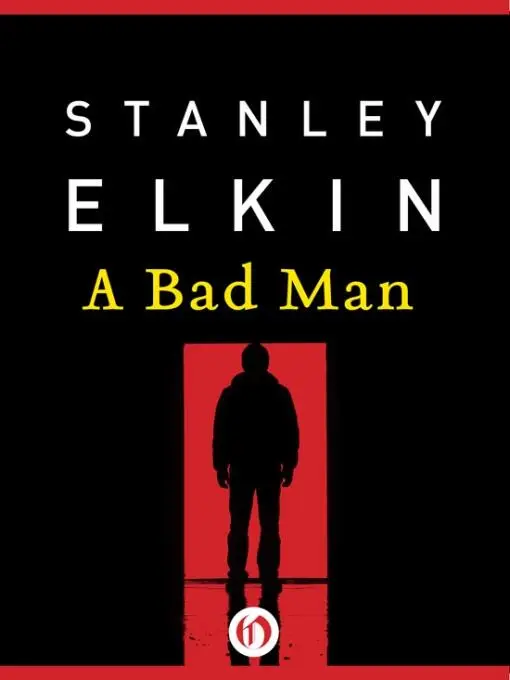
- Название:A Bad Man
- Автор:
- Издательство:Open Road Integrated Media LLC
- Жанр:
- Год:2010
- ISBN:нет данных
- Рейтинг книги:5 / 5. Голосов: 1
-
Избранное:Добавить в избранное
- Отзывы:
-
Ваша оценка:
A Bad Man: краткое содержание, описание и аннотация
Предлагаем к чтению аннотацию, описание, краткое содержание или предисловие (зависит от того, что написал сам автор книги «A Bad Man»). Если вы не нашли необходимую информацию о книге — напишите в комментариях, мы постараемся отыскать её.
A Bad Man — читать онлайн бесплатно полную книгу (весь текст) целиком
Ниже представлен текст книги, разбитый по страницам. Система сохранения места последней прочитанной страницы, позволяет с удобством читать онлайн бесплатно книгу «A Bad Man», без необходимости каждый раз заново искать на чём Вы остановились. Поставьте закладку, и сможете в любой момент перейти на страницу, на которой закончили чтение.
Интервал:
Закладка:
Seated in the high white leather chair, squat as a jolly king in the polished-lensy side of one bright brim-to-cloth goblet, he tucked himself into the broad twilled napkin and smoothed his damasked lap, comfy as a man in a deck chair. Beside his plate, in three smart folds, Lilly, as she did every day, had placed the front section of the New York Times (air-mailed, but more than a day old anyway. Wednesday’s paper mailed Tuesday night and read Thursday morning, so that he had come to think of all facts as tentative, subject to change, already changed, all bulletins stale, all remarks by all spokesmen revised by now or framed in clearer contexts, all outbursts toned down, apologized for, corky with loophole — so that gradually he conceived of most truth as of something even the air could change, set to spoil like standing milk or the browning oxidized flesh of halved apples, and learned to view the world and everything in it with a comfortable hindsight, and thought of wars and strikes and uprisings as fictions).
Feldman loved his solitary breakfasts, loved his own corpulent sense of them, and enjoyed, in the dark smoked mirror, seeing himself eating them, turning the pages of his paper, tapping at egg in the corners of his mouth with a thick, linen-wrapped finger, lighting cigarettes. Although he usually ate alone, Lilly — in an old beltless raincoat she used as a bathrobe, in damaged high heels, the counters broken — sometimes came in while he drank a second cup of coffee (in this one he took cream, two spoons of sugar, high, rounded as dunes).
He finished and scraped his nail absently on a piece of toast. He allowed himself to think of the store, and his mood changed. He did not even remember to enjoy the opulent ruin of his breakfast — the dark toast crumbs on the thick table linen, the stains of coffee and the greased plates and smudged tumblers and the jellied, sticky handles of the silver, the tiny bits of stiffened egg in the creases of his napkin like clots of rheumy eye matter. The store is not doing well, he thought. Things must pick up, he thought; they must.
He didn’t grieve for his condition so much as for the effort it would take to improve his condition. This he dreaded, as he dreaded all revision. He had discovered long ago that he did not enjoy competition, or even “business.” The truth was Feldman had no feel for patterns. Trends bored him. He hated even to be controlled by the seasons, the holidays, thought of Christmas as a violation of free enterprise, of the climate — summers, say, when he sold no skis — as a restraint of trade. He endured the nation’s economic crises impatiently, was indifferent to predictions of boom and angered by warnings of bust. He scorned even the empty optimisms of designers about a certain color or a length of skirt. Yet adopting an attitude toward the competition that was vaguely laissez-faire, coming, as it were, to Christmas as he came to the obsolete news in his thirty-six-hours-old newspaper — his store did the biggest volume in the state in post -Christmas selling — he had prospered, acquiring over the years a reputation for flair which had less to do with deliberation perhaps than with a certain looseness of timing. And of course he demanded good salesmen. Many of his people were old pitchmen, who — behind their counters, talking with their hands; their voices slightly raised, faintly nasal in high pressure’s elliptic twang; pointing, quick and graceful as men doing card tricks, to the features of a shirt — knew how to “build a tip.” (“You know, Leo,” one of them once said, “half us guys ain’t used to working indoors yet.”) A handful of men in departments like Furniture or Housewares had once sold on television. Others had sold over the telephone or door to door. There were barkers, men who’d owned shooting galleries or Pitch-a-Penny booths in carnivals.
What hurt him now was a shift in the structure of the city: the decay of old neighborhoods and proliferation of suburbs, the incursions of Negroes, the lousy parking and all the rest. Feldman’s city had held its shape into the postwar years, and he had not had to face the problem of discount houses, or — to show the flag — had to build, shopping center for shopping center, the murderous big branch stores. (It was the new Diaspora, the Diaspora of fat cats, the whole middle class in flight.) Now, belatedly, he had to do something. He had been paralyzed by conservatism — not fear, not even caution — just a strange Feldmanic inertia when it came to expending any energy on the merely remedial and makeshift. It was as if he were impatient with time itself, forbidding flux as he might have forbidden, if he knew it was happening and he had the power, a change in the structure of his cell tissue.
He heard Lilly before he saw her, the timid clack-clack of her heels and the lungy, wheezy chuffing of her feet as they moved over the broken counters and deeper into her shoes. “My dear?” he said, not looking up.
“Billy needs a tutor, Leo.” She carried a bowl of cold oatmeal in one hand and half a hardened fried egg on a plate in the other. It was their son’s unfinished breakfast. She would sit down now and finish it, wiping the egg into her mouth with Billy’s discarded crusts. Feldman appraised her. In her open raincoat she looked like a disaster victim. Lilly, the mailman’s treat, he thought, the paper boy’s first young love. “Billy should have a tutor, Leo. You saw last night.”
He had. A revelation. They had gone to “open house” at Billy’s school, and Billy’s second-grade teacher, Mrs. Blane, who looked to Feldman like an aging whore — it was the trenchcoat draped over the top of her desk; he knew those trenchcoats: $45.95, a big item with the singers in piano bars — had tried to give them an orange card with the words “Billy F.’s Father” printed across it. He had no intention of pinning the thing to his suit. (Billy F.’s mother already wore hers. Billy F.’s mother would pin on anything anyone gave her. She regarded her breasts as a sort of vast field bordering the highways and byways of her lapels and collars, the superhighway that was her cleavage. Around all this she would hang great shining pins like the blazing signs of motels.) Trampy Mrs. Blane’s own bosom was bare except for the pointy warheads of her nipples puckering her sweater. Feldman shoved the card into his pocket, pricking his finger on the pin.
“Goddamnit,” he said.
Mrs. Blane, who liked that kind of talk, smiled broadly and stroked her trenchcoat. A whore certainly, Feldman thought, and had an idea. Why not a sort of Show Biz Board, something like the board of college girls he used in the store during the summer? He could aim it at “26” Girls, Go Go dancers, burlesque queens, waitresses behind the bars in bowling alleys, the wives of army sergeants. A whole new line: satin stretch pants, brassieres like spider webs, half-bras like the pouches of kangaroos, panties with a quilted male finger at the crotch; rubber butts, foam tits; gratuitous garters. Marvelous , he thought.
Lilly had found Billy’s desk and was reading a note he had left for them on the top of his workbooks. “Leo,” she called, “look.” He took the sheet of paper from her and read:
dear mothat nad fothar, Hi. Lok arand my room hav a nice tiem. your Son billy F .
There were two words on the other side: “ Lok taebl .” Feldman didn’t understand all of it, but since he hadn’t known his son had started to learn to write he was rather pleased by the note. He gave it back to Lilly and smiled. “Not bad,” he said. Then he noticed that there were notes on all the children’s desks, and he leaned over to read them. “Welcome to our open house,” the note on the next desk said. “We have been working hard all week on the projects you see tonight. I hope you enjoy everything. Please look at my workbook before you leave and be sure to see the ‘city’ the class has been building on the table at the back of the room. It should amuse you. Certainly it has been a lot of fun to make. I made the fire station. I love you both and will see you at breakfast tomorrow before Dad goes to work. Your son, Oliver.”
Читать дальшеИнтервал:
Закладка:
Похожие книги на «A Bad Man»
Представляем Вашему вниманию похожие книги на «A Bad Man» списком для выбора. Мы отобрали схожую по названию и смыслу литературу в надежде предоставить читателям больше вариантов отыскать новые, интересные, ещё непрочитанные произведения.









Обсуждение, отзывы о книге «A Bad Man» и просто собственные мнения читателей. Оставьте ваши комментарии, напишите, что Вы думаете о произведении, его смысле или главных героях. Укажите что конкретно понравилось, а что нет, и почему Вы так считаете.