Stanley Elkin - Boswell
Здесь есть возможность читать онлайн «Stanley Elkin - Boswell» весь текст электронной книги совершенно бесплатно (целиком полную версию без сокращений). В некоторых случаях можно слушать аудио, скачать через торрент в формате fb2 и присутствует краткое содержание. Год выпуска: 2010, Издательство: Open Road Integrated Media LLC, Жанр: Современная проза, на английском языке. Описание произведения, (предисловие) а так же отзывы посетителей доступны на портале библиотеки ЛибКат.
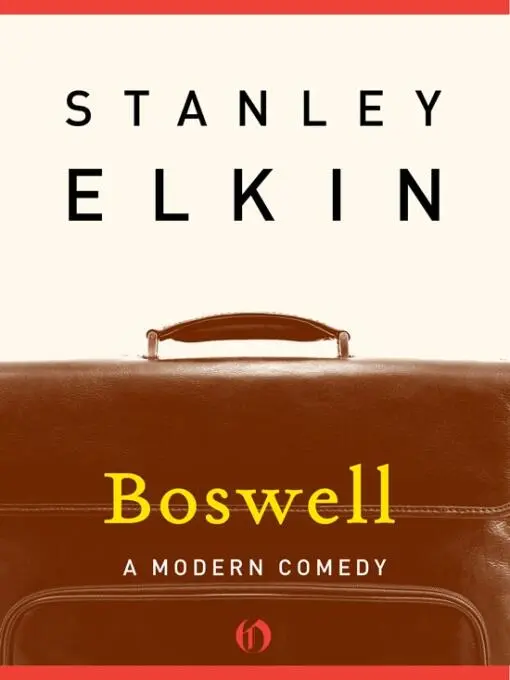
- Название:Boswell
- Автор:
- Издательство:Open Road Integrated Media LLC
- Жанр:
- Год:2010
- ISBN:нет данных
- Рейтинг книги:4 / 5. Голосов: 1
-
Избранное:Добавить в избранное
- Отзывы:
-
Ваша оценка:
Boswell: краткое содержание, описание и аннотация
Предлагаем к чтению аннотацию, описание, краткое содержание или предисловие (зависит от того, что написал сам автор книги «Boswell»). Если вы не нашли необходимую информацию о книге — напишите в комментариях, мы постараемся отыскать её.
Boswell — читать онлайн бесплатно полную книгу (весь текст) целиком
Ниже представлен текст книги, разбитый по страницам. Система сохранения места последней прочитанной страницы, позволяет с удобством читать онлайн бесплатно книгу «Boswell», без необходимости каждый раз заново искать на чём Вы остановились. Поставьте закладку, и сможете в любой момент перейти на страницу, на которой закончили чтение.
Интервал:
Закладка:
“See? He’ll hear.”
“Three days this time.”
“Messerman,” Traub called, “it’s enough already!”
“Where?” I asked. The man pointed to a basement window.
I went to the window. It was barred and screened, and only about a third of it was above the street. I squatted on the pavement and looked in. Through a crack I could see someone moving about. I went back to the men. “He didn’t answer when I rang the buzzer before. Is it broken?”
“What broken? Can a miracle rabbi that gets pilgrims from all over afford to have a broken buzzer? If he doesn’t answer it’s because it’s Shabbos.”
“Listen,” someone said seriously, “he’s crazy. He’s a very crazy person. For three days we need him for services in the shul.”
“He knows we’re here,” another said. “Don’t kid yourself.”
“Some miracle rabbi.”
“Some rabbi,” Traub said.
“If you ask me, Messerman don’t look Jewish,” the first man said.
“Why don’t you get rid of him?” I asked.
“There’s a law,” one of them said. “A rabbi is like a captain on a ship. You can’t go up to a captain on a ship and say, ‘We don’t like the way you’re running the ship. You’re not the captain no more.’ This is a mutiny, you understand. You must make first a report to Cincinnati.”
“Are you from Cincinnati?” one of them asked excitedly. “Maybe he’s from Yeshiva in Cincinnati to question the rabbi.”
“Him?”
“I’ll tell you the truth, I never seen him in the neighborhood.”
“Excuse me but he don’t look Jewish,” the first man said.
“Nobody looks Jewish to you, Plotman. How is that?”
“Excuse me but that’s not true,” Plotman said.
“Yeah? Yeah? Name one person who looks Jewish to you. Name one.”
“You look a little Jewish to me,” Plotman said.
“Are you from Cincinnati?” the tall man asked me.
“No.”
I moved away from the men and entered the building a second time. A card by the bell listed Messerman’s name but didn’t give his apartment number. I tried the hall door, knowing it was locked. I went back to the mailboxes, found the superintendent’s bell and pressed it. In three minutes I went back outside. “Look,” I told the men, “the super doesn’t answer.”
“It’s Shabbos,” one of the men said.
“Well, is there anyone in the damn building who isn’t Jewish?”
“In this neighborhood, young man, you’re the only one isn’t Jewish.”
“There’s Mrs. Helferman on six,” Traub said. He turned to me. “She’s Jewish, but she lost her husband and her son on the same day in two different car accidents. Maybe she would press the buzzer.”
“Yeah, yeah, Mrs. Helferman,” the tall man said.
I rushed back into the building. One of the name- plates said “Marvin Helferman”; I pressed the button. The men came inside to watch. In a moment I heard a voice through the speaking tube.
“If you’re look for Marvin Helferman,” it said, “he’s dead eight months Tuesday. His son Joe ain’t alive either. This is Bess.”
“I knew she would,” one of the men said behind me.
“Apostate,” said another.
“Bess,” I said, “ring the bell. I must get inside.”
“Do you mean to rob me?”
“No. Please, Bess. I’m an honest man.” This is ridiculous, I thought; this is the most ridiculous thing that has ever happened to me.
“How do I know you don’t mean to rape me?” Bess asked.
“Rape her?” Traub said. “She should live so long.”
“I’m a widow. My husband and son, alla sholem, are dead. The one lays in Portland in Oregon I didn’t have what to ship back his body. Robbers. Marvin came back from Chicago on the train. Did you ever hear? I didn’t go to my own son’s funeral.” Her voice over the speaking tube was broken, her sobs lost in the brassy static.
“Bess, please. I have to get inside to see the rabbi. He won’t answer the ring.” I turned to the men. “Does she know any of you?”
“Sure. Marvin was a good friend.”
“Bess,” I said, “there are some men here who could vouch for me.” I looked at the men. “Tell her it’s all right.”
The old men looked at each other uneasily. “It’s a sin,” one of them said shyly.
“I dassn’t,” another said.
“It’s Shabbos,” said someone else.
“Superstitious old men,” Traub said scornfully. “You expect superstitious old men to help you?” He moved two or three steps closer to the speaking tube. He was still half the distance between it and the door. “I say the young man is all right,” he said, raising his voice. “Traub says Bess ought to ring the bell.” He was almost shouting in the small hallway.
Another came up beside Traub. “Al Frickler says so too.”
“Al, do you miss Marvin?” Bess’ voice said.
“Everybody misses Marvin,” Frickler said. Though he was shouting he managed to make it sound kind.
The buzzer sounded brokenly, like a machine gun in the distance. I rushed to the door before it stopped.
“Which apartment number?”
The men shrugged.
I took the elevator down to the basement. When the door opened I was near the incinerator. Two days’ garbage was piled high in the bin; there were empty wine bottles, chicken bones, the rinds of oranges. I moved through the corridor trying to orient myself with the window outside the building.
I knocked on a door. “Who?” someone said immediately.
The abrupt response startled me. Throughout the building people seemed not so much celebrating or observing the day as besieged by it. I could see them in their apartments, in the redundant glare of the unnecessary electric, not answering their phones, their bells, not using machinery, not resting so much as marking time until the sun went down.
“Rabbi Messerman’s apartment?”
“Further down.”
“To my left? My right?”
“Further down.”
I continued in the direction I had been going in. I saw a mazuzah, the prayer cylinder, nailed to the doorway like a tin whistle. When I put my ear against the door I could hear a voice.
I knocked. “Rabbi Messerman,” I called. “I’m James Boswell.” The voice inside stopped. “Rabbi Messerman, let me in. I’m James Boswell and I’m here to find out the meaning of life.”
The little metal loop slid aside and I saw an eye stare out at me. I had an impulse to push my finger through the hole and touch it.
“What do you want?”
“I’m James Boswell and I want to learn the meaning of life. Let me in.”
The eye jiggled up and down behind the fixed peephole on the door. It was as though the pupil were somehow loose inside the eye socket.
The door was opened by a man dressed in a dirty white silk robe which hung in loose, heavy folds about his body. On his head was a white skullcap. I was startled to see that he was barefoot.
There were pictures everywhere, as in Lazaar’s apartment. Faces I had never seen but which were somehow familiar stared out of ten-cent-store frames. They were the relatives that should have been behind Lazaar’s frames, the cousins and fathers and uncles and brothers and mothers and aunts and grandparents and sisters, their faces stretching away in time to the very beginnings of photography. In strange ways, behind the alien fashions and notions of cosmetic, a queer resemblance emerged— as though they had all been painted by someone who had found his “style.” They offered a weird, elaborate genetic testimony. A certain shadow beneath an old woman’s eye would suddenly appear in some young boy, or a chin, like some flesh heirloom, made its way down the generations, sometimes recessive, sometimes dominant, as though it reflected the fortunes and attitudes of its successive owners much as a proper legacy, a house perhaps, might go through periods of repair or disrepair depending on the diligence and luck of its inhabitants. I much preferred. Lazaar’s pictures — movie stars, pastless, ghostless, one- shot beings who dwelled in an eternal present, like gods who sprang from some private conception of themselves. It was difficult to imagine that the rabbi and I were both men, that we were both human beings. He, so familied, so clearly the sum of his parts, related to the past as a model of one year’s automobile is related to a model of the next. At least I was not the incarnate nose, ears, hands, mouth of some primal Boswellian despot. Or at least I had been spared the knowledge. Who we didn’t know didn’t hurt us.
Читать дальшеИнтервал:
Закладка:
Похожие книги на «Boswell»
Представляем Вашему вниманию похожие книги на «Boswell» списком для выбора. Мы отобрали схожую по названию и смыслу литературу в надежде предоставить читателям больше вариантов отыскать новые, интересные, ещё непрочитанные произведения.







Обсуждение, отзывы о книге «Boswell» и просто собственные мнения читателей. Оставьте ваши комментарии, напишите, что Вы думаете о произведении, его смысле или главных героях. Укажите что конкретно понравилось, а что нет, и почему Вы так считаете.