Stanley Elkin - Mrs. Ted Bliss
Здесь есть возможность читать онлайн «Stanley Elkin - Mrs. Ted Bliss» весь текст электронной книги совершенно бесплатно (целиком полную версию без сокращений). В некоторых случаях можно слушать аудио, скачать через торрент в формате fb2 и присутствует краткое содержание. Год выпуска: 2010, Издательство: OpenRoad Integrated Media LLC, Жанр: Современная проза, на английском языке. Описание произведения, (предисловие) а так же отзывы посетителей доступны на портале библиотеки ЛибКат.
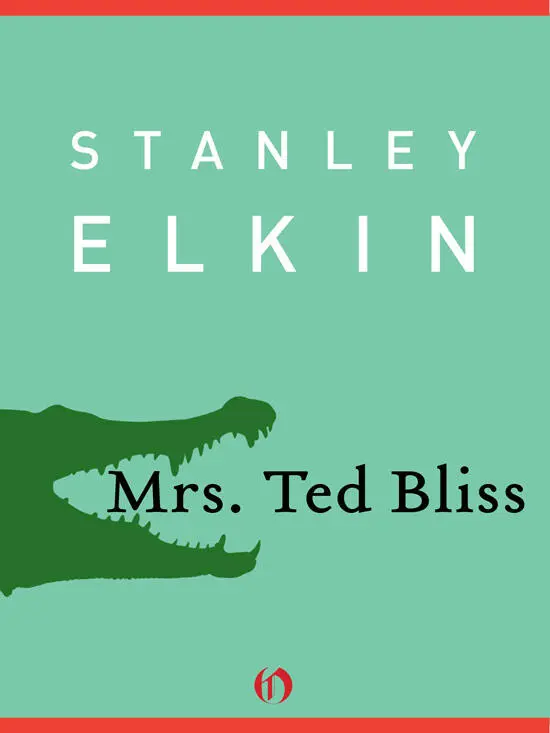
- Название:Mrs. Ted Bliss
- Автор:
- Издательство:OpenRoad Integrated Media LLC
- Жанр:
- Год:2010
- ISBN:нет данных
- Рейтинг книги:5 / 5. Голосов: 1
-
Избранное:Добавить в избранное
- Отзывы:
-
Ваша оценка:
Mrs. Ted Bliss: краткое содержание, описание и аннотация
Предлагаем к чтению аннотацию, описание, краткое содержание или предисловие (зависит от того, что написал сам автор книги «Mrs. Ted Bliss»). Если вы не нашли необходимую информацию о книге — напишите в комментариях, мы постараемся отыскать её.
Mrs. Ted Bliss — читать онлайн бесплатно полную книгу (весь текст) целиком
Ниже представлен текст книги, разбитый по страницам. Система сохранения места последней прочитанной страницы, позволяет с удобством читать онлайн бесплатно книгу «Mrs. Ted Bliss», без необходимости каждый раз заново искать на чём Вы остановились. Поставьте закладку, и сможете в любой момент перейти на страницу, на которой закончили чтение.
Интервал:
Закладка:
There wasn’t a buzzer. She wondered if she should knock first or just open the door and go in. She wondered if she should go in at all. And was about to turn, was in fact already partway around and starting to move off when the door opened and she was confronted by a large, broad man standing in the doorway, his head with its dark, thick hair inclined downward as he rifled through some papers on a clipboard that appeared — she recognized her blunt handwriting — to be the forms Mrs. Bliss had filled out in GMRTRC’s waiting room.
How did they work that one, Dorothy wondered.
“Come in,” the man said and, assuming her compliance, was already headed toward a chair behind a desk Mrs. Bliss instantly recognized as the same one Holmer Toibb had sat behind years before.
How can I know this? she asked herself, and she answered, How did my fingers know his number when I was dialing Maxine that time?
“Dorothy, what’d you do with the petition?” Milt said, still gazing downward and looking very closely, like someone terribly nearsighted, for that last sheet she had pulled from the back of the forms.
“I decided not to sign it.”
“Why? It’s important.”
“I didn’t want to get involved,” she said, staring straight at him and pointedly addressing him as Junior.
Because as it happened, “Milt” was Junior Yellin, né Milton, Ted’s former partner, Herbie Yellin’s kid. “Milt” was Junior Yellin, the new nickname crowding out the older one. He was Junior Yellin, the butcher book futzer. That Junior Yellin. The Junior Yellin turned realtor and, later, farmer in his own right when he bought back her dead husband’s spread (if that’s what you called a black-market slaughtering house) for a fraction of what Ted had given him for it in the first place. Junior Yellin, the handsome gutter boulevardier and drunk, gambling man and philandering father of two who’d once felt up Mrs. Ted Bliss herself right there in her husband’s shop when she was helping out behind the counter, behind her behind behind Ted’s back before Ted’s customer.
She blushed to remember it, felt a sort of intense, localized internal heat slide through her face that only grew warmer as she realized that even with their shared history he didn’t know her from Adam.
She couldn’t have said which humiliated her more, that he hadn’t recognized her, that she should be consulting someone she knew to be a crook who over the years had cost her family thousands, or that she was in the presence of the only man beside her husband ever to have confronted her sexually in the whole history of her life as a woman.
Was this some new fraud (not that this time around he’d set up as a recreational therapeusisist; she knew of course that that was a fraud, but his failure to acknowledge his name by so much as a blink)? Was the new fraud the complete annihilation of his own old self? Was he wiping his slate? Would he no longer carry baggage for his former Chicago, Las Vegas, and Michigan farm-cum-abattoir lives? Without quite realizing why (and all this — her surprise at discovering him, her complicated humiliation and shame, her new wonder — taken in in an instant), Mrs. Bliss was overcome by a depression and sadness unlike anything she’d ever known — unlike mourning, unlike bad news, unlike trouble, unlike the recent, piecemeal unraveling of her old confidence and well-being, and the remains of the kickless, disinterested life she allowed herself to play out in her kickless, disinterested exile.
It was almost as if, she made a stab at explaining herself to herself, she were not so much furious at as jealous of this new man. He’d been Milton Yellin; he’d been Junior; was now Milt — all his a.k.a.’s subsumed in discrete avatars: butcher, flirt, bum, partner-in-bad-faith, black marketeer, and, now, recreational therapeusisist in a long white coat like an actual doctor’s. But no. Now she looked closer. It wasn’t a doctor’s white lab coat at all. It seemed rougher, heavier. Why the son of a bitch, it was one of his old butcher’s jackets!
Mrs. Ted Bliss glared at him, the flush of shame she’d felt earlier when she remembered his having groped her gone now and the warmth converted into a sort of angry energy as she collected the features of her face rather like a telescope collects light, and attempted to project them at him as she willed him to recognize her.
Whatever she was sending, Milt wasn’t receiving, and for a moment Dorothy wondered whether she had the right man and, for another moment, worried that, even if she did, whether she were so very changed, her good looks so lost to her that she might have appeared now like someone damaged in an accident or burned in a fire.
“It’s Dorothy,” she said.
“Yes, Dorothy, I know,” he said, “what can I do for you?”
“No,” she said, “Dorothy Bliss. Ted’s wife.”
The butcher/therapeusisist looked at her closely, almost examined her.
He don’t look so changed, but he’s old, she thought. His eyesight ain’t good and he’s too vain to wear glasses. Whatever shame she’d felt, whatever anger, she relented. Pity broke the fall of her resentments, she buried her hatchets.
“ Teddy Bliss?” he asked, astonished, and, or at least Dorothy thought so, overcome by something closer to real fondness than genuine nostalgia. “ My Teddy Bliss? Oh, God, Dorothy, sit, sit. It’s been a thousand years.”
“More than forty,” Mrs. Bliss said, and now it was Junior who was blushing, perhaps remembering the precise terms of their queer old relationship. She thought there was a sort of moisture behind his eyes. What, was he going to break down and blubber? It was several seconds before he spoke. “I was sorry to hear about his death,” Junior Yellin said (for it was as Junior, not Milt, that he spoke). “I was shocked, shocked. I was out of town and couldn’t get to a phone. Did you get my card?”
No, she didn’t get his card. She didn’t get it because he’d never sent one. She knew because she had painstakingly written out thank-you notes to everybody who had. She still had every letter and condolence card anyone had ever written to her when Ted died. They were filed away in shoe boxes in the same closet she kept her photograph albums, and Frank’s little notes, and all her other personal papers.
“It must have been awful for you. Well I know from my own dad, cancer’s no picnic.”
“Yes, I heard,” said Dorothy. “You have my condolences.”
“Yeah, he was a good man, the greatest dad a kid could have. Well, you know. You probably recall when I had some trouble with Ted’s books that time. My behind could really have been in a sling if Dad hadn’t been there for me. He was a great dad, a great dad. Between you, and me, and the lamppost, he was a greater dad than I was a kid. You’re not contradicting me, I see. The motion carries.
“Hey, will you just listen to me? Going on about my troubles, my tragic flaws and little circumstances. Looks like I haven’t learned anything over the years, looks like I’m not only back at square one but that I never left it. I’ll let you in on a little secret, Dot — does anyone else still call you that? — the reason why is square one’s where I live. It’s practically my home town, square one. Square one zip, visitors plenty. I’m not ashamed to say this on myself even if I am a fellow almost in his seventies.
“Because the secret of life is not to change, Dot. Never. Never ever never. To thine own self be true, do you know what I mean? I’m speaking as a therapist now, so the rest of this is on the meter.”
Some therapist, thought Mrs. Ted Bliss. Oh, yes, she thought, I can just see that. I can’t wait to tell the children. I got a therapist tells me I should go live on square one. She had to laugh. Despite he was a momzer and gonif there was something almost charming about him. There always had been. That was probably why Ted had been taken in by him so often. Vaguely he reminded her of some of the Latins.
Читать дальшеИнтервал:
Закладка:
Похожие книги на «Mrs. Ted Bliss»
Представляем Вашему вниманию похожие книги на «Mrs. Ted Bliss» списком для выбора. Мы отобрали схожую по названию и смыслу литературу в надежде предоставить читателям больше вариантов отыскать новые, интересные, ещё непрочитанные произведения.





Обсуждение, отзывы о книге «Mrs. Ted Bliss» и просто собственные мнения читателей. Оставьте ваши комментарии, напишите, что Вы думаете о произведении, его смысле или главных героях. Укажите что конкретно понравилось, а что нет, и почему Вы так считаете.