Gerbrand Bakker - Ten White Geese
Здесь есть возможность читать онлайн «Gerbrand Bakker - Ten White Geese» весь текст электронной книги совершенно бесплатно (целиком полную версию без сокращений). В некоторых случаях можно слушать аудио, скачать через торрент в формате fb2 и присутствует краткое содержание. Год выпуска: 2013, ISBN: 2013, Издательство: Penguin USA, Жанр: Современная проза, на английском языке. Описание произведения, (предисловие) а так же отзывы посетителей доступны на портале библиотеки ЛибКат.
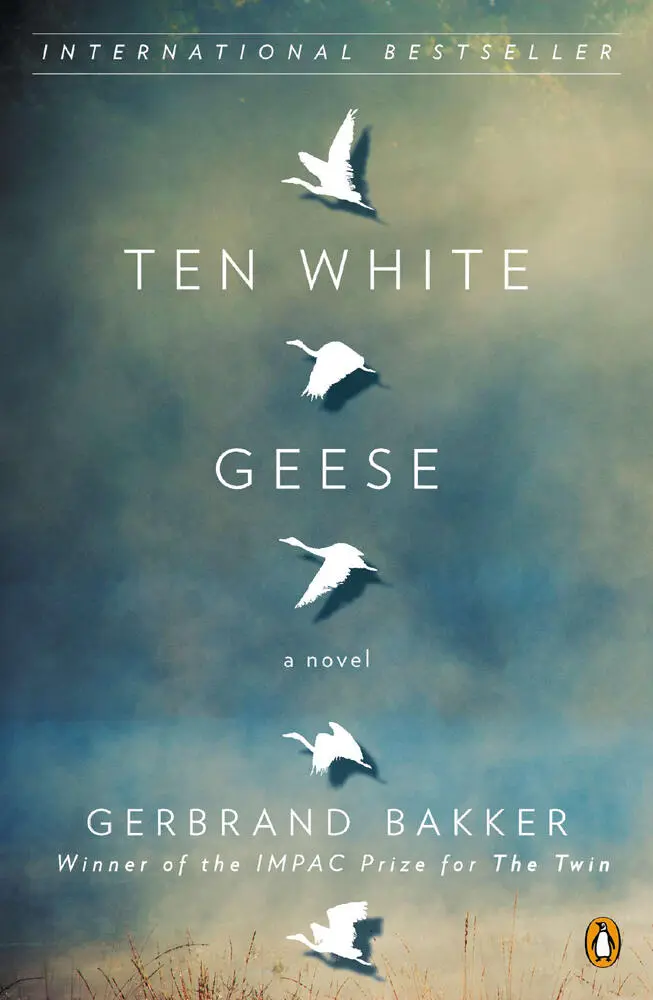
- Название:Ten White Geese
- Автор:
- Издательство:Penguin USA
- Жанр:
- Год:2013
- ISBN:9781101603055
- Рейтинг книги:3 / 5. Голосов: 1
-
Избранное:Добавить в избранное
- Отзывы:
-
Ваша оценка:
Ten White Geese: краткое содержание, описание и аннотация
Предлагаем к чтению аннотацию, описание, краткое содержание или предисловие (зависит от того, что написал сам автор книги «Ten White Geese»). Если вы не нашли необходимую информацию о книге — напишите в комментариях, мы постараемся отыскать её.
A woman rents a remote farm in rural Wales. She says her name is Emilie. An Emily Dickinson scholar, she has fled Amsterdam, having just confessed to an affair. On the farm she finds ten geese. One by one they disappear. Who is this woman? Will her husband manage to find her? The young man who stays the night: why won’t he leave? And the vanishing geese?
Set against a stark and pristine landscape, and with a seductive blend of solace and menace, this novel of stealth intrigue summons from a woman’s silent longing fugitive moments of profound beauty and compassion.
Ten White Geese — читать онлайн бесплатно полную книгу (весь текст) целиком
Ниже представлен текст книги, разбитый по страницам. Система сохранения места последней прочитанной страницы, позволяет с удобством читать онлайн бесплатно книгу «Ten White Geese», без необходимости каждый раз заново искать на чём Вы остановились. Поставьте закладку, и сможете в любой момент перейти на страницу, на которой закончили чтение.
Интервал:
Закладка:
Rhys Jones rose from the sofa with surprising speed. ‘Sam?’ he said.
The dog swerved slightly, ran to the sheep farmer and jumped into his arms.
Rhys Jones staggered.
She looked at Bradwen. Then back at the sheep farmer, whose eyes seemed even moister than usual.
Sam snorted and licked and barked.
44
‘ S’mai, Dad ,’ said Bradwen.
Rhys Jones put the dog down without answering the greeting. ‘Stay,’ he said. His galoshes were on the doorstep, facing away from the house; he could step right into them. He did, keeping his balance with one hand on the jamb. The dog looked up at him, panting excitedly. Without so much as looking at Bradwen, he walked down the crushed-slate path to his car, which was parked next to the house with the bumper almost touching the old pigsty. He opened the car door. ‘Sam,’ he called. The dog — which had tried to peer round the corner, nervous, with his head at an angle — flew out of the house and leapt into the car without a moment’s hesitation; it was obviously something he’d done many times before.
She had come out too by now, in her socks. A kind of triangle resulted: Rhys Jones at the car, Bradwen next to the future rose bed and her at the door. It wasn’t really cold any more; the last flakes of snow were dripping from the rose leaves.
‘So those socks are for you?’ the sheep farmer said. It wasn’t really a question. He’d already gone round the car and opened the door on the driver’s side.
‘Socks?’ the boy asked.
She looked from the boy to the man and back again. If Bradwen is a gymnast, she thought, Rhys Jones is a judoka who gave it up twenty years ago and let himself go to seed. She sucked on her cigarette, very hard, and blew out the smoke, which was thick in the damp air. Rhys Jones climbed in and started the car. Sam sat next to him, alert and staring straight ahead, his tongue lolling out of his mouth. A sheepdog. Happy. Next to his real master, the alpha male. Suddenly she understood why the dog had sat with her so often, why he had so willingly abandoned his post in front of the bathroom door that very first day: she was on the same level as the boy. The black car — it was a pickup — backed up, disappearing from her field of vision. She saw the shelf under the mirror before her, the first box of tablets. Just as her own body had seemed to emerge from the water with a slight lag earlier, everything outside seemed to be a quarter of a second out of sync too. She wanted to take another tablet now to keep it that way.
Shirley, the doctor, the baker and his wife, Rhys Jones and Bradwen. The boy was very naked now, without a dog, behind the pots with scrawny, dripping rose bushes, the straps of a small rucksack across his chest. ‘Come here,’ she said, when the car was out of earshot. If she didn’t call him, he would probably just stay there. She tossed the cigarette away and grabbed the boy. The rucksack was in the way; she wormed her hands in under it and hugged him to her chest. He smelt unbelievably good. She let her hands slide down and pulled his lower body up against hers.
‘Socks?’ he asked again, warm breath on her throat. He had wrapped his arms lightly around her.
‘That man doesn’t know what he’s talking about,’ she said. She saw the oak lying there like a fallen candelabra with uneven arms. If the tree’s left to lie there like that, it will end up turning into a second moss bridge. The smell of fresh bread overwhelmed the smell of the boy.
45
The husband moved his leg. That was what it felt like. Before, he’d only had to move his foot, but in the last few days the plaster cast had grown heavier and his leg cumbersome. Unable to drive, he’d taken a no. 4 tram to De Pijp, where he had arranged to meet the policeman in the bar on the Van Woustraat. He was glad he didn’t have to go to his parents-in-law’s by himself. Between the bar and their house the snow hadn’t been cleared off the pavement and the streets hadn’t been gritted; the policeman had to save him from falling more than once. The TV was on — long-distance ice skating — the commentators’ voices were a mumble in the background. One of the skaters was the one he’d seen advertising bread on the poster at the tram stop. His father-in-law was making tea; the policeman preferred it to coffee. Next to the TV was a Christmas tree decorated with tinsel and candles. His parents-in-law liked to do things the old-fashioned way and didn’t light the candles until Christmas Day itself. The triangle on the windowsill was lit, the flames adding an orange tint to a white amaryllis.
‘How’d they figure that out?’ the father asked.
‘No idea. “That information is confidential.” That’s what the woman who phoned me said.’
‘A woman?’
‘Yes.’
‘Wales. How’d she end up there? What’s in Wales?’
‘An English-speaking country’s an obvious choice, of course.’
‘And what’s it got to do with you?’
The policeman glanced at the husband before answering. ‘He can’t drive,’ he said, gesturing at the cast. ‘I’ve got some time off saved up. If I don’t use it before the end of the year, I lose it.’
‘When are you going?’
‘Next week.’
‘For Christmas?’
‘Yep. It’s Christmas everywhere.’
‘Don’t you have a wife? Kids? How do they feel about it?’
‘Oh, it’s fine by them,’ the policeman said. ‘They’re used to me being on duty.’
‘Hmm,’ said the father.
‘Unbelievable,’ said the mother.
‘What?’
‘That Kramer’s a monster. He’s even accelerating.’
‘Did you hear a word we said?’
‘What do you think? I was never really worried.’
‘Well, I was.’ He poured them all a second cup of tea. ‘I’ve had to take valerian at night,’ he told the policeman. ‘I could barely sleep otherwise.’
‘That’s good stuff,’ the policeman said. ‘I take it too sometimes.’
‘Do you?’
‘Have you been in touch with her?’ the father asked.
‘No. I wouldn’t know how,’ the husband said. ‘I still haven’t been able to get through on her mobile.’
‘But you’ve got her address?’
‘Yes. Kind of. I’ve got the name of a house.’
‘Then you could send her a letter.’
‘I could.’ The husband watched the TV for a moment. ‘It really is unbelievable, them tracking her down.’
‘That’s what they do,’ the policeman said.
The husband stood up. ‘I’ll just go to the loo,’ he said, grabbing a crutch and hobbling from the living room out into the small hallway. In the toilet he closed the lid and, after some effort, managed to sit down. With the door shut, he didn’t really have enough room for his foot. He couldn’t think about his wife in the living room and he had to decide what to say to his parents-in-law. Whether to tell them. Strange people, totally impervious. The way his father-in-law had just told the policeman about taking valerian to get to sleep. His mother-in-law nursing the exercise book she used to jot down the lap times. He wondered how long it was since he’d written a letter and realised how old-fashioned all that was: a pen, paper, envelope, stamp, postbox. His armpit was a bit chafed where the policeman had gripped him those three or four times. He turned the tap on and then off again. He couldn’t think about his wife here either. He found it completely impossible to imagine her in a house in the country.
A lot had changed in the last two months. Being alone didn’t even feel strange any more. After a couple of days at home with his foot up on a stool and a beer within reach, he had called the practice. They wouldn’t tell him anything. He’d sworn at them, and they’d put him through to the doctor. She too had kept silent and remained icy calm. He asked her about the results of the fertility test, something he’d completely forgotten during his visit. They were confidential too. Just before he rang off, she’d asked him how his foot was. That made him laugh out loud and he was still laughing when he hung up on her. He didn’t know anything. There was nothing he could really tell his parents-in-law. He hauled himself upright.
Читать дальшеИнтервал:
Закладка:
Похожие книги на «Ten White Geese»
Представляем Вашему вниманию похожие книги на «Ten White Geese» списком для выбора. Мы отобрали схожую по названию и смыслу литературу в надежде предоставить читателям больше вариантов отыскать новые, интересные, ещё непрочитанные произведения.







Обсуждение, отзывы о книге «Ten White Geese» и просто собственные мнения читателей. Оставьте ваши комментарии, напишите, что Вы думаете о произведении, его смысле или главных героях. Укажите что конкретно понравилось, а что нет, и почему Вы так считаете.