Ben Marcus - Notable American Women
Здесь есть возможность читать онлайн «Ben Marcus - Notable American Women» весь текст электронной книги совершенно бесплатно (целиком полную версию без сокращений). В некоторых случаях можно слушать аудио, скачать через торрент в формате fb2 и присутствует краткое содержание. Год выпуска: 2002, Издательство: Vintage, Жанр: Современная проза, на английском языке. Описание произведения, (предисловие) а так же отзывы посетителей доступны на портале библиотеки ЛибКат.
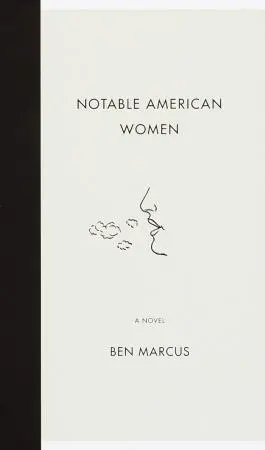
- Название:Notable American Women
- Автор:
- Издательство:Vintage
- Жанр:
- Год:2002
- ISBN:нет данных
- Рейтинг книги:4 / 5. Голосов: 1
-
Избранное:Добавить в избранное
- Отзывы:
-
Ваша оценка:
Notable American Women: краткое содержание, описание и аннотация
Предлагаем к чтению аннотацию, описание, краткое содержание или предисловие (зависит от того, что написал сам автор книги «Notable American Women»). Если вы не нашли необходимую информацию о книге — напишите в комментариях, мы постараемся отыскать её.
With Notable American Women he goes well beyond that first achievement to create something radically wonderful, a novel set in a world so fully imagined that it creates its own reality.
On a farm in Ohio, American women led by Jane Dark practice all means of behavior modification in an attempt to attain complete stillness and silence. Witnessing (and subjected to) their cultish actions is one Ben Marcus, whose father, Michael Marcus, may be buried in the back yard, and whose mother, Jane Marcus, enthusiastically condones the use of her son for (generally unsuccessful) breeding purposes, among other things. Inventing his own uses for language, the author Ben Marcus has written a harrowing, hilarious, strangely moving, altogether engrossing work of fiction that will be read and argued over for years to come.
Notable American Women — читать онлайн бесплатно полную книгу (весь текст) целиком
Ниже представлен текст книги, разбитый по страницам. Система сохранения места последней прочитанной страницы, позволяет с удобством читать онлайн бесплатно книгу «Notable American Women», без необходимости каждый раз заново искать на чём Вы остановились. Поставьте закладку, и сможете в любой момент перейти на страницу, на которой закончили чтение.
Интервал:
Закладка:
This is certainly not to imply that communication between persons and living things requires tone or sound, or that deaf figures of the female communities can have no names. There is always written text, to be apprehended through visual or tactile means, as well as the German-American technique of “handling” the name of a woman onto her thigh. My sister, as it happens, did not respond in any useful way to our repeated and varied handling of her body. As rough as we were, it made no apparent impression on her.
Here the American female name is regarded as a short, often brilliant word. Rarely should it inaccurately capture the person it targets, and its resistance to alternate uses, modifications, translations, and disruptions is an affirmation that individuals can and should be entirely defined by a sharp sound out of the mouth — these definitions have simply yet to be developed and written. Once they are, we will know what there is to know about all future persons who take on one of the appellations listed in the American Bank of Names, striving in their own particular way to become women of distinction.
Nicknames, admittedly, allow for a broader range of fetching, commanding, and calling, but the nickname only indicates an attribute or device of a person, such as the length of her legs, the way she sleeps, how she bounces a ball (in this case: “Sticks,” “Taffy,” “Horse”). A name, as the government instructs, can no longer be an accessory of a person, but must be her key component, without which the person would fold, crumble. She would cease, in fact, to be a person. The nickname, and more particularly the endearment (“Honey,” “Doddy,” “Love,” “Lady”), speaks to a deeper mistrust of the original name, a fear of acknowledging the person at hand. If it is possible to change a person by changing her name, why not employ a name of diminished potential and thus diminish or destroy the person? It’s a valid concern. When a man modifies or adorns a woman’s name, or dispatches an endearment into her vicinity, he is attempting at once to alter and deny her, to dilute the privacy of the category she has inherited and to require that she respond as someone quite less than herself. (Conversely, women who are scared of their own names are also typically afraid of mirrors.) The movement toward a single name for the entire female community (“Jill,” “James,” “Jackie”) — as aggressively espoused by Sernier and practiced by his younger employees — would disastrously limit the emotional possibilities for women and, rather than unify them as the Bible claims, probably force a so-called girls’ war in their ranks.
The task of my family in this regard was to process and unravel the names that arrived in the mail, then dispatch them onto my sister, generally with the naming bullhorn, a small seashell my mother carved for the purpose. We were enlisted by the government to participate in what was being called the most comprehensive book ever attempted, a study meant to catalog the names of American women. In the book, each name is followed by a set of tendencies that are certain to arise if the user employs the name as the full-time slogan for herself. The book is meant to serve as a catalog of likely actions, not only to predict various future American behaviors but to control them. If the government regulates the demographics of name distributions, using a careful system of quotas, it can generate desired behaviors in a territory, as well as prevent behavior that does not seem promising. It’s not exactly a style of warfare as much as it is deep dramatic control over the country. The book remains unpublished, but its authors are reported to be numerous, somewhere in the thousands, each working blind to the efforts of the others. In my possession are only the notes taken during the naming experiments on my sister — an intuitive set of definitions of the names she inhabited. We were not instructed how to define the names we were given, only to use them, study them, employ whatever research we could devise. I therefore have no notion if our material was ever incorporated into the text. We submitted it promptly but never received word on the matter.
We served up the names to my sister one by one and watched her change beneath them. Researchers here might say that she became “herself” or that it was her body expressing its name, as if something does not know what it is until the proper sound is launched at it. Each new morning that she appeared before us and we announced the name for the day through the bullhorn, we saw her become the new girl and release the old one, drop the gestures and habits and faces that the last name had demanded of her and start to search for the necessities of the new name.
I presume that other men launch their childhoods with sticks and mitts and balls, skinned knees, a sockful of crickets, and other accessories. They are shoved onto a lawn, where they know the routine, can find the snake or book of matches, sniff out water, or sit in a children’s ditch and watch the sky with their light and delicate heads. But I was the designated writer among us, unable to walk across grass or throw or catch or hide, equipped only with the stylus and pad, made to create our life in the form of notes on a page. This was unfortunate, because I don’t like to write, I don’t like to read, and I like language itself even less. My father read to me as a boy and I was mannered enough not to stop him. It was unbearable — book after book that failed to make or change me, my father’s lips twisting and stretching during a supposed story hour, massaging a stream of nonsense inside his mouth. I have always tried to be polite about words — good manners are imperative in the face of a father wrestling with a system that has so clearly failed — yet I find language plainly embarrassing. It is poor form, bad manners, that so much hope is pinned to such wrong sounds out of the mouth, to what is really only a sophisticated form of shouting and pain. It is not pleasant for me to hear “foreign” languages, either. All languages are clearly alien and untrue, and, absent of so-called meaning, it is repeatedly clear that language is a social form of barely controlled weeping, a more sophisticated way to cry. To speak is to grieve, and I would prefer not to listen to a weeping animal all day and every day, sobbing and desperate and lost. Particularly when that animal calls itself my father.
Each time we changed my sister’s name, she shed a brittle layer of skin. The skins accrued at first in the firewood bin and were meant to indicate something final of the name that had been shed — a print, an echo, a husk, although we knew not what. They were soft in my hands, devoid of information, and quite like what I always thought was meant by a “blanket,” a boy’s little towel, something to shield me from the daily wind that got into my room. It is not that the skins resembled a person anymore, or stood for one, or acted as a map of the past. They were, rather, a part of my sister I could have to myself — soft, foldable, smelling of bitter soap, perhaps like a toy she might have used. I kept them for hand warmers, penciled my pictures into their flaky surfaces, draped them over my bedroom lamp for spidery lighting effects and the whiff of a slightly burnt wind. Maybe I smelled something deeper as the skins burned away on the bulb, floating in and out of the cone of light that enabled my infrequent passage from bed to door, at such times when my bedpan was full. There was nothing of food to the smell, only houses, hands, glass, and hair. And her. They smelled of her.
Oddly, these skins my sister shed seemed to serve as a repellent to my sister herself, as if smelling her own body were uncomfortable for her. She would not come near my room when I was using them. Nor would she approach me, particularly if I wrapped myself in parts of her old body and walked through the halls, or bathed in a caul of her husks, which would cling to my skin in a gluey callus when they were wet. No one, I would venture, likes to be understood as deeply as I was understanding my sister at that time, shrouding myself in the flakes of her body that she had lost, wearing her. She preferred, I assume, not to know me.
Читать дальшеИнтервал:
Закладка:
Похожие книги на «Notable American Women»
Представляем Вашему вниманию похожие книги на «Notable American Women» списком для выбора. Мы отобрали схожую по названию и смыслу литературу в надежде предоставить читателям больше вариантов отыскать новые, интересные, ещё непрочитанные произведения.





Обсуждение, отзывы о книге «Notable American Women» и просто собственные мнения читателей. Оставьте ваши комментарии, напишите, что Вы думаете о произведении, его смысле или главных героях. Укажите что конкретно понравилось, а что нет, и почему Вы так считаете.