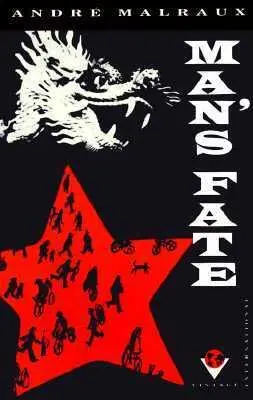
Andre Malraux - Man's Fate
Здесь есть возможность читать онлайн «Andre Malraux - Man's Fate» весь текст электронной книги совершенно бесплатно (целиком полную версию без сокращений). В некоторых случаях можно слушать аудио, скачать через торрент в формате fb2 и присутствует краткое содержание. Год выпуска: 1990, Издательство: Vintage, Жанр: Современная проза, на английском языке. Описание произведения, (предисловие) а так же отзывы посетителей доступны на портале библиотеки ЛибКат.
- Название:Man's Fate
- Автор:
- Издательство:Vintage
- Жанр:
- Год:1990
- ISBN:нет данных
- Рейтинг книги:3 / 5. Голосов: 1
-
Избранное:Добавить в избранное
- Отзывы:
-
Ваша оценка:
Man's Fate: краткое содержание, описание и аннотация
Предлагаем к чтению аннотацию, описание, краткое содержание или предисловие (зависит от того, что написал сам автор книги «Man's Fate»). Если вы не нашли необходимую информацию о книге — напишите в комментариях, мы постараемся отыскать её.
As a study of conspiracy and conspirators, of men caught in the desperate clash of ideologies, betrayal, expediency, and free will, Andre Malraux's novel remains unequaled.
Man's Fate — читать онлайн бесплатно полную книгу (весь текст) целиком
Ниже представлен текст книги, разбитый по страницам. Система сохранения места последней прочитанной страницы, позволяет с удобством читать онлайн бесплатно книгу «Man's Fate», без необходимости каждый раз заново искать на чём Вы остановились. Поставьте закладку, и сможете в любой момент перейти на страницу, на которой закончили чтение.
Интервал:
Закладка:
Within five minutes, three grenades entered through two of the windows aimed at; another blew up the iron- plate screen. Only the center one had not been hit. “Now to the center one!” shouted the cadet. Ch’en looked at him. For him commanding was a sport, and he gave himself over to it with a joyous enthusiasm. He scarcely protected himself. He was brave, beyond a doubt, but he was not attached to his men. Ch’en was attached to his, but not enough.
Not enough.
He left the cadet, crossed the street beyond the range of the police fire. He climbed up on the roof. The man who was holding on to the ridge was weakening: Ch’en took his place. Even there, with his wounded arm locked round the cement and plaster ornament, his right hand holding the hand of the first man on the chain, he did not escape his solitude. The weight of three sliding men was suspended from his it passed through his chest like an iron bar. The grenades were bursting inside the station, which had ceased firing. “We are protected by the attic,” he thought to himself, “but not for long. The roof will blow up.” In spite of the intimacy of death, in spite of that fraternal weight which was pulling him apart, he was not one of them. “Is even blood futile?” The cadet, down there, was looking at him without understanding. One of the men who had come up behind Ch’en offered to take his place.
“Al right. I’ll throw the grenades myself.”
He passed him the chain of bodies. In his stretched muscles rose a limitless despair. His hawk-like face with its narrow eyes was tense, absolutely motionless; with stupefaction he felt a tear roll down his nose. “Nervousness,” he thought. He pulled a grenade from his pocket, began to descend by hooking himself to the arms of the men forming the chain. But the chain was suspended from one of the ornaments which capped the roof at either end. From there it was almost impossible to reach the center window. Reaching the edge of the roof, Ch’en let go the arm of the grenade-thrower, clung to his leg, then to the eaves, swung over the edge and down by means of a drain-pipe: though he was too far from the window to reach it, he was near enough to throw. His comrades no longer stirred. Above the ground-floor a projection gave him footing. He was astonished that his wound hurt him so little. With his left hand holding on to one of the clamps which secured the drain-pipe, he gauged the weight of his first grenade: “If it falls in the street, under me, I’m as good as dead.” He hurled it with as much force as his position permitted: it.entered, exploded in the interior.
Below, the shooting began again.
Through the station doorway which had remained open, the policemen, driven from the last room, rushed out in a blind stampede, firing at random. From the roofs, from the porches, from the windows, the insurgents were shooting them down. The bodies fell one after another, numerous near the doorway, then more and more scattered.
The firing ceased. Ch’en climbed down, still clinging to his drain-pipe: he could not see his feet, and landed on a body.
The cadet was entering the station. He followed ^m, pulling from his pocket the grenade which he had not thrown. At each step he became more acutely conscious that the wails of the wounded had ceased. In the guardroom, nothing but corpses. The wounded were charred. On the second story, more dead, a few wounded.
“And now, to the South Station,” said the officer. “Let’s take all the guns: other groups will need them.” The arms were carried to the truck; when they had all beerr collected, the men hoisted themselves up on the machine, stood tightly packed, sat on the hood, cluster J on the running-boards, clung to tht: rear. Those who were unable to ride started off by way of the alley at a rapid pace. The great abandoned splotch of blood on the wall seemed inexplicable in the deserted street; at the corner the truck, bristling with men, with its accompaniment of rattling iron, vanished towards the South Station and the barracks.
It was soon forced to stop: the street was blocked by four dead horses, and three corpses, already disarmed. They were those of the cavalry men Ch’en had seen at the beginning of the day: the first armored car had arrived in time. On the ground, broken window- glass, but nothing living except an old Chinaman with a beard like a paint-brush, who was moaning. He spoke distinctly as soon as Ch'en approached:
“It is a very unjust thing and very sad! Four! Four! Alas!”
“Only three,” said Ch’en.
“Four, alas!”
Ch’en looked again: there were only three corpses- one on its side as though casuaUy thrown there, two an their bellies-between the two rows of houses, dead too, under the heavy sky.
“I’m talking about the horses,” said the old man, with contempt and fear: Ch'en was holding his revolver.
“I was talking of the men. One of the horses belonged to you?”
No doubt they had been requisitioned that morning.
“No. But I used to be a coachman. I know animals. Four killed! And for nothing!”
The driver of the truck stepped up:
“For nothing?”
“Let’s not waste time,” said Ch’en.
With the help of two men he dragged the horses to one side. The truck went on. At the end of the street Ch’en, seated on one of the running-boards, looked back: the old coachman was still among the corpses, moaning, no doubt, a black figure in the gray street".
Five o’clock in the afternoon
“The South Station has fallen.”
Ferral hung up the receiver. While he was keeping appointments (the International Chamber of Commerce was hostile to all intervention, but he controlled the greatest newspaper in Shanghai) the progress of the insurrection was striking him blow after blow. He had wanted to be alone at the telephone. He came back into his studio, where Martial, who had just arrived, was arguing with Chiang Kai-shek’s envoy: the latter had been unwilling to meet the Chief of Police either at police headquarters or at his home. Even before opening the door, Ferral overheard, in spite of the gun-fire:
“Now what do 1 represent here? — French interests. ”
“But what support can I promise?” answered the Chinaman in a tone of nonchalant insistence. “The Consul-General himself tells me to await de-tails from you.
104
Because you know our country, and its people, very well.”
The studio telephone rang.
“The Municipal Council has fallen,” said Martial.
And, changing his tone:
“I’m not saying that I don’t have a certain psychological understanding of this country, and of men in general. Psychology and action, that’s my job; and on the basis. ”
“But if persons who are as dangerous to your country as they are to ours, dangerous to the peace of civiliza- ti-on, seek refuge, as they always do, in the concession? The internati-onal police.
“That’s what he’s after,” thought Ferral, who was entering. “He wants to know if Martial, in case of a breaking-off of relations, would allow the Communist leaders to find refuge with us.”
“. have promised us their unqualified goodwill. What will the French police do?”
“We’ll take care of it. But watch out for this: no monkey-business with white women, except Russian ones. I have strict orders about that. But, as I told you: nothing official. Nothing official.”
In the modern studio-on the walls, Picassos of the rose period, and an erotic Fragonard sketch-the two men were standing on either side of a very large Kuan Yin in black stone of the T’ang dynasty, bought on Clappique’s advice and which Gisors believed to be false. The Chinaman, a young colonel with a curved nose, in civilian clothes, buttoned up to the neck, was looking at Martial and smiling, his head bent back.
Читать дальшеИнтервал:
Закладка:
Похожие книги на «Man's Fate»
Представляем Вашему вниманию похожие книги на «Man's Fate» списком для выбора. Мы отобрали схожую по названию и смыслу литературу в надежде предоставить читателям больше вариантов отыскать новые, интересные, ещё непрочитанные произведения.











Обсуждение, отзывы о книге «Man's Fate» и просто собственные мнения читателей. Оставьте ваши комментарии, напишите, что Вы думаете о произведении, его смысле или главных героях. Укажите что конкретно понравилось, а что нет, и почему Вы так считаете.