Robert Coover - Origin of the Brunists
Здесь есть возможность читать онлайн «Robert Coover - Origin of the Brunists» весь текст электронной книги совершенно бесплатно (целиком полную версию без сокращений). В некоторых случаях можно слушать аудио, скачать через торрент в формате fb2 и присутствует краткое содержание. Год выпуска: 2014, Издательство: Dzanc Books, Жанр: Современная проза, на английском языке. Описание произведения, (предисловие) а так же отзывы посетителей доступны на портале библиотеки ЛибКат.
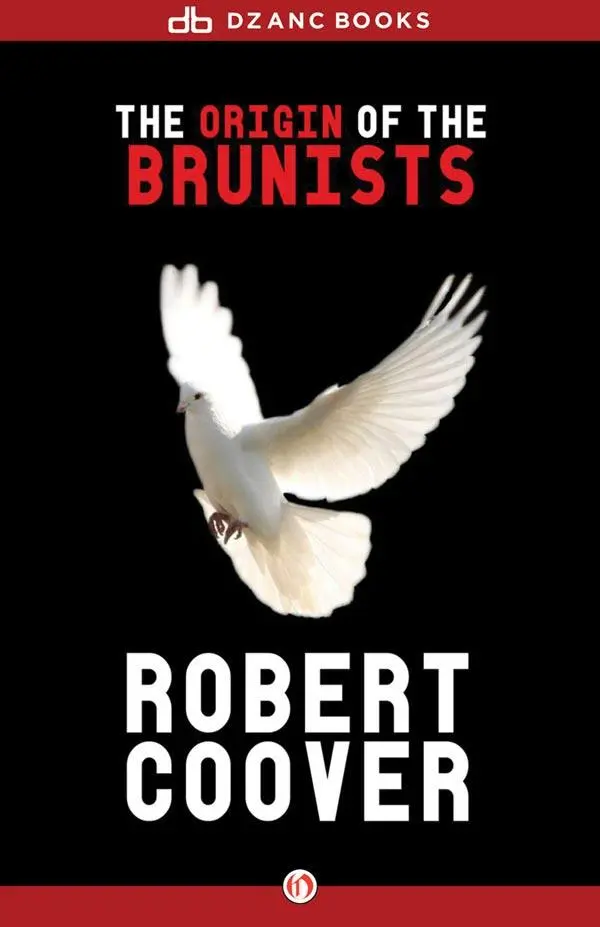
- Название:Origin of the Brunists
- Автор:
- Издательство:Dzanc Books
- Жанр:
- Год:2014
- ISBN:нет данных
- Рейтинг книги:5 / 5. Голосов: 1
-
Избранное:Добавить в избранное
- Отзывы:
-
Ваша оценка:
Origin of the Brunists: краткое содержание, описание и аннотация
Предлагаем к чтению аннотацию, описание, краткое содержание или предисловие (зависит от того, что написал сам автор книги «Origin of the Brunists»). Если вы не нашли необходимую информацию о книге — напишите в комментариях, мы постараемся отыскать её.
Origin of the Brunists — читать онлайн бесплатно полную книгу (весь текст) целиком
Ниже представлен текст книги, разбитый по страницам. Система сохранения места последней прочитанной страницы, позволяет с удобством читать онлайн бесплатно книгу «Origin of the Brunists», без необходимости каждый раз заново искать на чём Вы остановились. Поставьте закладку, и сможете в любой момент перейти на страницу, на которой закончили чтение.
Интервал:
Закладка:
“Oh, is that all! Well, that’s hardly something tragic! I’d say it was good riddance of bad rubbish!” She clamped her pencil between her neat white teeth, then apparently thought better of it and fitted it carefully over her ear, fiddled with a hairpin. There was a pause, filled only by an overemotional argument on TV and music from Angie’s radio that sounded to Vince like some guy having a public orgasm. Etta checked her sniffling, smiled feebly at Angie, and the girl went back to her room.
Vince walked over, patted Etta gently on the shoulder. “Care for half a beer?” She shook her head. Vince figured maybe they ought to try to work something up tonight, been a long time and he felt she deserved a share of his rediscovered potency. But later he fell asleep watching an old movie on the set, and when he woke, Etta had already long since turned in.
One night in bed with Wanda not long after that, he happened to mention that he had a boy going into the Marines. “You already got a boy growed up, Vince?” she asked absently.
He swallowed, felt it shrivel. “Yeah,” he said. Decided not to mention the other six.
At the bus station on Ash Wednesday, last week of the month, they made stale jokes about the snowstorm predicted and how Charlie, the lucky bastard, was headed south. Vince noticed how much taller the boy looked all of a sudden, and then, trying not to be nervous, said good-bye to Etta instead of Charlie. And from then on, there were just the three of them in the old house.
8
March tore into West Condon on a sudden savage snowstorm. The lawyer Ralph Himebaugh, brooding over the sinister state of affairs in the world, pushed through the swirling drifts, fur-capped head down butting the wind, feet secure in heavy galoshes, but still cold, cold to the bone. In the whine of wind and snow, there was little to see or hear. Ralph was a man removed, and it was as though the world were remarking the continuing aggravation of his isolation, as though nature herself were persecuting him, the victim, the sacrifice, the outcast. Disaster whistled at his wraps and portents stung his ears.
Discord, famine, war, cruelty, deaths, rape — couldn’t the fools see it? Every day, mounting, tragedy upon tragedy, horror succeeding horror, oh my God! It was too plain! Yet their blindness was a part of it, was it not? For years it had been clear to him, the pervasive current of mantling terror, discernible through the scrim of false and superficial reportage, and for years now he had kept records of its progress, scrapbooks of calamities and disasters, deathtoll lists, maps of its movements. Everything about it absorbed him: the scope, the periodicity, the routes of passage, certain correlativities, duration and instantaneity, origin and distant derivative effects, expenditure of energy, parallelisms and counteractions, and, above all, its wake of mathematical clues. Oh, he was wise to have done so! For although at the outset the incredible complexities had pitched him into a hell of confusion and despair, by disciplining himself, by literally chaining himself to the task and pummeling himself to greater wakefulness, he had at last mastered the necessary technology. No, it had been no delusion, not at all! Almost immediately, he had discovered the steady intensification of the disaster frequency, the irreversible course toward cataclysm.
Suddenly, as his own mind was on the terror, a car fluttering through the snow about a hundred yards away went into a spin. Ralph stood transfixed, appalled, as the black machine, mindless, yet possessed by its own inner necessities, lazed through wide chaotic circles in the unbounded street, then bumped up and stopped against a telephone pole that reared out of the shifting snow like a black cross. Oh my God, my God! How much time? A man got out, startling Ralph. He had somehow forgot to expect a man. Ralph felt the old impulse, the impulse to flee, but he overrode it; the recent years, while sobering, had engendered a new kind of courage. It was what emerged and took over, he supposed, when the old irrational constructs of hope and their false comforts were cut away. He stumbled through the snow toward the man, wind nearly blinding him.
The man looked up, smiled, shook his head. “Damn!” he said. “Just like a merry-go-round!”
“Are you all right?”
“Yeah.” The man laughed nervously. “But I’m gonna leave her stuck right where she’s at and walk the rest of the way. Boy! She really come in like a lion, didn’t she?”
Ralph nodded, but did not return the stupid smile. The man’s indifference to the experience angered him. They shook gloved hands, and the man left him. His heart still racing, Ralph considered the car and the pole. When the man was out of sight, Ralph glanced about to assure himself of the snow’s effective screen, then kicked a dent in the door. “Goddamn you!” he whispered. The rest of the walk home, the machine coiled and spun in maddening sweeps before his eyes.
On his porch, he mechanically checked the mailbox, then remembered it was Sunday. He tugged off the galoshes and stepped inside to greet his cats, Grendel, Nabob, Melpomene, Nyx, and Omar. They were hungry and so attended his presence. Nabob twisted and coiled, rubbing against his moving leg. It was not love. Their emotional range was between indifference and pure hate. He could accept that, yet at times it hurt him, for, against his will, he could not help loving them. He turned into the kitchen and Nabob nearly tripped him up — he brought his foot down on a paw. He removed hake from the freezer and put it to boil. He poured them some milk, but they lapped at it distractedly, their minds on the fish. Nyx sulked. He slipped her a piece of chicken liver. Nyx was a big pure-black animal with a long straight nose. Ralph feared her. “You hot black bitch!” he whispered at her.
While the fish thawed and cooked, he sat down at his desk in the front room and recorded the car accident in the P.O. — Personal Observations — journal. While constructing an essentially objective system, Ralph did not entirely reject subjectivity from it: the mere fact that it was he who had assumed the responsibility of this task was in itself a subjective element, and he recognized it. It was not proven, after all, that the force was mindless — the purity of its mathematics would in fact argue the contrary — and were it not mindless, he could well expect to be regarded as its enemy. He unwrapped last Sunday’s Guardian and Times , sent to him airmail, clipped out pertinent articles, recorded data from them.
The cats protested. He returned to the kitchen, poured the boiling water into the sink, dumped the fish on the cats’ plate. With his foot, he blocked Nyx’ approach to the plate, made sure the other four had got their share. She clawed his ankle, but he laughed and held her back a little longer. “One day …!” he warned her.
At his desk once more, he withdrew his scratchpad, did some hurried calculations. Still, the augmentation, the emergent numerical pattern, the cyclical behavior. Incredible! He sighed, chewed meditatively on the pencil, then began the task of carrying his figures all the way out. No, there was no escaping it. At the present rate of severity increase, mankind would necessarily be overcome within the next six or seven years. Six or seven years! Meticulously he rechecked his figures, and with graph paper he described a varied set of conceivable curves based on the slightly different scales he used in the different journal categories. And each time, it resulted in the same forecast — or suggested an even earlier date. Grotesque! It would be grotesque!
This had happened before, of course, signs leading to the immediacy of catastrophe, and dates had in fact been passed, but always he had uncovered some fundamental error in the schematism itself, some critical factor omitted in ignorance from his computations. For example, at the very beginning he had simply listed all events as numerically equal, an appalling lack of sophistication that now amazed and embarrassed him in retrospect. But time and error had brought wisdom. Now, he was convinced, the system could not be more complete. There was no hope in it, given the human condition, for omniscient finality, to be sure, but it had to be taken seriously.
Читать дальшеИнтервал:
Закладка:
Похожие книги на «Origin of the Brunists»
Представляем Вашему вниманию похожие книги на «Origin of the Brunists» списком для выбора. Мы отобрали схожую по названию и смыслу литературу в надежде предоставить читателям больше вариантов отыскать новые, интересные, ещё непрочитанные произведения.

Обсуждение, отзывы о книге «Origin of the Brunists» и просто собственные мнения читателей. Оставьте ваши комментарии, напишите, что Вы думаете о произведении, его смысле или главных героях. Укажите что конкретно понравилось, а что нет, и почему Вы так считаете.