William Vollmann - Kissing the Mask - Beauty, Understatement and Femininity in Japanese Noh Theater, with Some Thoughts on Muses (Especially Helga Testorf), Transgender Women, ... Geishas, Valkyries and Venus Figurines
Здесь есть возможность читать онлайн «William Vollmann - Kissing the Mask - Beauty, Understatement and Femininity in Japanese Noh Theater, with Some Thoughts on Muses (Especially Helga Testorf), Transgender Women, ... Geishas, Valkyries and Venus Figurines» весь текст электронной книги совершенно бесплатно (целиком полную версию без сокращений). В некоторых случаях можно слушать аудио, скачать через торрент в формате fb2 и присутствует краткое содержание. Год выпуска: 2010, Издательство: HarperCollins, Жанр: Современная проза, Публицистика, на английском языке. Описание произведения, (предисловие) а так же отзывы посетителей доступны на портале библиотеки ЛибКат.
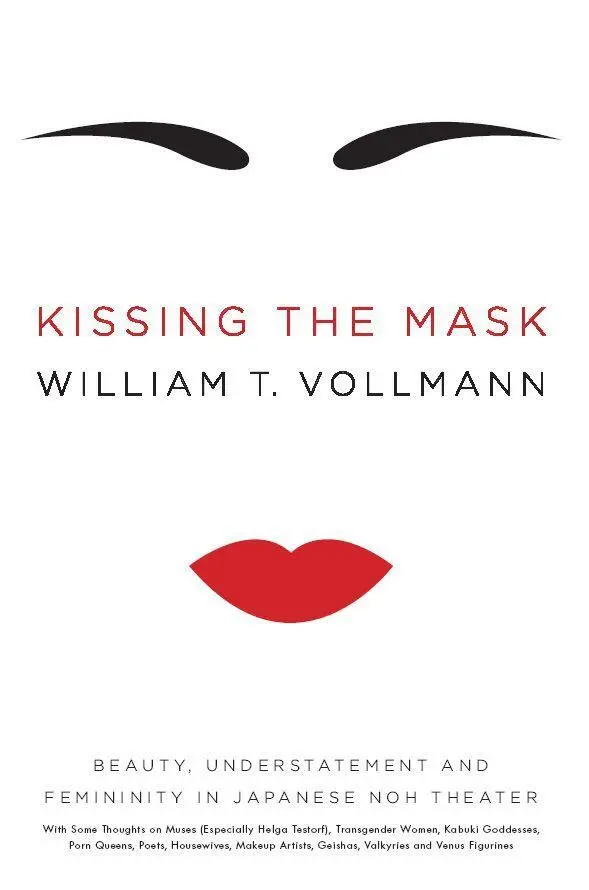
- Название:Kissing the Mask: Beauty, Understatement and Femininity in Japanese Noh Theater, with Some Thoughts on Muses (Especially Helga Testorf), Transgender Women, ... Geishas, Valkyries and Venus Figurines
- Автор:
- Издательство:HarperCollins
- Жанр:
- Год:2010
- ISBN:нет данных
- Рейтинг книги:3 / 5. Голосов: 1
-
Избранное:Добавить в избранное
- Отзывы:
-
Ваша оценка:
Kissing the Mask: Beauty, Understatement and Femininity in Japanese Noh Theater, with Some Thoughts on Muses (Especially Helga Testorf), Transgender Women, ... Geishas, Valkyries and Venus Figurines: краткое содержание, описание и аннотация
Предлагаем к чтению аннотацию, описание, краткое содержание или предисловие (зависит от того, что написал сам автор книги «Kissing the Mask: Beauty, Understatement and Femininity in Japanese Noh Theater, with Some Thoughts on Muses (Especially Helga Testorf), Transgender Women, ... Geishas, Valkyries and Venus Figurines»). Если вы не нашли необходимую информацию о книге — напишите в комментариях, мы постараемся отыскать её.
comes a charming, evocative and piercing examination of an ancient Japanese tradition and the keys it holds to our modern understanding of beauty….
What is a woman? To what extent is femininity a performance? Writing with the extraordinary awareness and endless curiosity that have defined his entire oeuvre, William T. Vollmann takes an in-depth look into the Japanese craft of Noh theater, using the medium as a prism to reveal the conception of beauty itself.
Sweeping readers from the dressing room of one of Japan's most famous Noh actors to a transvestite bar in the red-light district of Kabukicho,
explores the enigma surrounding Noh theater and the traditions that have made it intrinsic to Japanese culture for centuries. Vollmann then widens his scope to encompass such modern artists of attraction and loss as Mishima, Kawabata and even Andrew Wyeth. From old Norse poetry to Greek cult statues, from Japan's most elite geisha dancers to American makeup artists, from Serbia to India, Vollmann works to extract the secrets of staged femininity and the mystery of perceived and expressed beauty, including explorations of gender at a transgendered community in Los Angeles and with Kabuki female impersonators.
Kissing the Mask
Kissing the Mask: Beauty, Understatement and Femininity in Japanese Noh Theater, with Some Thoughts on Muses (Especially Helga Testorf), Transgender Women, ... Geishas, Valkyries and Venus Figurines — читать онлайн бесплатно полную книгу (весь текст) целиком
Ниже представлен текст книги, разбитый по страницам. Система сохранения места последней прочитанной страницы, позволяет с удобством читать онлайн бесплатно книгу «Kissing the Mask: Beauty, Understatement and Femininity in Japanese Noh Theater, with Some Thoughts on Muses (Especially Helga Testorf), Transgender Women, ... Geishas, Valkyries and Venus Figurines», без необходимости каждый раз заново искать на чём Вы остановились. Поставьте закладку, и сможете в любой момент перейти на страницу, на которой закончили чтение.
Интервал:
Закладка:
When performing a woman’s role, the actor should “slightly bend the hips, hold his hands high, sustain the whole body in a graceful manner, feel a softness in his whole manner of being, and use his physique in a pliant manner.” He must wear skirts long enough to hide his feet (as implied, this rule gets frequently disobeyed in Noh performances of my epoch). His body should be hidden below the neck. And Zeami will offer any number of such instructions to the man who wants to be perceived as female, as warriorlike, as old… But this does not get to the heart of grace. The following does, stunningly: Whether an actor plays woman, warrior, demon or old man, “it should seem as though each were holding a branch of flowers in his hand.” 2
The more I consider this statement, the more it thrills me. I am not at all sure that it must be true, but why not create something on the assumption that it is? The late A. R. Ammons once advised me in a poetry course that if one’s effect feels a little off, it is time to push the off-ness as far as it will go, until it achieves strange beauty (in other words, Zeami’s flower of novelty). — Zeami for his part asserts that off-ness has to do with being out of balance. Therefore, add the complement. If something is rough, add flowers to it. If it is weak, add strength. Even the beyond-conscious role of a beautiful woman will be out of balance — strengthless, even vulgar — without its opposite. The woman is more effectively female when tinctured with maleness. For his own part, the warrior must bear his flower-branch. Of course it would be superficial, reductive, to suppose that the man’s flower-branch must be the same as the woman’s. All the same, this feminine emblem which brings the various male roles into balance must surely remain feminine for the female ones; therefore, even though a Noh heroine as much as any Noh hero contains her opposite already (through the appropriate strong characteristics of chant, posture and dance), that branch of flowers can only make her more herself, 3in which case it would seem that the female principle is fundamentally more in balance than the male .
Set this aside for a moment, or for the rest of your life. I am not sure whether I believe it myself. But let us think more about this matter called balance, which can mean one or both of two things. An artist might impart opposite qualities to what he creates, either to make it neutral, or else to make it infinite. Photographers like to speak of a neutral surface for a print, meaning a scale of values whose color or value is not obtrusive. 4A rich but somehow nondescript black which can be decomposed into various greys neither warm nor cold, and a white which is not too sunny or snowy, will best allow the image to offer itself without extraneous connotations. Of course I might break this rule, and often do: following the more-is-more principle of Ammons, I selenium tone subjects which to my feeling possess “warm” connotations, so that the shadow areas in that portrait of the Mexicali street prostitute singing narco-ballads on a hot night take on a blackish-crimson tinge; while such “cold” subject as the jet-black men in the Congolese prison-cage deserve to be toned with gold chloride until the white areas bleach down harshly and the shadows take on a bitter blueness. But could it be that this procedure is a shallow or even hysterical insistence on telling the viewer how to feel? Should I cold-tone the street girl and warm-tone the prison-cage, so that only the subject remains?
In daytime, says Zeami, perform subdued plays, and in nighttime do brisk bright ones. When an actor expresses anger, “he must not fail to retain a tender heart. Such is his only means to prevent his acting from developing roughness…” When he stamps his feet, he must suppress his upper body into near immobility; and vice versa . The treatises offer many more such examples of cancellation. Always the tendency is to reduce, understate, dampen vibrations, approach neutral buoyancy until beauty hovers in the water, massively still, profound beyond sight, so pure that it might be mistaken for nothingness. “If the motion is more restrained than the emotion behind it,” he writes in “Kakyo,” “the body will become the substance and the emotion its function, thus moving the audience.” What would happen if the motion were insufficiently restrained, the silver gelatin of the photograph insufficiently neutral? Then our hothouse could raise only false flowers. This is why Zeami warns that a “surface brilliance” of visual spectacle may actually be inimical to a great performance, because the audience might then miss the subtle beauties of the acting. To avoid this, plays have slowed themselves down over the centuries; and, for the same reason, the sound of Noh ought to be “sober” even if that bores provincial audiences.
To artists who create in an unmediated rush of feeling (Céline, Rachmaninoff, Gauguin), this prescription will be deadly. Balance itself is hardly a prerequisite to beauty. But for the remainder of this book, I will either respect Zeami’s rules or else react to them.
When I see a Noh play, I think of strong, stately stillness . Indeed, as Zeami remarks, a good actor may fascinate his audience when seemingly doing nothing — in other words, when he is between two actions or movements. This achievement is possible thanks to tension and concentration. 5It is as if I could simultaneously increase both the warmth and the chilliness of my photographs, leaving each print to appear almost untoned. If so, my representation would be richer.
What then is the flower? What is grace? What is beauty? Many specific things can be said; for instance, body posture is as important as the specific characteristics of any role. Never mind. In another of his methodically enigmatic utterances, which always point beyond conceptualization, Zeami writes: Forget the details of a play in order to see the entirety. Then forget the play itself, and consider the actor. Next, forget the actor himself and observe his spirit. Finally, forget his spirit; and the essence of the Noh will be manifest.
And so the lovely woman approaches, sliding silently across the stage, the ancient mask of her face shining warmly like ivory. She is not a woman — not only because she is a man but also because she is inhuman: perfect grace and womanhood itself. Slowly, slowly she inclines her head, and her face alters expression an infinity of times, each expression feminine, tranquilly lovely, and alien to the faces of any of the living women I have ever known. Who is she, but the true flower herself? I cannot tire of her, perhaps because I cannot keep her. She gazes through me, into the spirit world; she sings in a deep old man’s voice. How beautiful is she to me precisely? With his customary flair for subcategorization, Zeami offers nine levels of beauty. Lowest of all is the way of crudeness and leadenness . I can understand that; I can grasp all of the lowest three levels, and even the middle ones, but of the highest three levels, each of which is associated with its own flower, I can comprehend only the third, and my comprehension, like my admiration for this woman on the Noh stage who is still more transient than I but whose face may still hover above a stage centuries from now, is wordless. Never mind the highest level; I am too small to see its beauty, let alone describe it. Never mind the next highest. Let me express, with grateful thanks to Zeami, the beauty of this woman from the perspective of the third level, which she might already have gone beyond — a beauty beyond logic, as beauty must surely be: “ The art of the flower of tranquility . Piling up snow in a silver bowl.”
Chapter 5. The Dragons of Kasuga
Интервал:
Закладка:
Похожие книги на «Kissing the Mask: Beauty, Understatement and Femininity in Japanese Noh Theater, with Some Thoughts on Muses (Especially Helga Testorf), Transgender Women, ... Geishas, Valkyries and Venus Figurines»
Представляем Вашему вниманию похожие книги на «Kissing the Mask: Beauty, Understatement and Femininity in Japanese Noh Theater, with Some Thoughts on Muses (Especially Helga Testorf), Transgender Women, ... Geishas, Valkyries and Venus Figurines» списком для выбора. Мы отобрали схожую по названию и смыслу литературу в надежде предоставить читателям больше вариантов отыскать новые, интересные, ещё непрочитанные произведения.











Обсуждение, отзывы о книге «Kissing the Mask: Beauty, Understatement and Femininity in Japanese Noh Theater, with Some Thoughts on Muses (Especially Helga Testorf), Transgender Women, ... Geishas, Valkyries and Venus Figurines» и просто собственные мнения читателей. Оставьте ваши комментарии, напишите, что Вы думаете о произведении, его смысле или главных героях. Укажите что конкретно понравилось, а что нет, и почему Вы так считаете.