Adam Mars-Jones - Pilcrow
Здесь есть возможность читать онлайн «Adam Mars-Jones - Pilcrow» весь текст электронной книги совершенно бесплатно (целиком полную версию без сокращений). В некоторых случаях можно слушать аудио, скачать через торрент в формате fb2 и присутствует краткое содержание. Год выпуска: 2008, Издательство: Faber and Faber, Жанр: Современная проза, на английском языке. Описание произведения, (предисловие) а так же отзывы посетителей доступны на портале библиотеки ЛибКат.
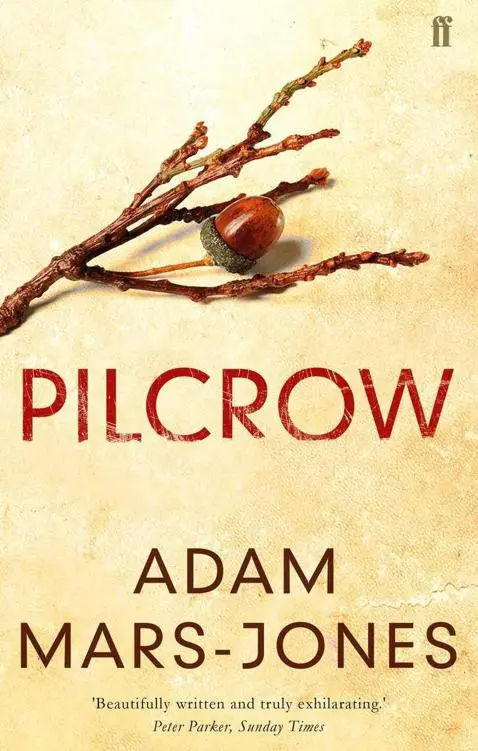
- Название:Pilcrow
- Автор:
- Издательство:Faber and Faber
- Жанр:
- Год:2008
- ISBN:нет данных
- Рейтинг книги:5 / 5. Голосов: 1
-
Избранное:Добавить в избранное
- Отзывы:
-
Ваша оценка:
Pilcrow: краткое содержание, описание и аннотация
Предлагаем к чтению аннотацию, описание, краткое содержание или предисловие (зависит от того, что написал сам автор книги «Pilcrow»). Если вы не нашли необходимую информацию о книге — напишите в комментариях, мы постараемся отыскать её.
Pilcrow — читать онлайн бесплатно полную книгу (весь текст) целиком
Ниже представлен текст книги, разбитый по страницам. Система сохранения места последней прочитанной страницы, позволяет с удобством читать онлайн бесплатно книгу «Pilcrow», без необходимости каждый раз заново искать на чём Вы остановились. Поставьте закладку, и сможете в любой момент перейти на страницу, на которой закончили чтение.
Интервал:
Закладка:
The progress of his braced left leg towards a tryst with my taily and dependent scallywag was sharply arrested by my knees. Instead of warmth and love I felt the hard press of metal and leather. The flash of pain was produced by his heavy callipers scraping against my legs. I winced, he lurched backwards and the exchange of secret information was over before it could begin.
My attempt at seduction was foiled by a double mechanical impossibility. My hips were immobile while his legs were floppy, needing to be braced mechanically for him to walk. What made me feel even more stupid after the event was that I’d so often watched polio boys having their callipers put on. Some of them needed help from the little matrons, others learned to fend for themselves. Julian pretty much put them on for himself. The contrast between strong upper bodies and wasted legs made those boys seem like mythical beasts, minotaur colts.
I had even examined Julian’s callipers in the early days of secret-agent fascination, while he explained the various modifications HQ was going to install. I tried to hold one when it was off, but it was too heavy for me to lift for more than a moment or two. I liked the idea of being close to a boy who had switches and hinges on him, as if Professor Branestawm had had a hand in designing him.
Each calliper consisted of two parallel metal bars which ran down each side of the leg. The bars were hinged at the knee and could be set to lock or unlock. To hold the calliper in place a series of leather straps and buckles ran crosswise and round the leg. It was vital that the hinge of the calliper coincided with the hinge of each knee, in order to avoid terrible pain when Julian wanted to bend his legs. For walking, the bars were set at lock. There was a release catch on each side of each knee, so in order to bend his knees for sitting down at meals or lessons Julian — and all the other boys with callipers — had to set four release catches, and then repeat the process in reverse for standing up.
Julian’s jeans were able-bodied items of clothing, but I could see that they didn’t wear out in the normal way. His legs weren’t mobile enough to manage much in the way of scuffing, but the hinges of his callipers were always nipping the cloth round the knees.
He’d told me often enough that putting the callipers on was an elaborate business. Gillie Walker and Biggie were the best ‘putter-onners’ — the love they had for their work meant their hands became sensitised to the boy’s requirements. All the straps had to be set at the right degree of tension. If the strap was set too loose the leg would wobble and shift inside the cage, making it dangerous or impossible for him to walk. If the strap was set too tight, then the circulation of blood would be impaired. An already difficult job was made even more taxing by the fact that the boys were growing fast, none faster than Julian, and the weather played its part. A boy’s leg would be smaller on a cold day and so need more strapping. It would expand in warmer weather. Additionally the leg would be much colder (and smaller) at the beginning of the day and hotter and larger at the end. So Julian and the other polio boys could often be seen fiddling with their callipers at various points in the day.
All this had gone out of my mind while I waited for the embrace of knowledge. I hadn’t yet learned that there are points in the body where energy gathers in debased forms unless it is released by the proper procedure. Julian and I were alarmingly clogged in our adolescent chakras with thickly sedimented desire, but ankylosis was my chaperone and Julian’s polio was his chastity belt.
Life became easier for calliper users a little later, when Velcro started to replace leather straps. Velcro had been around for some time, but its use in callipers came as a separate little break-through.
When I’d first seen this new material which mimicked couch grass, I’d fallen in love with it. I’d not personally had any great problem with manipulating zips. I even fancied myself something of an expert, but it had been an easy matter to convince Mum, who was always a dab hand at needle-work, that Velcro would be easier for me. She got to work with a vengeance. When the magic closures had been installed, I spent hours opening and closing the gap at my groin. I thoroughly enjoyed the tearing sound as the male and female surfaces were torn apart. In time, as the novelty wore off, I would forget to close the flies before the trousers were washed. After only a few adventures in the maëlstrøm of the washing machine, the male component of the Velcro would be festooned with stray fibres, bonded into unorthodox unions which allowed no divorce. There was no getting rid of the fluff once it had become embedded. The initial sharp rip of the tearing when the fly was opened would soften to a dull scrape.
Mum would scold me on the eve of my regular returns to Vulcan. ‘You must make sure that you join the Velcro zip before it gets washed — just see what fluff and what-not has got in!’ It was already too late. Gaps appeared in the fly opening as the male hooks lost interest in the arranged marriage intended by the manufacturers. They preferred to hook up with the low-life denizens which flaunted themselves in the vortex of the washing machine’s drum.
The Cromer Cocklebur
When I learned the circumstances of this material’s invention, it was a shattering disappointment. It was so obvious that it should have been me that made the break-through.
George de Mestral, Swiss engineer and outdoorsman, got the idea for Velcro from cockleburs caught in his clothes and his dog’s fur. How could a seed-case show the same affinity for his tweeds and for his dog’s coat? He detached a bur from his trousers and examined it under the microscope. It was covered with tiny hooks.
That’s all it took — ingredients which I also had to hand: dog, cockleburs from the burdock that grew so plentifully round the Abbotsbrook Estate, microscope. An eye that noticed oddities and a mind that followed them up. How many significant inventions are born so painlessly? It should have been me — surely it would have, if George de Mestral hadn’t beaten me to it by taking that fateful walk the year before I was born.
I had looked to chemistry as my medium for making a mark on the world, not entirely foolishly. Joseph Priestley and John Dalton, after all, were amateurs without laboratories or extensive materials. William Perkin was only eighteen when he discovered a wonderful new dye while experimenting at home with his own chemicals.
An invention, though, was a greater achievement than a discovery. It could have been me, looking up with a smile from the microscope and murmuring to my select audience (a dog with matted fur, trying in vain to remove its infestation of hook-balls), ‘I tell you, Gipsy, I will design a unique, two-sided fastener, one side covered with tiny stiff hooks like these burs and the other side with soft loops like the fabric of my trousers. I will fund and research the whole enterprise myself. I will call my invention “Velcro” by combining the words velour and crochet . It will out-shine the fallible zip in the excellence of its fastening ability. Shortly I will be selling six million metres a year.
‘On second thoughts, since I don’t think in French, and therefore have no particular reason for devising a portmanteau name combining the words in that language for velvet and hook , I will select a trade-name which will enshrine my name in glorious company. The Cromer Cocklebur Closure. The Cromer for short. Accept no substitute. In the future, when people want to get out of their clothes, they will simple undo their Cromers …’
I suppose this scenario would have benefited from Peter being present, pushing the wheelchair. And since the burs would be unlikely to leap up onto my clothing, perhaps it would fall to Peter to say, slapping ineffectually at his trousers, ‘Drat these bally things! They’re not sticky when you touch them, but they stick like mad to fabric and pelt! I wonder how that comes about?’ He was a Cromer too, after all. He could share in the glory, before he got down to the chore of brushing Gipsy’s coat. Leaving me to say the fateful words, ‘Hold on a minute. I’ve got an idea. Let’s take a proper scientific look at one of those things …’ Though of course I’d also have to invent a time machine, so that I could pop back in time and steal a march on M. de Mestral, before he could steal a march on me.
Читать дальшеИнтервал:
Закладка:
Похожие книги на «Pilcrow»
Представляем Вашему вниманию похожие книги на «Pilcrow» списком для выбора. Мы отобрали схожую по названию и смыслу литературу в надежде предоставить читателям больше вариантов отыскать новые, интересные, ещё непрочитанные произведения.










Обсуждение, отзывы о книге «Pilcrow» и просто собственные мнения читателей. Оставьте ваши комментарии, напишите, что Вы думаете о произведении, его смысле или главных героях. Укажите что конкретно понравилось, а что нет, и почему Вы так считаете.