Ha Jin - The Bridegroom - Stories
Здесь есть возможность читать онлайн «Ha Jin - The Bridegroom - Stories» весь текст электронной книги совершенно бесплатно (целиком полную версию без сокращений). В некоторых случаях можно слушать аудио, скачать через торрент в формате fb2 и присутствует краткое содержание. Год выпуска: 2001, Издательство: Pantheon, Жанр: Современная проза, на английском языке. Описание произведения, (предисловие) а так же отзывы посетителей доступны на портале библиотеки ЛибКат.
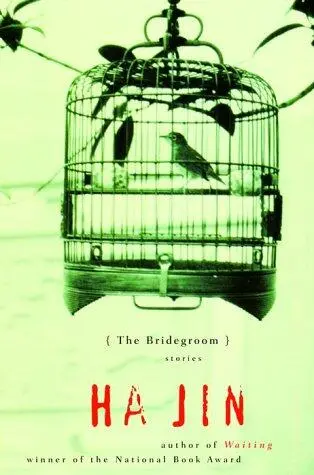
- Название:The Bridegroom: Stories
- Автор:
- Издательство:Pantheon
- Жанр:
- Год:2001
- ISBN:нет данных
- Рейтинг книги:5 / 5. Голосов: 1
-
Избранное:Добавить в избранное
- Отзывы:
-
Ваша оценка:
The Bridegroom: Stories: краткое содержание, описание и аннотация
Предлагаем к чтению аннотацию, описание, краткое содержание или предисловие (зависит от того, что написал сам автор книги «The Bridegroom: Stories»). Если вы не нашли необходимую информацию о книге — напишите в комментариях, мы постараемся отыскать её.
, a collection of comical and deeply moving tales of contemporary China that are as warm and human as they are surprising, disturbing, and delightful.
In the title story, the head of security at a factory is shocked, first when the hansomest worker on the floor proposes marriage to his homely adopted daughter, and again when his new son-in-law is arrested for the "crime" of homosexuality. In "After Cowboy Chicken Came to Town," the workers at an American-style fast food franchise receive a hilarious crash course in marketing, deep frying, and that frustrating capitalist dictum, "the customer is always right."Ha Jin has triumphed again with his unforgettable storytelling in
.
The Bridegroom: Stories — читать онлайн бесплатно полную книгу (весь текст) целиком
Ниже представлен текст книги, разбитый по страницам. Система сохранения места последней прочитанной страницы, позволяет с удобством читать онлайн бесплатно книгу «The Bridegroom: Stories», без необходимости каждый раз заново искать на чём Вы остановились. Поставьте закладку, и сможете в любой момент перейти на страницу, на которой закончили чтение.
Интервал:
Закладка:
“Why are you so sure?” asked our boss.
“I have this.” With two fingers Peter pulled the crook’s receipt out of his breast pocket.
We all laughed. Actually, even with the receipt in hand, that old bastard wouldn’t have dared come again. He wasn’t afraid of Jinglin exactly but feared his four brothers, who were all stevedores on the riverbank, good at fighting and never hesitant to use a club or a dagger or a crowbar. That was why Jinglin, unlike the rest of us, could get rid of him without fear of retaliation.
Later we revealed to Peter what we had done in the alley. He smiled and promised he would not breathe a word to Mr. Shapiro.
As our business became stable, Peter grew into a local power of sorts. For months he had been building a house in the countryside. We wondered why he wanted his home to be four miles away from town. It would be costly to ride a motorcycle back and forth every day. One Sunday morning, Baisha, Feilan, Manyou, Jinglin, and I set out to see Peter’s new home. We pedaled abreast on the wide embankment along the Songhua River, humming movie songs and cracking jokes. Birds were crying furiously in the willow copses below the embankment, while on a distant jetty a team of men sang a work song as they unloaded timber from a barge. Their voices were faltering but explosive. It hadn’t rained for weeks, so the river was rather narrow, displaying a broad whitish beach. A few boys fishing there lay on their backs; around them stood some short bamboo poles planted deep into the sand. When a fish bit, a brass bell on one of the poles would jingle. On the other shore, toward the horizon, four or five windmills were turning, full like sails; above them the gray clouds floated lazily by, like a school of turtles.
We knew Peter had a few American dollars in the bank, but we were unsure how rich he really was. His house, though unfinished, staggered us. It was a three-story building with a garage in its back; it sat in the middle of two acres of sloping land, facing a gentle bend in the river and commanding a panorama that included two islands and the vast landscape on the other shore.
Peter wasn’t around. Six or seven workers were busy, rhythmically hammering something inside the house. We asked an older man, who looked like a supervisor, how much the house would cost.
“At least a quarter of a million yuan,” he said.
“So expensive?” Manyou gasped, his large lashless eyes blazing.
“You know what? It could be even more than that. We’ve never seen a home like this before.”
“What kind of house is this?” asked Feilan.
“It’s called Victorian. Mr. and Mrs. Jiao designed it themselves. It has two marble fireplaces, both imported from Hong Kong.”
“Damn! Where did he get so much money?” Baisha said and kicked a beer bottle with her white leather sandal.
We were all pondering the same question, and it weighed down our hearts like a millstone. But we didn’t stay long, fearing Peter might turn up. On the way back we spoke little to one another, unable to take our minds off Peter’s house. Obviously he made much more than we did, or he wouldn’t have had the money for such a mansion, which was larger even than the mayor’s. Before setting out, we had planned to have brunch together at a beer house, but now none of us had an appetite anymore. We parted company the moment we turned away from the quay.
After that trip, I noticed that my fellow workers often looked suspiciously at Peter, as though he were a hybrid creature. Their eyes showed envy and anger. They began learning English more diligently. Manyou attended the night college, working with a textbook called English for Today, while Baisha and Feilan got up early in the morning to listen to the study program on the radio and memorize English words and expressions. Jinglin wanted to learn genuine American English, which he said was more natural, so he was studying English 900. I was also learning English, but I was older than the others and didn’t have a strong memory, so I made little progress.
At work, they appeared friendlier to Mr. Shapiro and often poured coffee for him. Once Baisha even let him try some scallion pancake from her own lunch.
One morning, when we were not busy, I overheard Baisha talking with Mr. Shapiro in English. “Have you a house in U.S.A.?” she asked.
“Yes, I have a brick ranch, not very big.” He had a cold, his voice was nasal and thick.
“How many childs in house?”
“You mean children?”
“Yes.”
“I have two, and my wife has three.”
“Ah, you have five jildren?”
“You can say that.”
Mr. Shapiro turned away to fill out a form with a ballpoint pen, while Baisha’s narrow eyes squinted at his heavy cheek and then at the black hair on his wrist. She was such a flirt, but I was impressed. She was brave enough to converse with our boss in English! — whereas I could never open my mouth in front of him.
Because we had seen Peter’s mansion, our eyes were all focused on him. We were eager to find fault with him and ready to start a quarrel. But he was a careful man, knowing how to cope with us and how to maintain our boss’s trust. He avoided arguing with us. If we didn’t listen to him, he’d go into Mr. Shapiro’s office and stay in there for a good while. That unnerved us, because we couldn’t tell if he was reporting us to the boss. So we dared not be too disobedient. Every night Peter was the last to leave. He’d close the shutters, lock the cash register, wrap up the unsold chicken, tie the package to the back of his Honda motorcycle, and ride away.
Ever since the beginning, the daily leftovers had been a bone of contention between Mr. Shapiro and us. We had asked him many times to let us have the unsold chicken at the end of the day, but he refused, saying the company’s policy forbade its employees to have leftovers. We even offered to buy them at half price, but he still wouldn’t let us. He assigned Peter alone to take care of the leftovers.
It occurred to us that Peter must have been taking the leftovers home for the construction workers. He had to feed them well, or else they might jerry-build his mansion. Damn him, he not only earned more but also got all the perks. The more we thought about this, the more resentful we became. So one night, after he closed up the place and rode away, we came out of the nearby alley and pedaled behind him. Manyou was at the night college, and Jinglin had to look after his younger brother in the hospital who had just been operated on for a hernia, so they couldn’t join us. Only Feilan, Baisha, and I followed Peter. He was going much faster than we were, but we knew where he was headed, so we bicycled without hurry, chatting and laughing now and then.
In the distance Peter’s motorcycle was flitting along the embankment like a will-o’-the-wisp. The night was cool, and a few men were chanting folk songs from their boat anchored in the river. We were eager to prove Peter had shipped the leftovers home, so that we could report him to Mr. Shapiro the next morning.
For a long while the light of Peter’s motorcycle disappeared. We stopped, at a loss. Apparently he had turned off the embankment, but where had he gone? Should we continue to ride toward his home, or should we mark time?
As we were discussing what to do, a burst of flames emerged in the north, about two hundred yards away, at the waterside. We went down the embankment, locked our bicycles in a willow copse, and walked stealthily toward the fire.
When we approached it, we saw Peter stirring something in the fire with a trimmed branch. It was a pile of chicken, about twenty pieces. The air smelled of gasoline and burned meat. Beyond him, the waves were lapping the sand softly. The water was sprinkled with stars, rippling with the fishy breeze. On the other shore everything was buried in darkness except for three or four clusters of lights, almost indistinguishable from the stars in the cloudless sky. Speechlessly we watched. If there had been another man with us, we might have sprung out and beaten Peter up. But I was no fighter, so we couldn’t do anything, merely crouch in the tall grass and curse him under our breath.
Читать дальшеИнтервал:
Закладка:
Похожие книги на «The Bridegroom: Stories»
Представляем Вашему вниманию похожие книги на «The Bridegroom: Stories» списком для выбора. Мы отобрали схожую по названию и смыслу литературу в надежде предоставить читателям больше вариантов отыскать новые, интересные, ещё непрочитанные произведения.











Обсуждение, отзывы о книге «The Bridegroom: Stories» и просто собственные мнения читателей. Оставьте ваши комментарии, напишите, что Вы думаете о произведении, его смысле или главных героях. Укажите что конкретно понравилось, а что нет, и почему Вы так считаете.