Ha Jin - The Bridegroom - Stories
Здесь есть возможность читать онлайн «Ha Jin - The Bridegroom - Stories» весь текст электронной книги совершенно бесплатно (целиком полную версию без сокращений). В некоторых случаях можно слушать аудио, скачать через торрент в формате fb2 и присутствует краткое содержание. Год выпуска: 2001, Издательство: Pantheon, Жанр: Современная проза, на английском языке. Описание произведения, (предисловие) а так же отзывы посетителей доступны на портале библиотеки ЛибКат.
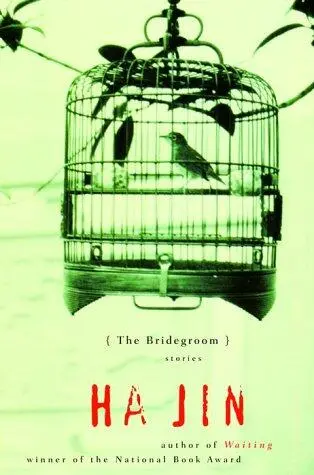
- Название:The Bridegroom: Stories
- Автор:
- Издательство:Pantheon
- Жанр:
- Год:2001
- ISBN:нет данных
- Рейтинг книги:5 / 5. Голосов: 1
-
Избранное:Добавить в избранное
- Отзывы:
-
Ваша оценка:
The Bridegroom: Stories: краткое содержание, описание и аннотация
Предлагаем к чтению аннотацию, описание, краткое содержание или предисловие (зависит от того, что написал сам автор книги «The Bridegroom: Stories»). Если вы не нашли необходимую информацию о книге — напишите в комментариях, мы постараемся отыскать её.
, a collection of comical and deeply moving tales of contemporary China that are as warm and human as they are surprising, disturbing, and delightful.
In the title story, the head of security at a factory is shocked, first when the hansomest worker on the floor proposes marriage to his homely adopted daughter, and again when his new son-in-law is arrested for the "crime" of homosexuality. In "After Cowboy Chicken Came to Town," the workers at an American-style fast food franchise receive a hilarious crash course in marketing, deep frying, and that frustrating capitalist dictum, "the customer is always right."Ha Jin has triumphed again with his unforgettable storytelling in
.
The Bridegroom: Stories — читать онлайн бесплатно полную книгу (весь текст) целиком
Ниже представлен текст книги, разбитый по страницам. Система сохранения места последней прочитанной страницы, позволяет с удобством читать онлайн бесплатно книгу «The Bridegroom: Stories», без необходимости каждый раз заново искать на чём Вы остановились. Поставьте закладку, и сможете в любой момент перейти на страницу, на которой закончили чтение.
Интервал:
Закладка:
“Mmm. . probably the writer,” said the tall man.
“Correct. All the evidence shows you two coauthored the slander, so you have to answer for all the consequences.”
“Does this mean you won’t let us go home?” asked the short man.
“Correct.”
“How long are you going to jail us?”
“It depends — a month, maybe life.”
“What?” the tall peasant shouted. “I haven’t thatched my house for the winter yet. My kids will freeze to death if you keep me in—”
“You still don’t get it!” Chairman Lou bellowed and slapped the tabletop with his fleshy hand. “You both should feel lucky that you’re still alive. How many people were executed because they spread counterrevolutionary rumors? Keep your butts in prison here, and remold yourselves into new men. I’ll have your families informed of where to send your underwear, if you have any.”
In amazement, all eyes turned to look at the little man standing on an upholstered chair. Unshod, his large feet were in violet woolen socks.
The chief ordered the guards, “Send them to the City Prison and put them among the political criminals.” He took off his glasses, smirking and wiping the lenses on the sleeve of his shirt. True, he couldn’t pass a definite sentence on the jokers, because the length of their imprisonment would depend on how long the Provincial Administration was interested in this case.
“Chairman Lou, have mercy, please,” begged the tall man.
Lou said, “It serves you right. See if you dare to be so creative again.”
“I do it to your little ancestors, Dwarf Lou!” the short peasant yelled, stamping his feet. Four policemen walked up, grabbed the prisoners, and hauled them away.
An Official Reply
Professor Pan Chendong, Party Secretary
English Department
Beijing Humanities University
Dear Professor Pan:
Please allow me to express my deep admiration for your paper on Theodore Dreiser’s novels, which you presented at the Shanghai conference three years ago. My name is Zhao Ningshen, and I have chaired the Foreign Language Department at Muji Teachers College for two years. You may still remember me: a man in his mid-thirties, bespectacled, of slender build and medium height, with slightly hirsute arms and a head of luxuriant hair. After your talk at Splendor Hotel, we conversed for a few minutes in its lobby, and you gave me your card. Later I wrote you a letter and mailed you under separate cover a paper of mine on Saul Bellow’s Adventures of Augie March. I assume you received them.
In response to your inquiry about Professor Fang Baichen of my department, I shall refrain from dwelling too much on his character, because he was once my teacher and I can hardly be impartial. Although you may have heard anecdotes and depictions of him — he is a fool, a megalomaniac, an incorrigible lecher, a braggart, a charlatan, an opportunist, and so forth — none of those terms can adequately describe this unusual man. In the following pages, let me provide you with some facts, from which you may draw your own conclusion.
I came to Muji Teachers College as a freshman in the winter of 1977 and met Mr. Fang on the very day of my arrival. At that time he was a lecturer, in charge of the instruction of the freshmen. I had been disappointed by being made to major in English, for I was not interested in any foreign tongue. I had applied for philosophy and Chinese literature in hopes of becoming a scholar of classics. To this day I am still unclear how the hand of fate steered me into the field of English studies. Probably because I was among the few applicants bold enough to tackle the English examination — I mean the written part — some people on the Provincial College Admission Committee had decided to make me specialize in this language. In my heart I resented their decision, though there was no way to express my indignation. On our first evening on campus, all the freshmen were given a listening comprehension test in a lecture hall. Mr. Fang dictated the test.
He read slowly in a vibrant voice: “In the old days, my grandfather was a farmhand hired by a cruel landlord. Day and night he worked like a beast of burden, but still his family did not have enough food and clothes. . ”
I was impressed by his clear pronunciation, never having met anyone who read English better than this dapper man. But I felt miserable because I couldn’t write down a complete sentence and had to turn in my test sheet almost blank. More disappointing was that the result of this test determined our placements in the classes, which were immediately divided into four levels. The freshmen of our year were the first group to take the entrance examinations after the Cultural Revolution. During the previous ten years, colleges had partly or mostly shut down and young talents had accumulated in society, so the student pool now was replete with all kinds of creatures. In our English program, three or four freshmen could read Jane Eyre, The Gadfly, and A Tale of Two Cities in the original, and they even scored higher than the graduating seniors in a test. On the other hand, many freshmen, like myself, knew only a couple of English words and had been assigned to study the language mainly on the strength of our high scores in the other subjects. A few boys and girls from Inner Mongolia, who had excelled in mathematics and physics, didn’t even know a single English word; nonetheless, they had been sent here too, to learn the language because their region needed English teachers.
Naturally I was placed in the lowest class. I was so upset that I began to play truant. Mr. Fang’s class was from 7:30 to 9:30 in the morning, so I often skipped it. He was a good teacher, amiable and conscientious, and I bore him no grudge. In truth, I liked his way of running the class — he tried to make every one of us speak loudly, however shy or slow of comprehension we were. He loved the word “apple” because its vowel could force our mouths open. He would drop his roundish jaw and bare his even teeth, saying, “Open your mouth for a big apple.” That was his way of building our confidence as English speakers. Later I came to learn that he had been labeled a rightist and banished to the countryside for three years in the late fifties. I also could tell that his English pronunciation was not as impeccable as I had thought. The tip of his tongue often missed the edge of his teeth when he pronounced the interdental th, which Chinese does not have. Once in a while he would say “dick” for “thick” or “tree” for “three.” In addition, he spoke English with a stiff accent, perhaps because he had studied Russian originally. In the early sixties, when the relationship between China and Russia was deteriorating, Mr. Fang, like thousands of college teachers who responded to the Party’s call, had changed his field from Russian to English. (I always wonder who among our national leaders at the time had the foresight to discern the drift of history. How could he, or they, foresee that within twenty years English would replace Russian as the most powerful linguistic instrument for our country?)
One evening I was lying in bed with a pair of earphones on my head, listening to an opera. Someone knocked at the door, but I did not bother to answer. To my surprise, the door opened and Mr. Fang’s face emerged. He was panting slightly, with his sheepskin hat under his arm; his left hand held a pale-blue tape recorder that weighed at least thirty pounds (at that time a cassette player was as rare as a unicorn here). On his steaming forehead a large snowflake was still melting, right beside a giant mole. His neck was muffled with a gray woolen scarf, which made him appear shorter than he was. I got up from my bed.
Читать дальшеИнтервал:
Закладка:
Похожие книги на «The Bridegroom: Stories»
Представляем Вашему вниманию похожие книги на «The Bridegroom: Stories» списком для выбора. Мы отобрали схожую по названию и смыслу литературу в надежде предоставить читателям больше вариантов отыскать новые, интересные, ещё непрочитанные произведения.






Обсуждение, отзывы о книге «The Bridegroom: Stories» и просто собственные мнения читателей. Оставьте ваши комментарии, напишите, что Вы думаете о произведении, его смысле или главных героях. Укажите что конкретно понравилось, а что нет, и почему Вы так считаете.