Padgett Powell - Typical - Stories
Здесь есть возможность читать онлайн «Padgett Powell - Typical - Stories» весь текст электронной книги совершенно бесплатно (целиком полную версию без сокращений). В некоторых случаях можно слушать аудио, скачать через торрент в формате fb2 и присутствует краткое содержание. Год выпуска: 2013, ISBN: 2013, Издательство: Open Road Media, Жанр: Современная проза, на английском языке. Описание произведения, (предисловие) а так же отзывы посетителей доступны на портале библиотеки ЛибКат.
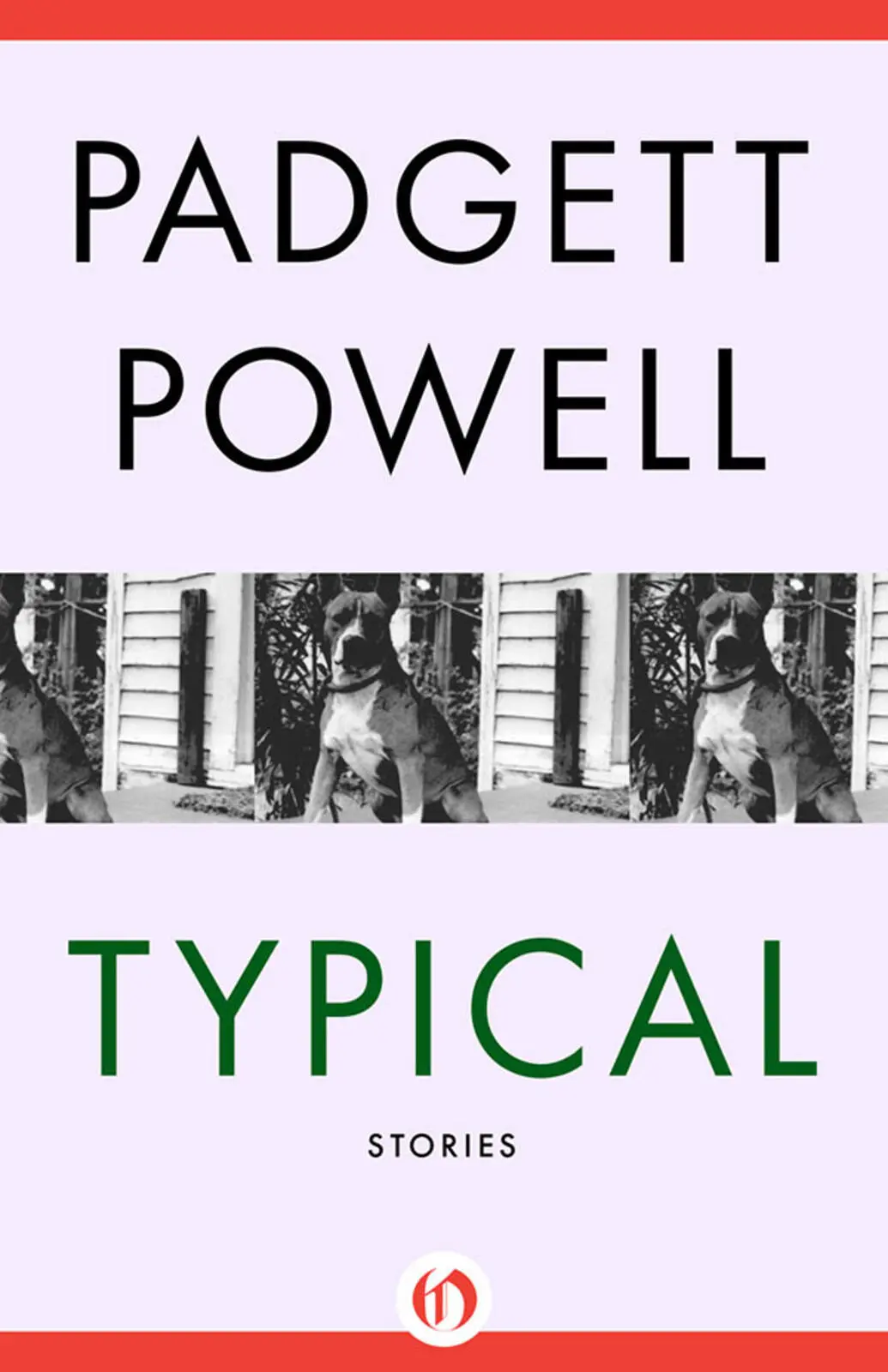
- Название:Typical: Stories
- Автор:
- Издательство:Open Road Media
- Жанр:
- Год:2013
- ISBN:978-1-4804-4158-3
- Рейтинг книги:3 / 5. Голосов: 1
-
Избранное:Добавить в избранное
- Отзывы:
-
Ваша оценка:
Typical: Stories: краткое содержание, описание и аннотация
Предлагаем к чтению аннотацию, описание, краткое содержание или предисловие (зависит от того, что написал сам автор книги «Typical: Stories»). Если вы не нашли необходимую информацию о книге — напишите в комментариях, мы постараемся отыскать её.
Typical: Stories — читать онлайн бесплатно полную книгу (весь текст) целиком
Ниже представлен текст книги, разбитый по страницам. Система сохранения места последней прочитанной страницы, позволяет с удобством читать онлайн бесплатно книгу «Typical: Stories», без необходимости каждый раз заново искать на чём Вы остановились. Поставьте закладку, и сможете в любой момент перейти на страницу, на которой закончили чтение.
Интервал:
Закладка:
Mr. Desultory
MR. DESULTORY CANNOT, FOR the life of him, or of anyone else, or of any thing, do this after that, or that after this, if either sequence might logically look sequential from a distance of, say, 2 cm or more. Mr. Desultory, as a somewhat colorful British roofer he once knew put it, referring not to Mr. Desultory but to the roofing concern in whose employ they at the moment were, Mr. Desultory an ordinary interloper and the colorful Brit somewhat more wayward in that he had accepted a proposal of marriage from an unnubile American woman to stay his imminent deportation only to find himself praying for deportation immediately after the honeymoon and thereafter referring to his immigration bride as the Dragon — anyway the colorful British roofer subject to a harridaning beyond the wildest torments of immigration authorities or coal mining or whatever he had to do back home, it must have been something unpleasant for the Dragon Knot, as the wedding was called, to have been tied in the first place, though even Mr. Desultory can remember the colorful British roofer’s having said she, the Dragon, was “sweet,” he used that word, and straight, without a glint of irony or sarcasm in his glinty little eyes, all colorful British roofers have glinty little eyes to match their glinty little Cockney mouths, where are we? The Cockney married to the sweet, fat (he said she was huge, a matter that all the boys on the roof found impossible to verify, though try they did — running to the edge of the roof when the Dragon came to retrieve her husband, and looking down from their roof at the roof of the tiny car from which she never stepped and speculating just how large she might be to be in so small a car, what is that a Comet or what? She can’t be that big, and look at old Bob stepping right on in, he step in there without a shoehorn, don’t he? Don’t see him squoze out the window either — look, he smilin! ) American girl, the Cockney married to the American girl told her that the company for whom he and Mr. Desultory and those who speculated upon her size worked could not have organized a piss-up in a brewery or a shaggin session in a brothel, and it is arguable that both colorful expressions, which had to be translated somewhat to American idiom, both expressions could be said to apply, and to have applied, though not so much then as now, for he is worse now, to Mr. Desultory himself.
Mr. Desultory cannot rub two quarters — not quarters, ideas, he can’t get two … things, he can’t do two related, sequential, yes it is in sequencing that … this goes before that, so he’ll get that squared away and then go to do this, but it is already backwards, he must do this then that, so forget that, let’s do this now, but this could arguably precede this which is already that because here’s this new this here — two quarters refers to wealth, or lack of it, a tired little phrase that must have come from the Depression, a time which sometimes Mr. Desultory feels sounds like his kind of time. He could have handled the Great Depression, you either jumped out of a skyscraper window, no sequencing problem there: one open her up, two review at the last minute your collapsed financial state, weep and moil your hands shedding tears, ink running on your last financial statement — maybe not ink but pencil, would a last financial statement, even one coming to zeros zeros zeros, be in ink or pencil?
Is it ink or pencil? In the Depression did your accountant hold behind his back your last big ledger sheet and smile because maybe he did not like you and then whip out the pale-green Boorum & Pease ten-column double-entry ledger sheet and — did they have … was Boorum & Pease extant in the thirties? Or in ’29, rather? You’d think, wouldn’t you, that of all businesses to go out with the lights it would have been first and foremost, very head of the line, some outfit making accounting products, zero dollars after all does not require extensive books, so if Boorum & Pease existed before the Crash it had to have Crashed, it was therefore born from the embers, later, its gentle green products sprouting humbly up along with other, new, and miraculous shoots of recovery, the accountant could not whip out Boorum & Pease paper and you couldn’t wonder then or now if it was pen or pencil that sent you flying out the window, the good old double-hung sash window with two fine slugs, or pendula, what’s the right word, those long, hangy-down doobers on the rope inside the walls, iron, like billy sticks, hard to find now, very hard to find, hard to know what to do with them if you do find one, tell other people who are looking for them for whatever reason they’re looking for them that you’ve found one, or ten, maybe ten is enough to get them to buy them from you, then they go get some old windows, wind up fixing up a house of about Depression vintage — can you jump out of the window fifty years before the damned pig-iron thingamajigs are to be used restoring perhaps the same window? Can you jump? Is it an inked or penciled zero, whether on Boorum & Pease or not (let’s forget that absurd debate!), is it a zero … or maybe a negative … yes, why on earth would a zero inspire anyone to jump out of a window? Zeros never hurt anyone, it’s negative numbers make people kill themselves, zeros are perfectly harmless, often salubrious, just sometimes unsettling to the capitalist mind with its impractical insistence on constant growth, a more absurd proposition than the Boorum & Pease wrangle by a factor of … of a lot, so is it an inked negative million dollars which will keep your kids from attending college, which wasn’t so important in 1930 anyway, they could just go to your alma mater, the School of Hard Knocks, but a negative million dollars would keep your wife out of the beauty parlor and good-looking probably low-cut post-flapper dresses, and you out of walnut-wainscoted boardrooms for the rest of your bathtub-gin life, or is it a penciled negative million dollars that could be erased and changed either before you jump out the window or, if you take yourself by the scrotum and leap, after you jump out the window—
— Mr. Desultory can’t jump out the window in his beloved simple time, no binary easy time that, a debit-credit St. Vitus dance before a skyscraper window; the Depression’s not for him, maybe something earlier, wax seals come to mind, quill pens and ink, no, not more ink, trouble there, before writing would be safer, rocks, fires, elephants, and not elephants that evoke global economic ecologic politics ivory wars Greenpeace ozone acid rain what to do what to do what to do, no, elephants and plenty of them, maybe more than you want to see, but let’s leave that alone, impossible idea surplus herd in ancient times, elephants, plenty of them, yes: elephants with hair on them, don’t even have to call them elephants if they have hair on them, or enough hair, all elephants have hair, bristles coming out of their deep rubber flesh like wire —how much hair was the cutting-off point, made you a mastodon, cut the girls as it were from the boys, sheep from goats, dainty modern pachyderm from the woolly mammoth?
Mr. Desultory must continue to regress, it won’t work, he can go all the way to the Big Bang and still not manage two consecutive or consequential — no, just sequential, two … okay: Big Bang, BANG! Is Mr. Desultory in it or not in it? Does he go that way into the black hole, whatever that is and if one may enter it, or this way into the light of day, elephants with or without hair, Boorum & Pease in ink or pencil, windows to be jumped out of or to be restored — here, perhaps, his error, or not his, somebody’s, Fate’s or Accident’s: if he had gone that way, through the black hole at the beginning of time, at the moment before which there was no decision but after which there was no deciding, he would not be in the difficulties he is in today. There would be no problem. It, the Bang, was a larger, simpler, if in a sense higher window than the later double-hung one in the Depression, and he wishes he had jumped, or been sucked, through it.
Читать дальшеИнтервал:
Закладка:
Похожие книги на «Typical: Stories»
Представляем Вашему вниманию похожие книги на «Typical: Stories» списком для выбора. Мы отобрали схожую по названию и смыслу литературу в надежде предоставить читателям больше вариантов отыскать новые, интересные, ещё непрочитанные произведения.

Обсуждение, отзывы о книге «Typical: Stories» и просто собственные мнения читателей. Оставьте ваши комментарии, напишите, что Вы думаете о произведении, его смысле или главных героях. Укажите что конкретно понравилось, а что нет, и почему Вы так считаете.