Karen Russell - Swamplandia!
Здесь есть возможность читать онлайн «Karen Russell - Swamplandia!» весь текст электронной книги совершенно бесплатно (целиком полную версию без сокращений). В некоторых случаях можно слушать аудио, скачать через торрент в формате fb2 и присутствует краткое содержание. Год выпуска: 2011, Издательство: Knopf, Жанр: Современная проза, на английском языке. Описание произведения, (предисловие) а так же отзывы посетителей доступны на портале библиотеки ЛибКат.
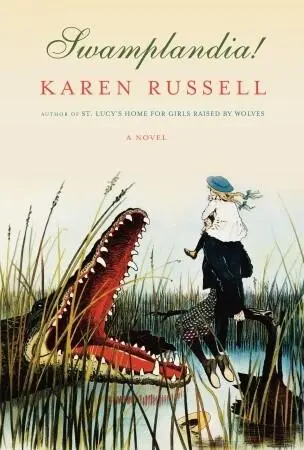
- Название:Swamplandia!
- Автор:
- Издательство:Knopf
- Жанр:
- Год:2011
- ISBN:нет данных
- Рейтинг книги:4 / 5. Голосов: 1
-
Избранное:Добавить в избранное
- Отзывы:
-
Ваша оценка:
Swamplandia!: краткое содержание, описание и аннотация
Предлагаем к чтению аннотацию, описание, краткое содержание или предисловие (зависит от того, что написал сам автор книги «Swamplandia!»). Если вы не нашли необходимую информацию о книге — напишите в комментариях, мы постараемся отыскать её.
Ava, a resourceful but terrified twelve year old, must manage seventy gators and the vast, inscrutable landscape of her own grief. Her mother, Swamplandia!’s legendary headliner, has just died; her sister is having an affair with a ghost called the Dredgeman; her brother has secretly defected to the World of Darkness in a last-ditch effort to keep their sinking family afloat; and her father, Chief Bigtree, is AWOL. To save her family, Ava must journey on her own to a perilous part of the swamp called the Underworld, a harrowing odyssey from which she emerges a true heroine.
Swamplandia! — читать онлайн бесплатно полную книгу (весь текст) целиком
Ниже представлен текст книги, разбитый по страницам. Система сохранения места последней прочитанной страницы, позволяет с удобством читать онлайн бесплатно книгу «Swamplandia!», без необходимости каждый раз заново искать на чём Вы остановились. Поставьте закладку, и сможете в любой момент перейти на страницу, на которой закончили чтение.
Интервал:
Закладка:
If you really were gay, Kiwi thought for maybe the thousandth time since he’d arrived at Loomis County, how could you possibly live here in Loomis County? If you were a bookworm, a Mormon, an albino, a virgin; if you were a “reffy” ([n] Loomis slang for a recent immigrant, derivative of “refugee” and used in Loomis night schools as a shorthand for kids with bad clothes, dental afflictions, accents as pure as grain alcohol); if you had any kind of unusual hairstyle, evangelical religion, a gene for altruism or obesity; if you wrestled monsters on an island, like Ava, or conjugated Latin, like he did, or dated the motherfucking dead , how could you survive to age eighteen in an LCPS high school?
Ava and Ossie: how would his sisters survive a trip to a high school bathroom, even?
Just that morning Kiwi had found a fanciful lilac Post-it stuck above the faucets of the dormitory john: TO THE ASSHOLE WHO KEEPS BLEEDING IN THE SINK …
“You need to have something in your stomach, bro,” said Vijay, with the weird brotherly solicitousness that cropped up between them sometimes when nobody else was around. If other dudes were present they stayed gruff and neutral; when girls were in the backseat Vijay treated Kiwi like his mentally challenged ten-year-old cousin, giving him slow, emphatic instructions (Put the tape in the tape deck , bro … Thank you! ), which Kiwi pretended to hate but somehow didn’t exactly mind. We are brothers , he’d think sometimes in the middle of a volley of “bro”s, pleased that he knew enough about the mainlanders’ culture by now to keep this happiness a secret.
“I can’t eat,” Kiwi said, staring at his thin hands. “I’m going to vomit. What if you do everything right but you vomit your Burger Burger special in the cockpit, do you still pass the test?”
“You’ll be fucking fantastic, Bigtree,” Vijay said, lying badly and kindly.
“Look, if I go down in flames, turn in my homework for me, okay?”
“Okay.” Vijay chewed. “That would suck, though. Who do I give it to?”
“It’s under my bed. My night school instructor won’t accept late assignments. Miss Voila Arenas — she’s kind of a hard-ass. But I bet she will accept it if it’s posthumous. Be careful with the toll plaza. I spent, like, sixteen hours on it.”
Kiwi had created a scale model of the Golden Gate Bridge out of dry fettuccine. This was a supplement to the actual assignment. The actual assignment had been to describe the Golden Gate Bridge in three paragraphs.
“Good luck up there, Margarita!” Vijay said an hour later when he dropped Kiwi off at the airfield. “Remember you don’t got insurance and I’m not going to be the one to spoon-feed you baby food and change your diapers when you shit so don’t crash .”
“Yeah.” Kiwi grinned lamely. “See you.”
He would do this, he would get this done. To get a pilot’s salary you had to fly a plane. There was no way out but up.
In a Cessna you were soaring, sailing above everything, and a new sense entered the world. All the irregularities retreated into surfaces. Dennis was letting Kiwi do everything this time.
“Okay. Carb heat off, area clear, water rudders up, stick aft.
“Going good. Full power now, watch your nose come up, ease off the back pressure, now you’re going to want to accelerate to taxi speed … good … you ready?”
Kiwi eased the stick forward until it hit 70 and let the plane climb. At 1,000 MSL they hit the cloud bottom. The wind was light and from the north. The sky today was a sea of blues and they flew through cloud wall after cloud wall, bulleting right through the white banks. Tints shifted; the world slid away from them at an angle. The sun made the wings flash tin and gold. Kiwi watched the swell of Coral City, a place he’d never visited. West of Loomis, way out. Rooftops out there made a uniform field of squares as the plane soared higher — brown and mustard and flecks of green quilted the suburbs, while the downtown was mostly eel-flashes of steel and cement white; in the drab center of the city, Kiwi recognized the striking tangerine rooftop of a famous luxury hotel, the Coral Castillo — and everywhere glass flashed, cars moved up the freeway like sluggish blood cells.
His nausea was gone, he realized. His stomach had settled itself somehow, miles above the ground. And then it was happening — Kiwi stared at his two hands moving over the control panel. He was flying .
Tailwinds, minor turbulence. The plane sheared gently to the left and clouds veiled the sun; when they emerged the city had vanished. Now they were flying over the saw-grass prairie.
Kiwi was shocked to see how beautiful his home was. This beauty was a secret that the trees had been keeping — the islands looked so different from this altitude. Shining green, shining blue. The sun webbed the mangrove jungle in inky red. Where was Swamplandia!? Kiwi wondered. Distance turned all the tree islands into identical green teardrop shapes — at this altitude you could see how the current’s hand had shaped them. You could also see the melaleuca stands, which looked like mildew on bread, gray trees grouped so thickly there was not a breath between them.
They were flying very low — five hundred feet, “dragging the river,” Denny called it, to check for sunken logs or boats or other obstructions “that could cause us to swim on a landing, son.” Now Kiwi could see the network of Army Corps dams and dikes and levees, which cut up the natural flow of the floodplains from Lake Okeechobee. They looked like Tinkertoys, a small and ambitious child’s game — it amazed Kiwi to see the way the river scissored off course or dropped out of sight because of these dikes. He saw hunters’ cabins on the banks of remote islands. Kiwi couldn’t see any actual alligators, but he sighted dozens of their hairy nests along the bayheads. Now they sheared right and Kiwi saw two Calusa shell middens rising out of the river.
“Look at that.” Kiwi touched his forehead to the glass. “What is that thing?”
A woman was standing on the coastline, jumping up and down. Kiwi looked closer, startled: she was waving and waving at them, in some kind of real distress. All he could really make out was the frenzy of her beating arms. Later he’d wonder if something about her movements hadn’t seemed familiar to him, even then.
Privately, Kiwi always credited what he did next to Grandpa Sawtooth. If he hadn’t won his first fight just yesterday — if he hadn’t made a fist and connected with a throat — Kiwi didn’t think that the next action he took would ever have occurred to him. But today his body was full of new ideas. Without asking Denny, he began to cut the power.
It was a nerve-jangling ride down — the Cessna came within thirty feet of the treetops, S-turning all the way down to the lake’s surface. As the turbulence worsened Kiwi grew steadily calmer. The water he planned to land on was so glassy that he couldn’t gauge its depth, but he was going to use the woman as his LVP — the last visual point, the last thing he’d seen to judge his altitude before descending. Incredibly, it seemed like Dennis Pelkis was going to let him do this; Dennis Pelkis was talking him through it: “Seventy mph approach, fifteen hundred rpm — to idle — to LVP, slow to fifty mph, then power to sixteen hundred rpm until touchdown. Power way, way back now …” Pull up, pull up, something screamed in Kiwi, wanting to recover the view from the cockpit window — trees were spearing up outside the windows, becoming individual. Slashes of color became streaked and knobbed trunks. There were fish in the lake. Kiwi could see them, individual fish. He turned left just slightly and pulled his nose up when they went gliding onto the water’s surface. He straightened out and dropped the bottom rudders. Kiwi heard spray striking the floats, and then it was over: the plane drove hard across the slough, the sun kaleidoscoping through great wheels of water. Kiwi’s breathing stopped with the engine.
Читать дальшеИнтервал:
Закладка:
Похожие книги на «Swamplandia!»
Представляем Вашему вниманию похожие книги на «Swamplandia!» списком для выбора. Мы отобрали схожую по названию и смыслу литературу в надежде предоставить читателям больше вариантов отыскать новые, интересные, ещё непрочитанные произведения.



Обсуждение, отзывы о книге «Swamplandia!» и просто собственные мнения читателей. Оставьте ваши комментарии, напишите, что Вы думаете о произведении, его смысле или главных героях. Укажите что конкретно понравилось, а что нет, и почему Вы так считаете.