Mai Jia - Decoded
Здесь есть возможность читать онлайн «Mai Jia - Decoded» весь текст электронной книги совершенно бесплатно (целиком полную версию без сокращений). В некоторых случаях можно слушать аудио, скачать через торрент в формате fb2 и присутствует краткое содержание. Год выпуска: 2014, Издательство: Allen Lane, Жанр: Современная проза, на английском языке. Описание произведения, (предисловие) а так же отзывы посетителей доступны на портале библиотеки ЛибКат.
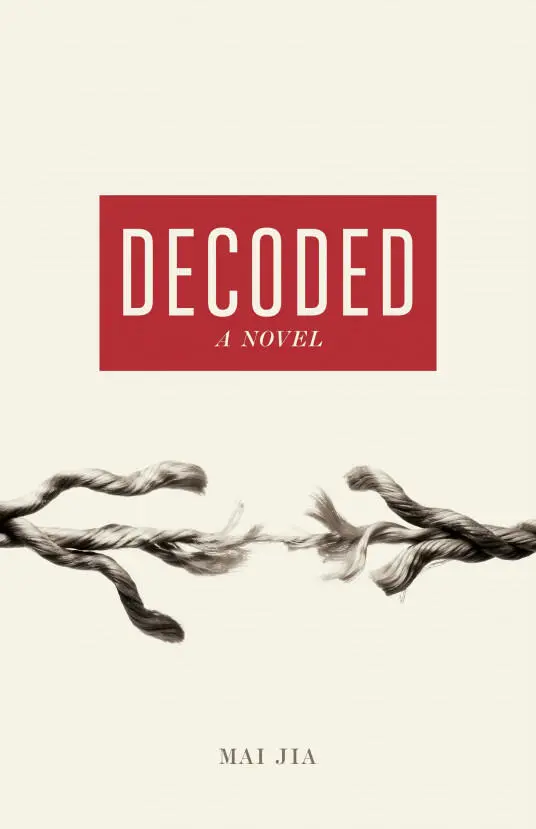
- Название:Decoded
- Автор:
- Издательство:Allen Lane
- Жанр:
- Год:2014
- ISBN:нет данных
- Рейтинг книги:3 / 5. Голосов: 1
-
Избранное:Добавить в избранное
- Отзывы:
-
Ваша оценка:
Decoded: краткое содержание, описание и аннотация
Предлагаем к чтению аннотацию, описание, краткое содержание или предисловие (зависит от того, что написал сам автор книги «Decoded»). Если вы не нашли необходимую информацию о книге — напишите в комментариях, мы постараемся отыскать её.
Decoded — читать онлайн бесплатно полную книгу (весь текст) целиком
Ниже представлен текст книги, разбитый по страницам. Система сохранения места последней прочитанной страницы, позволяет с удобством читать онлайн бесплатно книгу «Decoded», без необходимости каждый раз заново искать на чём Вы остановились. Поставьте закладку, и сможете в любой момент перейти на страницу, на которой закончили чтение.
Интервал:
Закладка:
That evening, when Jinzhen mentioned at the supper table that Professor Liseiwicz had lent him a couple of books and agreed that in the future he could borrow whatever books he wanted whenever he liked, Young Lillie suddenly felt his heart thud. He now realized that in spite of his assurance that he was ahead of the rest, in fact Liseiwicz had already left him far behind. More than anything else, it was this that made Young Lillie realize quite how important Jinzhen was in Liseiwicz’s eyes: he was irreplaceable. Liseiwicz was hoping for great things from Jinzhen, much greater than Young Lillie could even begin to imagine.
7
Of the two wierdos of the mathematics department, Master Rong’s story was very sad and people felt a great deal of respect for her. Professor Liseiwicz on the other hand seemed to be making a mountain out of a molehill, and it caused a lot of talk. Under normal circumstances, where there is a lot of talk, you end up with endless gossip. Hence, of the two wierdos, there were a lot more rumours about Professor Liseiwicz than there ever were about Master Rong. Pretty much everyone at the university had some sort of story to tell. Because everyone had heard about him refusing to lend anyone his books, they also heard about the fact that he was now lending books to one person — this is the effect you get when some little thing is done by someone famous. This is like the mathematical conversion of mass into energy. People gossiped constantly, asking why Professor Liseiwicz was so kind to Jinzhen, and only to him? It was practically as if he were letting him sleep with his wife. One explanation was that the foreign professor appreciated his student’s intelligence and hoped for great things from him — but the theory that he was doing it purely out of friendly motives was not particularly popular. Eventually those who said that Professor Liseiwicz was taking advantage of Jinzhen’s genius out-shouted the rest.Even Master Rong mentioned this in my interview with her.
[Transcript of the interview with Master Rong]
The very first winter after the end of the Second World War, Jan Liseiwicz went back to Europe. The weather was terribly cold, but I guess that it was even worse in Europe, because he didn’t take any of his family with him — he just went on his own. When he came back, Daddy borrowed a Ford car from the university and told me to go down to the docks to collect him. When I got there I was stunned to see that Professor Liseiwicz was sitting on an enormous wooden packing case, about the same size as a coffin, with his name and address at N University written on it in both Chinese and English. The size and the weight of his packing case made it impossible to get into the car. I had to get a cart and four brawny men to transport it back to the department. On the way, I asked Liseiwicz why on earth he had brought so many books back with him and he said excitedly, ‘I have a new research interest and I need these books!’
Apparently on this trip to Europe, Liseiwicz had recovered the interest in research that had been dormant in recent years: he was feeling inspired and was going to make a new start. He had determined to begin research on an enormous new topic: artificial intelligence.
Nowadays, everyone has heard of the subject, but at that time the world’s first computer had only just been built.* That was what had given him the idea — he was way ahead of most people in realizing the potentials of the field. Given the massive scope of the research project that he had in mind, the books that he brought back were just a tiny part of the whole; but it is not surprising that he was not prepared to lend them to other people.
The problem is that the blanket ban applied to everyone except Zhendi, and so people started making wild guesses about what was going on. There were all sorts of stories circulating in the mathematics department anyway about what a genius Zhendi was — how he completed four years of study in the space of two weeks, how cold sweat broke out on Professor Liseiwicz’s face at the mere sight of him; and before you knew it, some people who didn’t understand the first thing about how these things work were saying that the foreign professor was using Zhendi’s intelligence to advance his own research.
That kind of gossip breaks out all the time in academia — it makes professors look bad and people enjoy the idea that they get where they are by stealing someone else’s work — that is just the way it is.
When I heard this story, I went right round to Zhendi to ask him about it and he said it was a pack of lies. Daddy asked him about it too and he still said it was all rubbish.
Daddy said, ‘I hear that you spend every afternoon round at his house, is that right?’
‘Yes,’ said Zhendi.* The world’s first computer, ENIAC, was built in 1946.
‘What are you doing there?’ asked Daddy.
‘Sometimes I read books, sometimes we play chess,’ said Zhendi. Zhendi was very definite, but we still felt that where there is smoke, there must also be fire — we were worried that he was lying. After all, he was still only sixteen years old and knew nothing about how complicated the world can be; it was quite possible that he was being deceived. Well, I made excuses several times to go round to Liseiwicz’s house and find out what they were doing, and every time I saw that they were indeed playing chess: the standard international game. Zhendi often played go at home with my father, and he was a fine player — the two of them were pretty evenly matched. Sometimes he also played tiddlywinks with Mummy, but that was just for fun. When I saw the two of them playing chess together, I thought that Liseiwicz was just doing it to keep him company, because everyone knew that he played at grandmaster level.
In fact, something completely different was going on. According to what Zhendi told me himself, he and Liseiwicz had played all sorts of different kinds of chess together — the standard kind, go, elephant chess, battle chess and so on. Occasionally he could win at battle chess, but he never beat Liseiwicz at any of the others. Zhendi said that Liseiwicz played all these games to an amazingly high level, so the only reason that he could occasionally win at battle chess was because ultimately victory in that game is not dependent entirely upon the player’s skill; at least half the time the outcome is determined by sheer luck. If you think about it, even though tiddlywinks is a much simpler game than battle chess, it is a much better determinant of the player’s skill, because the element of luck is so much smaller. In Zhendi’s opinion, battle chess should strictly speaking not be considered a type of chess at all; at the very least, it should not be regarded as a chess game for adults.
You may well be wondering, given that Zhendi was so far from being able to give Liseiwicz a good game, why did they keep on playing together time after time?
Let me explain. As a game, all types of chess are easy to learn to play, in the sense that they do not require the player to develop any special skills: you can just learn the basic rules and get stuck in. The problem is that once you have started playing, chess calls upon completely different attributes from any game requiring physical skill, where as you practice you just get better and better; from a rank beginner you become a practiced player, then a skilled one, and finally an excellent one. The more you play chess the more complicated it gets. The reason for this is that as you improve, you learn more of the set variations and that then opens up more avenues for you to explore — it is like walking into a maze. At the entrance, there is only one way to go, but the further you penetrate, the more crossroads you encounter; the more options you are faced with. That is one reason that the game is so complex; the other is that as you might imagine, if two opponents are walking through the maze at the same time, as one proceeds he is also trying to block the other’s advance, and he is trying to do the same — advance and block, advance and block — well, that is adding another level of difficulty to an already extremely complex game. That is what chess is like: you have standard openings and endgames, attacking and defensive moves, obvious and secret manoeuvres, pieces that you move close at hand and those you send to the other side of the board, enveloping your opponent in a fog of mystery. Under normal circumstances, whoever knows the most set variations has the most room to manoeuvre, and can create the most mystery about his moves. Once his opponent has become confused and can no longer determine the direction of attack, he has created the most favourable circumstances to win the game. If you wish to play a good game of chess, you have to learn the set variations, but that is not enough. The whole point about set variations is that everybody knows about them.
Читать дальшеИнтервал:
Закладка:
Похожие книги на «Decoded»
Представляем Вашему вниманию похожие книги на «Decoded» списком для выбора. Мы отобрали схожую по названию и смыслу литературу в надежде предоставить читателям больше вариантов отыскать новые, интересные, ещё непрочитанные произведения.








Обсуждение, отзывы о книге «Decoded» и просто собственные мнения читателей. Оставьте ваши комментарии, напишите, что Вы думаете о произведении, его смысле или главных героях. Укажите что конкретно понравилось, а что нет, и почему Вы так считаете.