Richard Ford - The Sportswriter
Здесь есть возможность читать онлайн «Richard Ford - The Sportswriter» весь текст электронной книги совершенно бесплатно (целиком полную версию без сокращений). В некоторых случаях можно слушать аудио, скачать через торрент в формате fb2 и присутствует краткое содержание. Год выпуска: 1995, Издательство: Vintage Books, Жанр: Современная проза, на английском языке. Описание произведения, (предисловие) а так же отзывы посетителей доступны на портале библиотеки ЛибКат.
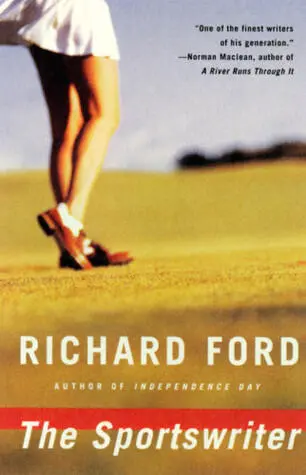
- Название:The Sportswriter
- Автор:
- Издательство:Vintage Books
- Жанр:
- Год:1995
- ISBN:нет данных
- Рейтинг книги:3 / 5. Голосов: 1
-
Избранное:Добавить в избранное
- Отзывы:
-
Ваша оценка:
The Sportswriter: краткое содержание, описание и аннотация
Предлагаем к чтению аннотацию, описание, краткое содержание или предисловие (зависит от того, что написал сам автор книги «The Sportswriter»). Если вы не нашли необходимую информацию о книге — напишите в комментариях, мы постараемся отыскать её.
The Sportswriter — читать онлайн бесплатно полную книгу (весь текст) целиком
Ниже представлен текст книги, разбитый по страницам. Система сохранения места последней прочитанной страницы, позволяет с удобством читать онлайн бесплатно книгу «The Sportswriter», без необходимости каждый раз заново искать на чём Вы остановились. Поставьте закладку, и сможете в любой момент перейти на страницу, на которой закончили чтение.
Интервал:
Закладка:
“Just a bone warmer. We can sneak right over into the Manasquan.” Across the lot was the Manasquan Bar, a barny old hip-roofed fisherman’s madhouse with a red BAR sign on top. Ben Mouzakis had invested in it with his wife’s brother, Evangelis, as he told me once when we talked about tax shelters up on deck. “What d’ya say?” Walter said and started off. “Let’s drink one, Frank.”
I did not want to have a nightcap with Walter Luckett. I wanted to go speeding back toward Vicki and drowsy Lambertville while the last flickers of sunlight clung in the western sky. The memory of those awful centuries spent in The Coffee Spot rose up in my thoughts suddenly, and I almost jumped in the car and rammed out of the lot like a desperado. But I didn’t. I stood and looked at Walter, who by now had walked halfway across the empty lot in his walking shorts and sweater, and had turned toward me and assumed a posture I can only describe as heartbreaking. And I could not say no. Walter and I had something in common — something insignificant, but something that his heartbreaking posture made undeniable. Walter and I were both men, Vicki or no Vicki, Lambertville or no Lambertville.
“Only one,” I said into the parking lot darkness. “I’ve got a date.”
“You’ll make it,” Walter said, lost now in the bleary seaside lowlights of Brielle. “I’ll see to that myself.”
In the Manasquan Walter ordered a scotch and I ordered a gin, and for a while we sat in complete uncomfortable silence and stared at the old pictures behind the bar that showed record stripers caught off the dock. I thought I could detect Ben Mouzakis in several — a chesty young roughneck of the Fifties, a big immigrant’s crazy grin, no shirt, muscles bristling, standing beside some other taller men in khakis and two hundred dead fish strung along a rafter board.
The Manasquan is a dark, pine-board, tar-smelling pile of sticks inside and in truth it is one of my favorite places for small departures. Any other time I wouldn’t have minded being there one bit. It has a long teak bar with a quasi-nautical motif, and no one makes the first attempt to be friendly, though drinks are poured honestly and at a reasonable price for a touristy seaside area. Sometimes, arriving too early for our excursion, I have walked over, taken a seat at the bar and bought a good greasy hamburger and felt right at home reading a newspaper or watching TV alongside the few watchcap fishermen who huddle and mutter at the end of the bar, and the woman or two who float around speaking brashly to strangers. It is a place where you’d be happy to consider yourself a regular, though when all is said and done you have nothing at all in common with anyone there except some speechless tenor of spirit only you know a damn thing about.
“Frank, were you ever an athlete?” Walter said forthrightly after our long and studious staring.
“Just an athletic supporter, Walter,” I said and gave him a grin to set him at his ease. He obviously had something on his mind; and the sooner he got it out, the sooner I could be blazing a trail west.
Walter smiled back at me ironically, gave his nose a disapproving pinch, pushed up at his glasses. Walter, I realized, was actually a handsome man, and it made me like him. It isn’t easy for handsome people to be themselves, or even try to be. And I had a feeling Walter was trying to be himself for the moment, and I liked him for that reason, though I wished he’d get on with it.
“You were out at Michigan, is that right,” Walter asked.
“Right.”
“That’s Ann Arbor, not East Lansing.”
“Right.”
“I know that’s different.” Walter nodded thoughtfully and sniffed again. “You couldn’t be an athlete there, I comprehend that. That’s like a factory.”
“It wasn’t that bad.”
“I was an athlete out at Grinnell. Anybody could be one. It wasn’t a big thing, although I’m sure it’s gotten bigger now. I never go back anymore.”
“I don’t go back to Ann Arbor, either. What’d you do?”
“Wrestled. One forty-five. We wrestled against Carleton and Macalester and those places. I wasn’t very good.”
“Those are good schools, though.”
“They are good schools,” Walter said. “Though you don’t hear much about them. I guess everybody wants to talk about sports, right?” Walter looked at me seriously.
“Sometimes,” I said. “But I don’t mind it. Other people know a lot more about sports than I do, to tell you the truth. It’s a pretty innocent part of people, and talking has the effect of bringing us all together on a good level.” I don’t know why I started talking to Walter in this Grantland Rice after-dinner speech way, except that he seemed to want that and it was truthfully the only thing I could think of. (It’s also true that I believe every word of it, and it’s a lot better than talking about some pretentious book that only one person’s read.)
Walter moved the ice around in his drink using his finger. “What would you say’s the worst part about your job, Frank? I hate traveling myself, and I have to do it. I bet that’s it, right?”
“I don’t mind it,” I said. “There’re things about it I’m not sure I could live without anymore. In particular, now that I’m home alone.”
“Okay, sure.” Walter drank down his scotch in one gulp and signaled for another in one continuous finger-wiggle gesture. “So it’s not the travel. Okay, that’s good.”
“I think the hardest part about my job, Walter, since you asked, is that people expect me to make things better when I come. If I come to interview them or write about them or just call them up on the phone, they want to be enriched. I’m not talking about money. It’s just part of the natural illusion of my profession. The fact is, we can sometimes not make things worse, or we can make things worse. But we can’t usually make things better for individuals. Sometimes we can for groups. But then not always.”
“Interesting.” Walter Luckett nodded as though it was anything but interesting. “What do you mean, worse?”
“I mean sometimes things can seem worse just by not being better. I don’t know if I ever thought about it before,” I said. “But I think it’s right.”
“People don’t have any right to think you can make life better for them,” Walter said soberly. “But it’s what they want, all right. I agree.”
“I don’t know about rights,” I said. “It’d be nice if we could. I think I once thought I could.”
“Not me,” Walter said. “One lousy marriage proved that.”
“It’s a disappointment. I don’t mean marriage is a disappointment. Just ending it.”
“I guess.” Walter looked down at the fishermen at the dim-lit end of the bar, where they were huddling over some playing cards with fat Evangelis. One of the men laughed out loud, then another man put the cards in his coat pocket and smirked, and the talk got quiet. I would’ve given anything for a peek at those cards and to have had a good laugh with the fishermen instead of being land-locked with Walter. “Your marriage wasn’t disappointing to you, then?” Walter said in a way I found vaguely insulting. Walter had just the tips of his slender fingers touching the glass of scotch, and then he looked at me accusingly.
“No. It was really a wonderful marriage. What I remember of it.”
“My wife’s in Bimini,” Walter said. “My ex-wife, I need to say now. She went down there with a man named Eddie Pitcock, a man I’ve never seen and know nothing about except his name, which I know from a private detective I hired. I could find out a lot more. But who cares? Eddie Pitcock’s his name. Isn’t that a name for the guy who runs away with your wife?”
Читать дальшеИнтервал:
Закладка:
Похожие книги на «The Sportswriter»
Представляем Вашему вниманию похожие книги на «The Sportswriter» списком для выбора. Мы отобрали схожую по названию и смыслу литературу в надежде предоставить читателям больше вариантов отыскать новые, интересные, ещё непрочитанные произведения.




Обсуждение, отзывы о книге «The Sportswriter» и просто собственные мнения читателей. Оставьте ваши комментарии, напишите, что Вы думаете о произведении, его смысле или главных героях. Укажите что конкретно понравилось, а что нет, и почему Вы так считаете.