Richard Ford - Let Me Be Frank With You
Здесь есть возможность читать онлайн «Richard Ford - Let Me Be Frank With You» весь текст электронной книги совершенно бесплатно (целиком полную версию без сокращений). В некоторых случаях можно слушать аудио, скачать через торрент в формате fb2 и присутствует краткое содержание. Год выпуска: 2014, Издательство: Ecco, Жанр: Современная проза, на английском языке. Описание произведения, (предисловие) а так же отзывы посетителей доступны на портале библиотеки ЛибКат.
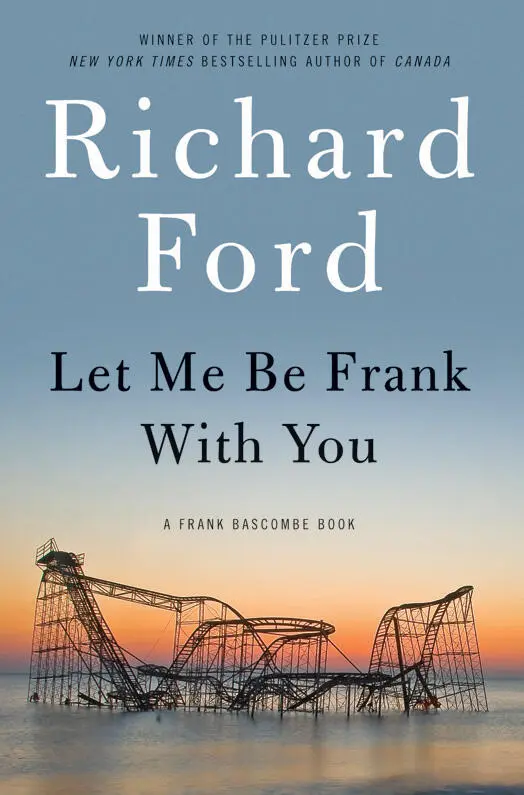
- Название:Let Me Be Frank With You
- Автор:
- Издательство:Ecco
- Жанр:
- Год:2014
- ISBN:нет данных
- Рейтинг книги:4 / 5. Голосов: 1
-
Избранное:Добавить в избранное
- Отзывы:
-
Ваша оценка:
Let Me Be Frank With You: краткое содержание, описание и аннотация
Предлагаем к чтению аннотацию, описание, краткое содержание или предисловие (зависит от того, что написал сам автор книги «Let Me Be Frank With You»). Если вы не нашли необходимую информацию о книге — напишите в комментариях, мы постараемся отыскать её.
In his trio of world-acclaimed novels portraying the life of an entire American generation, Richard Ford has imagined one of the most indelible and widely-discussed characters in modern literature, Frank Bascombe. Through Bascombe — protean, funny, profane, wise, often inappropriate — we’ve witnessed the aspirations, sorrows, longings, achievements and failings of an American life in the twilight of the twentieth century.
Now, in Let Me Be Frank with You, Ford reinvents Bascombe in the aftermath of Hurricane Sandy. In four richly luminous narratives, Bascombe (and Ford) attempts to reconcile, interpret and console a world undone by calamity. It is a moving and wondrous and extremely funny odyssey through the America we live in at this moment. Ford is here again working with the maturity and brilliance of a writer at the absolute height of his powers.
Let Me Be Frank With You — читать онлайн бесплатно полную книгу (весь текст) целиком
Ниже представлен текст книги, разбитый по страницам. Система сохранения места последней прочитанной страницы, позволяет с удобством читать онлайн бесплатно книгу «Let Me Be Frank With You», без необходимости каждый раз заново искать на чём Вы остановились. Поставьте закладку, и сможете в любой момент перейти на страницу, на которой закончили чтение.
Интервал:
Закладка:
None of us, as far as I can tell, are really designed to have that many friends. I’ve done reading on this subject, and statistics from the Coolidge Institute (unfriendly to begin with) show that we each of us devote a maximum of 40 percent of our limited time to the five most important people we know. Since time invested determines the quality of a friendship, having more than five genuine friends is pretty much impossible. I’ve, for that reason, narrowed my important-time-with-others to time with Sally, to my two children (blessedly in faraway cities), to my former wife, Ann (now in a high-priced “care facility” uncomfortably close by). Which leaves only one important slot open. And that I’ve decided to fill by calling my own number — by making me my last, best friend. The remaining 60 percent I leave available for the unexpected — although I read for the blind on the radio once every week, and each Tuesday I drive to Newark Liberty to welcome home our returning heroes — which turns out to take up a good bit of the extra.
Like most people, of course, I was never a very good friend in the first place — mostly just an occasionally adequate acquaintance, which was why I liked the Divorced Men’s Club. Selling real estate is also perfect for such people as me, as is sportswriting — two pursuits I proved pretty good at. I am, after all, the only child of older parents who doted on me — the ne plus ultra of American adult familial circumstances. I was, thus, never in possession of that many friends, being always captivated by what the adults were doing. The standard American life-mold, especially in the suburbs, is that we all have a smiling Thorny Thornberry just over our back fence, someone to go to the big game with, or to talk things over late into autumn nights at some roadside bar; a friend who helps you hand-plane the fir boards to the precise right bevel edge for that canoe you hope, next June, to slide together into Lake Naganooki and set out for some walleye fishing. Only, that hasn’t been my fate. Most of my friends over time have been decidedly casual and our contacts ephemeral. And I don’t feel I’ve lost anything because of it. In fact, like many of the things we suddenly stop to notice about ourselves, once we’re fairly far down the line we are how we are because we’ve liked it that way. It’s made us happy.
Friendship, in fact, has always seemed over-rated. Back in my military-school yearbook, if some poor cadet was ever shackled with the phrase “A stalwart friend,” it always meant he was a pariah whom nothing else could be said or done for. Ditto college. Supposedly — this was also in the Coolidge Institute study — emotional closeness has declined 15 percent per year in the last decade, due to social and economic mobility eroding “genuine connectedness”—which we probably didn’t need anyway. Many things, in truth, that pass through my life and mind and which I might be inclined to “share” with a friend, I have nothing to say about. All the information we’re constantly collecting and storing up in our brains and that we trust we’ll later have a use for… what am I or any of us supposed to do with all of it? Especially at age sixty-eight? What am I supposed to do, for instance, with the fact that armadillos cause leprosy? Or that dog bites are on the uptick? Or that there’s a rise in the religiously unaffiliated and a trend toward less community involvement? Or that tsetse flies nurse their young, just like Panda bears? It beats me. I could put it on Facebook or Twitter. But, as Eddie Medley says, everybody knows everything, and already doesn’t know what to do with it. I’m not on Facebook, of course. Though both my wives are.
Is this “economizing on others” nothing but a blunt, shoring-up defense against death’s processional onset (as half the jury might argue)? Or, as the other half would agree, is it a blunt, shoring-up acceptance of the very same thing? I’d say neither. I’d say it’s a simple, goodwilled, fair-minded streamlining of life in anticipation of the final, thrilling dips of the roller coaster. During which ride I don’t want to be any more distracted than I already am.
In any case, most of my friends are already dead or, like Eddie, soon will be. Every week, my reading in The Packet involves — first thing — a visit to the Corrections box on page two, for concise, reliable attendance on setting the record straight, once and for all. It’s satisfying to have something be correct — no matter what the subject is — even on the second try. After that, once I see if there’s anyone I know who’s croaked, I read at least one non-celebrity obituary — what in newpapers of yore used to be called the “Deaths of Others” page (no four-star generals or nonagenarian actresses or Negro League standouts). I do this, of course, to honor the deceased, but also quietly to take cognizance of how much any life can actually contain (a lot!), while acknowledging that for any of us a point comes when most of life’s been lived and there’s much less of it than there used to be, and yet what’s there is not to be missed or pissed away in a blur. It’s a true corrective to our woolly, reflexive shiverings about “the end.” Jettisoning friends (I could provide a list, but why bother, there weren’t many)… jettisoning friends, along with these small, private acts of corrective thinking, has altogether made death mean a great deal less to me than it used to; but better yet, has made life mean a great deal more.
So far I haven’t spoken about any of this to Sally, although I mean to. She would only tell me — since she now sees the world through a prism of grief — that I started feeling this way because of the hurricane and the terrible, anonymous death it exacted; and that my actions (jettisoning friends, etc.) are a version of deep grief, which she could counsel me about if I’d let her. Since October she’s been dedicating herself, over on The Shore, to elderly Jersey-ites who’ve lost everything, trying to give them something to look forward to at average age ninety-one. (What could that be?) Though lately I’ve noticed her more and more staring at me, as she did when I was combing my hair in the bathroom, and she was questioning me about Eddie. By staring, it’s almost as if she wants to ask me, “Where did you come from?” Or more to the point, “Where did I come from? And why, by the way, am I here now?” I take this to be some unknown-by-me-yet-well-documented syndrome of grief counseling, and itself another consequence of the hurricane, like the callers on WHAD are always going on about. Sally’s at present studying for her state grief-counseling “certification” and is only an “adult trainee”—though she’s proved herself skillful and is much in demand at the disaster sites. But if you’re a grief counselor and hard at the hard business of counseling the truly grieved — whereas I’m only here on the sidelines and not, in my opinion, suffering any evident grief — then the natural inclination would be to suspect that I’m either irrelevant, or that I’m suffering an even worse grief than anyone knows. Or third, that I’m a malcontent who has too much time on his hands and needs to find better ways to be useful. Determining which of those is true isn’t so easy in any life.
On another occasion, when I noticed Sally staring at me in the undisguisedly estimating way she’s lately adopted, she said — wrinkling her nose as if she smelled something bad—“Sweetheart, have you ever thought of writing a memoir? Your life’s had a pretty interesting trajectory, if you ask me.”
This is not true at all. My life’s fine, in most ways, but doesn’t have a “trajectory.” It’s only the budding mental-health professional in Sally to want to compliment and encourage me — a form of freelance counseling. Though less likably, saying this gives the spurious concept of a “trajectory” a pointless life of its own. In other words, it gives me something different to deal with instead of what I am dealing with — which, happily enough, is not that much.
Читать дальшеИнтервал:
Закладка:
Похожие книги на «Let Me Be Frank With You»
Представляем Вашему вниманию похожие книги на «Let Me Be Frank With You» списком для выбора. Мы отобрали схожую по названию и смыслу литературу в надежде предоставить читателям больше вариантов отыскать новые, интересные, ещё непрочитанные произведения.








Обсуждение, отзывы о книге «Let Me Be Frank With You» и просто собственные мнения читателей. Оставьте ваши комментарии, напишите, что Вы думаете о произведении, его смысле или главных героях. Укажите что конкретно понравилось, а что нет, и почему Вы так считаете.