Richard Ford - Women with Men
Здесь есть возможность читать онлайн «Richard Ford - Women with Men» весь текст электронной книги совершенно бесплатно (целиком полную версию без сокращений). В некоторых случаях можно слушать аудио, скачать через торрент в формате fb2 и присутствует краткое содержание. Год выпуска: 2006, Издательство: Bloomsbury Publishing PLC, Жанр: Современная проза, на английском языке. Описание произведения, (предисловие) а так же отзывы посетителей доступны на портале библиотеки ЛибКат.
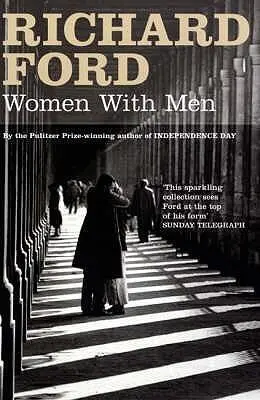
- Название:Women with Men
- Автор:
- Издательство:Bloomsbury Publishing PLC
- Жанр:
- Год:2006
- ISBN:нет данных
- Рейтинг книги:3 / 5. Голосов: 1
-
Избранное:Добавить в избранное
- Отзывы:
-
Ваша оценка:
Women with Men: краткое содержание, описание и аннотация
Предлагаем к чтению аннотацию, описание, краткое содержание или предисловие (зависит от того, что написал сам автор книги «Women with Men»). Если вы не нашли необходимую информацию о книге — напишите в комментариях, мы постараемся отыскать её.
Women with Men — читать онлайн бесплатно полную книгу (весь текст) целиком
Ниже представлен текст книги, разбитый по страницам. Система сохранения места последней прочитанной страницы, позволяет с удобством читать онлайн бесплатно книгу «Women with Men», без необходимости каждый раз заново искать на чём Вы остановились. Поставьте закладку, и сможете в любой момент перейти на страницу, на которой закончили чтение.
Интервал:
Закладка:
He had believed that he and Joséphine could have a different kind of relationship. Sexual, but not sexual at its heart. But rather, a new thing, founded on realities — the facts of his character, and hers. With Barbara, he'd felt he was just playing out the end of an old thing. Less real, somehow. Less mature. He could never really love Joséphine; that he had to concede, since in his deepest heart he loved only Barbara, for whatever that was worth. Yet he'd for a moment felt compelled by Joséphine, found her appealing, considered even the possibility of living with her for months or years. Anything was possible.
But seeing her in her apartment today, looking just as he knew she would, being exactly the woman he expected her to be, had made him feel unexpectedly bleak. And he was savvy enough to know that if he felt bleak now, at the very beginning, he would feel only bleaker later, and that in all likelihood life would either slowly or quickly become a version of hell for which he would bear all responsibility.
His thumb still vaguely ached. The women were laughing again on the tennis courts beyond the flowering rhododendrons. Austin could actually see a pair of woman's calves and tennis shoes, jumping from side to side as though their owner was striking a ball first forehand, then backhand, the little white feet dancing over the red surface. “ Arrête! Stop!” a woman yelled, and sighed a loud sigh.
Frenchwomen, Austin thought, all talked like children: in high-pitched, rapid-paced, displeasingly insistent voices, which most of the time said, “Non, non, non, non, non,” to something someone wanted, some likely as not innocent wish. He could hear Joséphine saying it, standing in the living room of her little apartment the only other time he'd visited there — a week ago — speaking on the phone to someone, spooling the white phone cord around her finger as she said into the receiver, “Non, non, non, non, non, non. C'est incroyable. C'est in-croy-a-ble!” It was terrifically annoying, though it amused him now to think of it — at a distance.
Barbara had absolutely no use for Frenchwomen and made no bones about it. “Typical Froggies,” she'd remark after evenings with his French clients and their wives, and then act disgusted. That was probably what bothered him about Joséphine: that she seemed such a typical bourgeois little Frenchwoman, the kind Barbara would've disliked in a minute — intractable, preoccupied, entirely stuck in her French life, with no sense of the wider world, and possibly even ungenerous if you knew her very long (as her husband found out). Joséphine's problem, Austin thought, looking around for little Léo, was that she took everything inside her life too seriously. Her motherhood. Her husband's ludicrous book. Her boyfriend. Her bad luck. She looked at everything under a microscope, as if she were always waiting to find a mistake she could magnify big enough that she'd have no choice but to go on taking life too seriously. As if that's all adulthood was — seriousness, discipline. No fun. Life, Austin thought, had to be more lighthearted. Which was why he'd come here, why he'd cut himself loose — to enjoy life more. He admired himself for it. And because of that he didn't think he could become the savior in Joséphine's life. That would be a lifelong struggle, and a lifelong struggle wasn't what he wanted most in the world.
When he looked around again, Léo was not where he'd been, standing dreamily to the side of the older boys, watching their miniature cutters and galleons glide over the still pond surface. The older boys were there, their long tending sticks in their hands, whispering among themselves and smirking. But not Léo. It had become cooler. Light had faded from the crenellated roof line of the École Supérieure des Mines, and soon it would be dark. The man having his picture taken was walking away with the photographer. Austin had been engrossed in thought and had lost sight of little Léo, who was, he was certain, somewhere nearby.
He looked at his watch. It was six twenty-five, and Joséphine could now be home. He scanned back along the row of apartment blocks, hoping to find her window, thinking he might see her there watching him, waving at him happily, possibly with Léo at her side. But he couldn't tell which building was which. One window he could see was open and dark inside. But he couldn't be sure. In any case, Joséphine wasn't framed in it.
Austin looked all around, hoping to see the white flash of Léo's T-shirt, the careening red Cadillac. But he saw only a few couples walking along the chalky paths, and two of the older boys carrying their sailboats home to their parents’ apartments. He still heard tennis balls being hit— pockety pock. And he felt cold and calm, which he knew to be the feeling of fear commencing, a feeling that could rapidly change to other feelings that could last a long, long time.
Léo was gone, and he wasn't sure where. “Leo,” he called out, first in the American way, then “Lay-oo,” in the way his mother said. “O êtes-vous?” Passersby looked at him sternly, hearing the two languages together. The remaining sailboat boys glanced around and smiled. “Lay-oo!” he called out again, and knew his voice did not sound ordinary, that it might sound frightened. Everyone around him, everyone who could hear him, was French, and he couldn't precisely explain to any of them what was the matter here: that this was not his son; that the boy's mother was not here now but was probably close by; that he had let his attention stray a moment.
“Lay-oo,” he called out again. “O êtes-vous?” He saw nothing of the boy, not a fleck of shirt or a patch of his dark hair disappearing behind a bush. He felt cold all over again, a sudden new wave, and he shuddered because he knew he was alone. Léo — some tiny assurance opened in him to say — Léo, wherever he was, would be fine, was probably fine right now. He would be found and be happy. He would see his mother and immediately forget all about Martin Austin. Nothing bad had befallen him. But he, Martin Austin, was alone. He could not find this child, and for him only bad would come of it.
Across an expanse of grassy lawn he saw a park guardian in a dark-blue uniform emerge from the rhododendrons beyond which were the tennis courts, and Austin began running toward him. It surprised him that he was running, and halfway there quit and only half ran toward the man, who had stopped to permit himself to be approached.
“Do you speak English?” Austin said before he'd arrived. He knew his face had taken on an exaggerated appearance, because the guardian looked at him strangely, turned his head slightly, as though he preferred to see him at an angle, or as if he were hearing an odd tune and wanted to hear it better. At the corners of his mouth he seemed to smile.
“I'm sorry,” Austin said, and took a breath. “You speak English, don't you?”
“A little bit, why not,” the guardian said, and then he did smile. He was middle-aged and pleasant-looking, with a soft suntanned face and a small Hitler mustache. He wore a French policeman's uniform, a blue-and-gold kepi, a white shoulder braid and a white lanyard connected to his pistol. He was a man who liked parks.
“I've lost a little boy here someplace,” Austin said calmly, though he remained out of breath. He put the palm of his right hand to his cheek as if his cheek were wet, and felt his skin to be cold. He turned and looked again at the concrete border of the pond, at the grass crossed by gravel paths, and then at a dense tangle of yew bushes farther on. He expected to see Léo there, precisely in the middle of this miniature landscape. Once he'd been frightened and time had gone by, and he'd sought help and strangers had regarded him with suspicion and wonder — once all these had taken place — Léo could appear and all would be returned to calm.
Читать дальшеИнтервал:
Закладка:
Похожие книги на «Women with Men»
Представляем Вашему вниманию похожие книги на «Women with Men» списком для выбора. Мы отобрали схожую по названию и смыслу литературу в надежде предоставить читателям больше вариантов отыскать новые, интересные, ещё непрочитанные произведения.










Обсуждение, отзывы о книге «Women with Men» и просто собственные мнения читателей. Оставьте ваши комментарии, напишите, что Вы думаете о произведении, его смысле или главных героях. Укажите что конкретно понравилось, а что нет, и почему Вы так считаете.