John Barth - Giles Goat-Boy
Здесь есть возможность читать онлайн «John Barth - Giles Goat-Boy» весь текст электронной книги совершенно бесплатно (целиком полную версию без сокращений). В некоторых случаях можно слушать аудио, скачать через торрент в формате fb2 и присутствует краткое содержание. Год выпуска: 1966, Издательство: Doubleday & Company, Inc., Жанр: Современная проза, на английском языке. Описание произведения, (предисловие) а так же отзывы посетителей доступны на портале библиотеки ЛибКат.
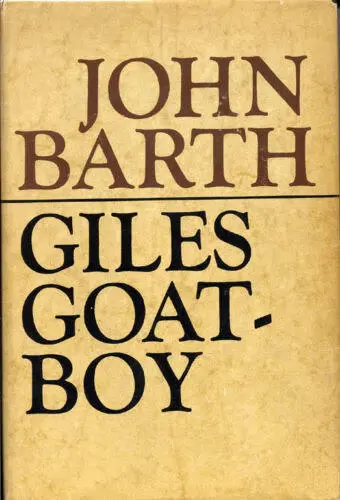
- Название:Giles Goat-Boy
- Автор:
- Издательство:Doubleday & Company, Inc.
- Жанр:
- Год:1966
- ISBN:нет данных
- Рейтинг книги:5 / 5. Голосов: 1
-
Избранное:Добавить в избранное
- Отзывы:
-
Ваша оценка:
Giles Goat-Boy: краткое содержание, описание и аннотация
Предлагаем к чтению аннотацию, описание, краткое содержание или предисловие (зависит от того, что написал сам автор книги «Giles Goat-Boy»). Если вы не нашли необходимую информацию о книге — напишите в комментариях, мы постараемся отыскать её.
computer system that threatens to destroy his community in this brilliant "fantasy of theology, sociology & sex"--
Giles Goat-Boy — читать онлайн бесплатно полную книгу (весь текст) целиком
Ниже представлен текст книги, разбитый по страницам. Система сохранения места последней прочитанной страницы, позволяет с удобством читать онлайн бесплатно книгу «Giles Goat-Boy», без необходимости каждый раз заново искать на чём Вы остановились. Поставьте закладку, и сможете в любой момент перейти на страницу, на которой закончили чтение.
Интервал:
Закладка:
"The things she used to do for me with Croaker!" he exclaimed. "She knew it helped me to watch her through the night-glass, especially when the gossips said she might be my daughter. Remarkable girl!"
He would have documented in more detail, but I waved away the offer. In an effort to raise my spirits he had Croaker refill my stein and recounted what he knew of Harold Bray.
"A crazy-man. A fake. A mountebank," he insisted. "Don't believe him for a minute; he doesn't even have the qualifications you have." But, he allowed, Bray was an extraordinary fellow, if a gross impostor, and had acquired a diverse notoriety on the campus before ever the "Grand-Tutor craze" began. It was generally agreed that he'd first appeared in NTC about eight years previously — though no one could say for sure when and whence he'd come, and it was merely a hypothesis, albeit a likely one, that the several roles attributed to him under different names and appearances had been played by a single man. "Sometimes I think he's a species instead of one man," Eierkopf declared. "At least he must be quintuplets."
In brief, within a few months of his appearance in NTC he seemed to know the names, histories, achievements, and involvements of nearly everyone on campus — including their friendships, enmities, and privatest lives, as if he had an S.S. system of his own. Basically squat and dark-haired, and in years somewhere between young manhood and early middle age, he nonetheless contrived to change his appearance substantially overnight from time to time, and his vocation as well. First he'd been an avant-garde poet — bearded, booted, long-locked, and malodorous — the darling of eccentric undergraduates, an enfant terrible in exotic garb who'd boasted of his sexual prowess, dropped famous names like birdlime all over Great Mall, spread slanderous gossip (always with a grain of substance in it) that set the members of the Poetry Department at one another's throats, and published scores of poems, some of which could not be proved to have been plagiarized. Subsequently — perhaps even simultaneously, it was far from certain — he had been a psychotherapist — bald, cleanshaven, dapper, washed, and fat — cashiered from the Psych Clinic when his glowing reference-letters proved to be forgeries, but not before he'd achieved a fair percentage of apparently successful cures. Again, under a third name, with a crew haircut and a stocky-muscled build, he'd been a field entomologist, explorer, and survival expert, able to flourish indefinitely in the wilderness without so much as a pocketknife or canteen of water — but the Departments of Cartography and Entomology, satisfied as they were with his abilities and indifferent of his credentials, had reluctantly to fire him when he refused to disclose his methods. He had no ID-card; rather, he had such a variety of forged and stolen ones that no one could say what his actual, original name was. No one had ever seen him eat, sleep, or relieve himself; no one knew where he lived; he spent all his hours in taverns and other people's offices and dwelling-places, talking endlessly and knowledgeably on any subject whatever — he was either a pathological liar or a widely traveled polymath, everyone agreed. Neither had anyone seen him at work; yet books and monographs in a dozen languages and a score of fields (survival techniques excepted) appeared under his noms-de-plume and sundry aliases; they were always challenged, but seldom wholly discredited. In time he had become the chief topic of conversation at New Tammany committee-meetings and cocktail parties. He was laughed at and over, reviled, contemned, cashiered, threatened with lawsuits — and yet stood in awe of, especially by students. His most hostile critics agreed that the man was a gifted impostor — so much so that in some instances the question of his fraudulence became more metaphysical than legal or ethical. If a man utterly without experience and knowledge of painting resolves to pose as an artist, Eierkopf hypothesized, and purely as part of the mimicry comes up with a painting that at least a few respectable critics deem a work of art, is the painter a fraud? If to prevent its being discovered that his surgical knowledge is only feigned, a man successfully removes an appendix, is he a hoax? Many people thought not, and the celebrated impostor had in time become a bonafide celebrity, an institution, a kind of college mascot whose deceptions often delighted the deceived. New Tammanians waited with approved curiosity to see where Bray would turn up next, and in what capacity; his poems, paintings, and scholarly articles became collector's items; everyone agreed that he was in his counterfeit way as considerable a genius as the encyclopedic giants of the Rematriculation, and in some quadrangles it was fashionable to claim for his productions a legitimate intrinsic value.
"So if anybody can mimic a Grand Tutor, it's Bray," Dr. Eierkopf concluded. "No telling what he's got up his sleeve; the curious thing is that he's posing without disguise. He's using one of the names he's known by instead of making up a new one, and the face is the same face he used as a psychotherapist." In consequence, it was already being suggested by some news commentators that this time he wasn't posing at all; that his former impostures had been in the nature of preparatory omens, or deliberate challenges to faith, as who should say, "I dare you to believe in me!" That thousands were ready to accept the challenge was evident: what Eierkopf was interested in seeing was how many actual Passages Bray could effect; how he would comport himself as an accepted Grand Tutor, especially in the matter of descending into WESCAC; how WESCAC itself would appraise him — as inevitably it must, if it had not already; and what would occur when the time came for him to meet that end described in the GILES profile as the fate of all Grand Tutors…
"The Enochists say that a man can teach the Syllabi effectively even though he's flunkèd himself," he declared. "If everybody believes Bray's the Grand Tutor, and he goes into WESCAC's Belly and Commences the student body, does it make any difference whether he's the real thing?"
"Absolutely!" I cried. "All the difference on campus! I'm the Grand Tutor, whether anybody believes it or not!" Even as I protested, my throat smarted at the thought of Peter Green's apostasy, and Dr. Sear's (though I knew they'd only been being agreeable from the beginning), and particularly Anastasia's, since I'd come to regard her as my first protégée. Croaker himself had forsaken me, to squat by the night-glass against his master's further orders.
"I don't feel well at all," I said.
"Do you want a woman?" Dr. Eierkopf asked at once. "I'll have Croaker bring up a Dairy Science co-ed."
I declined the offer.
"An aspirin, then? Or a sandwich? I'll have to ask you to eat it in the bathroom, though."
These too I declined, observing that perhaps it was sleep after all that I needed most, next to Max's counsel.
"Whatever you please," said Eierkopf. "Croaker fixes you a cot, and we see to it you're up in time to register. I really am grateful to you for bringing him home, I suppose."
I closed my eyes for a moment. "You're welcome, sir."
"You know…" He dandled his head on the other side, and his magnified eyes rolled merrily. "I almost wish you were the GILES, George — may I call you George? And you call me Eblis, if you like…" He sighed briefly, whereupon as if commanded Croaker came and set him on his shoulders. Eierkopf seemed quite at home there, but I was surprised to see what looked like tears shining behind his spectacles.
"You see? He's always getting things mixed up, like my eggs a while ago. Nothing ever gets done just the way I intended. But what can I do? And I cramp his style, too, I'm sure…"
Читать дальшеИнтервал:
Закладка:
Похожие книги на «Giles Goat-Boy»
Представляем Вашему вниманию похожие книги на «Giles Goat-Boy» списком для выбора. Мы отобрали схожую по названию и смыслу литературу в надежде предоставить читателям больше вариантов отыскать новые, интересные, ещё непрочитанные произведения.




Обсуждение, отзывы о книге «Giles Goat-Boy» и просто собственные мнения читателей. Оставьте ваши комментарии, напишите, что Вы думаете о произведении, его смысле или главных героях. Укажите что конкретно понравилось, а что нет, и почему Вы так считаете.