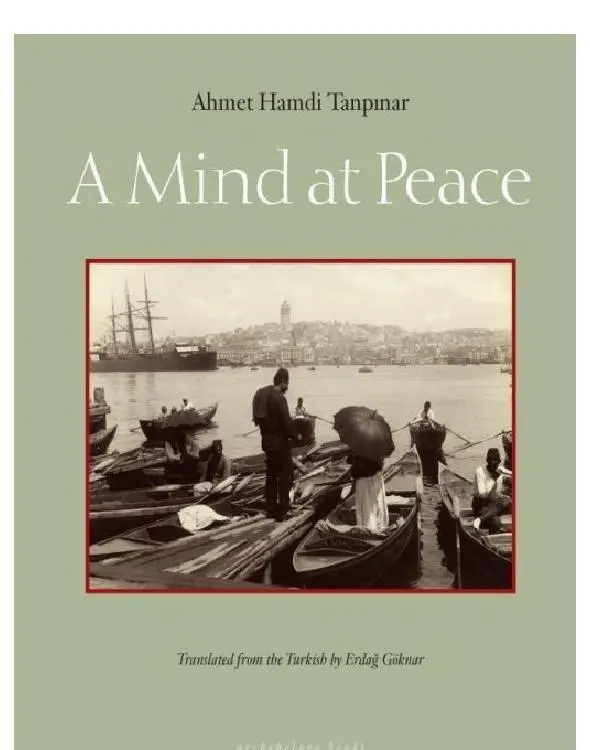
Ahmet Tanpinar - A Mind at Peace
Здесь есть возможность читать онлайн «Ahmet Tanpinar - A Mind at Peace» весь текст электронной книги совершенно бесплатно (целиком полную версию без сокращений). В некоторых случаях можно слушать аудио, скачать через торрент в формате fb2 и присутствует краткое содержание. Год выпуска: 2011, Издательство: Archipelago, Жанр: Современная проза, на английском языке. Описание произведения, (предисловие) а так же отзывы посетителей доступны на портале библиотеки ЛибКат.
- Название:A Mind at Peace
- Автор:
- Издательство:Archipelago
- Жанр:
- Год:2011
- ISBN:нет данных
- Рейтинг книги:4 / 5. Голосов: 1
-
Избранное:Добавить в избранное
- Отзывы:
-
Ваша оценка:
A Mind at Peace: краткое содержание, описание и аннотация
Предлагаем к чтению аннотацию, описание, краткое содержание или предисловие (зависит от того, что написал сам автор книги «A Mind at Peace»). Если вы не нашли необходимую информацию о книге — напишите в комментариях, мы постараемся отыскать её.
The promise of modernization and progress has given way to crippling anxiety rather than hope for the future. Fragmentation and destabilization seem the only certainties within the new World where they now find themselves. Mümtaz takes refuge in the fading past, immersing himself in literature and music, but when he falls in love with Nuran, a complex woman with demanding relatives, he is forced to confront the challenges of the World at large. Can their love save them from the turbulent times and protect them from disaster, or will inner obsessions, along with powerful social forces seemingly set against them, tear the couple apart?
A Mind at Peace, originally published in 1949 is a magnum opus, a Turkish Ulysses and a lyrical homage to Istanbul. With an innate awareness of how dueling cultural mentalities can lead to the distress of divided selves, Tanpinar gauges this moment in history by masterfully portraying its register on the layered psyches of his Istanbulite characters.
A Mind at Peace — читать онлайн бесплатно полную книгу (весь текст) целиком
Ниже представлен текст книги, разбитый по страницам. Система сохранения места последней прочитанной страницы, позволяет с удобством читать онлайн бесплатно книгу «A Mind at Peace», без необходимости каждый раз заново искать на чём Вы остановились. Поставьте закладку, и сможете в любой момент перейти на страницу, на которой закончили чтение.
Интервал:
Закладка:
V
Come afternoon, he paid a visit to the tenant, and on his return he stopped at the Beyazıt coffeehouse. This two- or three-hour journey, like poking one’s nose out into the dark night of a snowstorm, had quickly informed him of a number of circumstances. When he’d just about arrived in Beyazıt, the trolley stopped for the crossing of a military detachment. Taking advantage of the opportunity, Mümtaz stepped off the streetcar to walk the remainder of the way. He’d long enjoyed this route. He was fond of watching the pigeons beneath the huge walnut tree beside Beyazıt Mosque, browsing through books in the Sahaflar book market, chatting with booksellers of his acquaintance, entering into the half-light of the Grand Bazaar, whose coolness overwhelmed him after the sweltering day and bright radiance, and rambling as he sensed the abrupt chill in his flesh. Not to mention that if he’d been in no rush and felt the impulse, he’d enter through the flea market and meander through labyrinthine streets to the Old Bedesten, the heart of the bazaar. The market contained cheap imitations and makeshift goods today; he came across only knockoffs, shoddy imports, and knickknacks, or inexpensive wholesale products. Normally, were he paying careful attention, he’d always find something astonishing in the flea market or Bedesten.
Here two opposing and difficult-to-imitate polarities of life, which didn’t appear without latching on to one’s skin or settling deep within, actually merged: genuine poverty and grandeur, or rather, their castoffs… At each step, remnants of out-of-fashion entertainments and the traces of old and grand traditions, whose origins and means had been forgotten, could be found heaped together. In one of these narrow, contiguous shops, old Istanbul, veiled Anatolia, and even the last remnants of the Ottoman Empire’s heritage would glimmer in the most unanticipated way. Vintage outfits that varied from town to town, tribe to tribe, and period to period; old carpets and kilims whose locale of weaving he’d be sure to forget even once reminded, yet whose motifs and colors he’d remember for days; a store of artwork from Byzantine icons to old Ottoman calligraphy panels; embroidery, decorations, all in all, caches of objets d’art; jewelry that had adorned the neck and arms of some forgotten beauty from a lost generation or two; all of it, in this humid and crepuscular world, could keep him in its thrall for hours with the allure of a by gone age and the appeal of the mysterious added in for good measure. This represented neither the traditional nor the modern East. Perhaps it was a state of timelessness whose very clime had been exchanged for another. When Mümtaz left this setting for the hubbub of the Mahmutpaşa street bazaar, he felt the inebriation of a man who’d gotten drunk on laced wine in a cellar before stepping into direct sunlight. And the satisfaction imparted seemed to be quite a middle-aged pleasure for a man his age — like an addiction.
On this occasion, he relented again. First he watched the pigeons. Then he gave in and fed them. While he did so, he was prodded by an urge to make an appeal to Allah, as he used to do in his childhood. Mümtaz, however, no longer wanted to mix everyday matters with his personal conception of the divine. The divine should be like a fountainhead, unencumbered by humanity, robust, removed from all types of experience, and should simply provide the resilience to endure life. He didn’t think this way solely to resist the pagan superstition that often reared its head during times of trouble and had recently established a vast shadowy realm within him. Perhaps he wanted to remain faithful to the notions that preoccupied him. About a month ago, a friend of his whom life had staggered rather profoundly had told him how society filled him with revulsion, how little by little the ties that bound him to the community had loosened. He was in fullscale revolt: “The social contract won’t continue, it cannot continue,” he raved.
At that time, Mümtaz tried to explain to his friend the absurdity of the connection he’d arbitrarily made between his experience and his ephemeral mental states. He said, “Just because things have taken a bad turn, let’s not blame the gods. Our affairs are always susceptible to the betrayal of circumstance and to trivial mishaps. Things might even go wrong for a few generations. The breakdown and disorganization shouldn’t alter our relationship to our inner beliefs. If we conflate these two distinct things, we’ll be left naked and exposed. Furthermore, we shouldn’t assume that success is granted by the gods, either. Matrices of probability contain failure. What’s the relationship between the postponement of your uncle’s trial and our historic rights over this nation? Between your sister’s marriage and the morning prayer called at the Süleymaniye Mosque or to your birth to a Muslim father? Or between the real estate broker who swindles you of your money and the values that constitute our inner character or the colossal realities that make us who we are? Even if these realities ultimately rest in society, they shouldn’t incite us to inkâr, denial of ourselves, but to change the conditions in which we find ourselves. Of course there are countries and citizens more content than us; of course we feel in our lives — rather, in our flesh and blood — the vast fallout of two centuries of disintegration and collapse, of being the remnants of an empire and still unable to establish our own norms and idioms. Allowing this suffering to drive us to nihilistic inkâr, in effect, would be to accept even greater catastrophe, would it not? Motherland and nation are cherished because they are the motherland and the nation; religion is disputed, rejected, or accepted as religion, and not based on the ease it purports to bring to our lives…”
As Mümtaz spoke, he realized that his expectations of others were high. He knew that when the social idiom changed, people changed and the faces of the gods paled. Yet he also realized it shouldn’t always be this way. While he fed the pigeons, he contemplated such thoughts; at the same time he noticed that the fine grain coating his palm irritated him like an aperture shutting somewhere in his person.
No, he wouldn’t ask anything of Allah anymore. Mümtaz wasn’t going to confront Him with his fate or the missteps of his life, because were his plea ignored, his loss would be twofold.
The pigeons, indifferent toward the grain in the midafternoon heat, approached reluctantly, hovering close to the ground and gliding in one at a time. Like the hand of a magician producing a bright blue handkerchief out of thin air, they still made surprising and illusive movements as they flew, but they didn’t flock and crest all at once with the swiftness of a wave under a southerly breeze as they did when in full feather and hungry; they didn’t pivot in the airy void as if there were a whirlwind above them; and they didn’t lose all speed in the aether and plummet as if they’d come to an unseen pier or the wall of a manor by the sea.
They made a rather tranquil arrival, sluggish and languid. Some of them looked dubiously — almost with pity — at the grain on the ground from the wall of the opposite building where they’d perched in a line. Yet, beneath them a small, oneiric flock gathered and pecked, each detail of its movements depicted separately and as an isolated form, like seas issuing from the brushwork of the Fauvist Raoul Dufy.
Despite their avarice and exploitation of one’s affection, they were beautiful creatures. Especially in the way they trusted, they were beautiful. Humans were this way, they delighted in being trusted. This sensation deeply satisfied man as master and singular, eminent creator of life. Despite man’s brief and tormented life, his absurdity and selfishness, this hobbled and deficient deity recognized such trust as the sole expression of worship toward him. But he took pleasure in betraying those who trusted in him. Because he liked to change, and he enjoyed the cognizance of himself during different moments and situations. Because he was narcissistic, yet the conversation within him wasn’t merely one-sided.
Читать дальшеИнтервал:
Закладка:
Похожие книги на «A Mind at Peace»
Представляем Вашему вниманию похожие книги на «A Mind at Peace» списком для выбора. Мы отобрали схожую по названию и смыслу литературу в надежде предоставить читателям больше вариантов отыскать новые, интересные, ещё непрочитанные произведения.




![Джон Харгрейв - Mind Hacking [How to Change Your Mind for Good in 21 Days]](/books/404192/dzhon-hargrejv-mind-hacking-how-to-change-your-min-thumb.webp)




Обсуждение, отзывы о книге «A Mind at Peace» и просто собственные мнения читателей. Оставьте ваши комментарии, напишите, что Вы думаете о произведении, его смысле или главных героях. Укажите что конкретно понравилось, а что нет, и почему Вы так считаете.