Richard House - The Kills
Здесь есть возможность читать онлайн «Richard House - The Kills» весь текст электронной книги совершенно бесплатно (целиком полную версию без сокращений). В некоторых случаях можно слушать аудио, скачать через торрент в формате fb2 и присутствует краткое содержание. Год выпуска: 2013, Издательство: Picador, Жанр: Современная проза, на английском языке. Описание произведения, (предисловие) а так же отзывы посетителей доступны на портале библиотеки ЛибКат.
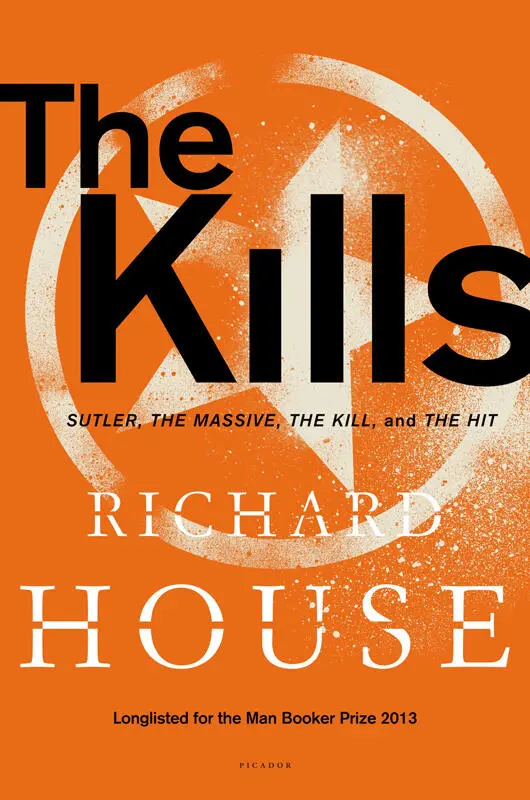
- Название:The Kills
- Автор:
- Издательство:Picador
- Жанр:
- Год:2013
- ISBN:нет данных
- Рейтинг книги:3 / 5. Голосов: 1
-
Избранное:Добавить в избранное
- Отзывы:
-
Ваша оценка:
The Kills: краткое содержание, описание и аннотация
Предлагаем к чтению аннотацию, описание, краткое содержание или предисловие (зависит от того, что написал сам автор книги «The Kills»). Если вы не нашли необходимую информацию о книге — напишите в комментариях, мы постараемся отыскать её.
The Kills — читать онлайн бесплатно полную книгу (весь текст) целиком
Ниже представлен текст книги, разбитый по страницам. Система сохранения места последней прочитанной страницы, позволяет с удобством читать онлайн бесплатно книгу «The Kills», без необходимости каждый раз заново искать на чём Вы остановились. Поставьте закладку, и сможете в любой момент перейти на страницу, на которой закончили чтение.
Интервал:
Закладка:
Ford looked hard across the water as the tour boat fell behind.
In his pocket an open ticket to Bodrum, then Bodrum to Kos, Kos to Athens, Athens to Malta. As per his promise to Zubenko, he would never return to Istanbul, and as the sea-fog enveloped the ferry he could feel himself disappear.
4.7
Parson read of Howell’s death in the International Guardian. Fifty-seven years old. Heart failure, post-surgery, while undergoing treatment for burns. He also heard from both of the German journalists on the same day. The first call came from Susanna Heida, anxious that she had not heard from the photographer, her partner, Gerhard Grüner.
Heida, a comedy of hyper-disorganization, claimed that she had seen Sutler in Ankara, in broad daylight, two days ago. He’d walked right beside her, la-di-dah, as carefree as you like, no effort to disguise himself. She’d watched him board the coach to Istanbul then immediately called Grüner to let him know when Sutler would arrive. The last she’d heard from Grüner he was at the Konak Hostel. Parson asked Heida why she hadn’t contacted him first. Sutler should not be approached. Hadn’t he said this? Hadn’t he made this perfectly clear?
‘But there he was,’ she answered, Sutler in Ankara. ‘I wasn’t looking for him.’ This statement, plain as it sounded, came with teeth. How was it that she had seen Sutler twice, yet Parson never seemed to get close to him? ‘We had an agreement,’ she said. ‘You were supposed to help with our visas, you gave us a name of someone who was supposed to help, but this was no good,’ because of this she felt no obligation to call him.
Parson didn’t believe that she had seen Sutler. The claim was nonsense. No, this was about her not getting the visas for Iraq, nothing else.
* * *
Later in the afternoon Parson received a call from the Turkish police that made him change his mind. Gerhard Grüner was in hospital in Istanbul, having broken his leg in a fall. Unlike Heida, Grüner was particular that Parson should know his whereabouts. He had information and wanted to speak as soon as possible.
When the Turkish police checked the Konak Hostel they found no trace of a Stephen Sutler, but plenty of evidence of Gerhard Grüner. The desk clerk stated that Grüner had asked for assistance in procuring the services of a man, or preferably a young boy. He had asked for magazines and places to go. Grüner, it seemed, had been clumsy, and suffered nothing less than he deserved.
Parson took note of the information, but as soon as the call was completed he tore the page out of his notebook. This was nonsense.
It took time to find where the police were holding Afan Zubenko and his sons; because of Grüner’s statement the men had been brought into custody, and Parson was having trouble finding out where. When he finally located them at the Central Police Station in Eminonu, he found that the police in Istanbul weren’t interested in assisting him. Access to the Zubenkos, he was told, would be impossible. Parson called Gibson to see what muscle he could employ.
* * *
Rather than wait for Gibson’s reply, Parson met Grüner at the hospital and brought him back to his hotel. The two men stood side by side at the window looking down on the grey parkway before the city walls. Grüner leaned forward on his crutches, one leg bandaged from his knee to his thigh: unbalanced, he veered toward the glass. A scuff ran from his cheek to his temple, pink and sore enough to make Parson cringe.
‘This was where you saw him?’
‘He came by coach.’ Grüner tapped the window. ‘Where that stall is, by the wall.’
Parson looked down on the terminus at men selling newspapers and boys with flat baskets of fruit, lokum, sandwiches. Sutler could be among those people right now, he had no way of knowing. While hunting Sutler he’d developed ideas about who the man might be, but he didn’t know much. It would be possible to pass Sutler in the street and not know it. In ten days he could have adopted any kind of disguise with minimal effort, although Grüner was emphatic that the man looked exactly like the photograph they were using online and in the US press, the photograph taken from Sutler’s ID. Coming to Istanbul was a risk. A risk Sutler could have avoided by veering north of the city and crossing by land to Greece or Bulgaria.
‘And where was his hotel?’
Grüner pointed out the Konak and the travel agency on a tourist map. He’d drawn in red the route he’d followed with Sutler. His voice a little slow, lulled with medication.
Within an hour they began to roll over the same information. Grüner’s voice became dry, his expression a little glassy. Ready to leave, Parson helped the journalist to a seat. He laid the crutches carefully within reach and asked the man what he would do now. Grüner shrugged and shook a cigarette out of the pack. Lined side by side on the table, a small digital camera, the map, a pencil, and a red sports cap.
‘I don’t know. Iraq is not possible. Those men took my camera. I don’t have the pictures. I have this.’ He pointed at the camera. ‘It’s not as good. Not good enough for work. I have a story now without pictures.’
They looked out at the city to a view of a cold, bright, and cloudless sky. Parson accepted a cigarette. He picked up the camera, turned it over in his hands.
‘How did Sutler look?’
‘Not so good. His face. He had these bruises, and his nose was big. Swollen.’
Parson drew on his cigarette. ‘But describe him.’
‘Like before. Thin. Nervous. He has short hair now. English.’
‘Does he look like me?’
Grüner looked at Parson and shook his head. ‘Not so much. I mean maybe the same shape, more or less, in the face. A little rounder. The hair is much shorter.’
‘You need a photo?’
‘Of course. Maybe the story runs for a day or so, but with a picture it would be different. It would mean more money. People would take it more seriously. A picture is what everybody wants. I had him in the terminal and outside the hotel. Some in the street.’
‘And he doesn’t look like me?’
Grüner looked again at Parson and studied him hard. ‘Maybe, if you were in the street? It’s possible.’
Parson picked up the sports cap as he rose. ‘And after this you return to Frankfurt?’
‘To Hamburg. They said that I can travel. But I don’t know what will happen now.’
Parson shook the journalist’s hand and pointed to the window. ‘You said you saw him at the buses? Beside the coaches?’
* * *
Gibson did not call Parson back. Instead — as he walked among the coaches parked at the terminus, deliberate enough to provide Grüner a good opportunity to photograph him — he received a call from the German consulate. One of their men, Henning Bastian, was interviewing Afan Zubenko at the Central Police Station and they wanted him to come in.
The tone of the call disturbed Parson. This was not a polite request.
* * *
An hour later Parson arrived at the Central Police Station — a long building tagged on to a new apartment complex, with ironwork in front of the lower windows, pale magnolia walls, and bare planters. Informed that Henning Bastian was still interviewing Zubenko, Parson was escorted to one of the interrogation rooms and told to wait.
He sat at a table for an hour in a simple windowless room with the faint odour of fresh paint; two guards at the door, hefty men, both silent, and faintly bothersome, their attention locked on him so surely he began to feel that he had done something wrong.
The feeling deepened with the arrival of the cultural attaché. Bastian: boyish, lanky, thin-faced, dressed in a light grey suit, wiped his hands with a piece of tissue before he sat down. He looked to Parson, then the table, then the three men who had accompanied him, and briskly told them all to sit down, a clipped precision about his instructions. One of the men handed him a black-backed register as the others scurried to fetch chairs.
Читать дальшеИнтервал:
Закладка:
Похожие книги на «The Kills»
Представляем Вашему вниманию похожие книги на «The Kills» списком для выбора. Мы отобрали схожую по названию и смыслу литературу в надежде предоставить читателям больше вариантов отыскать новые, интересные, ещё непрочитанные произведения.











Обсуждение, отзывы о книге «The Kills» и просто собственные мнения читателей. Оставьте ваши комментарии, напишите, что Вы думаете о произведении, его смысле или главных героях. Укажите что конкретно понравилось, а что нет, и почему Вы так считаете.