Richard House - The Kills
Здесь есть возможность читать онлайн «Richard House - The Kills» весь текст электронной книги совершенно бесплатно (целиком полную версию без сокращений). В некоторых случаях можно слушать аудио, скачать через торрент в формате fb2 и присутствует краткое содержание. Год выпуска: 2013, Издательство: Picador, Жанр: Современная проза, на английском языке. Описание произведения, (предисловие) а так же отзывы посетителей доступны на портале библиотеки ЛибКат.
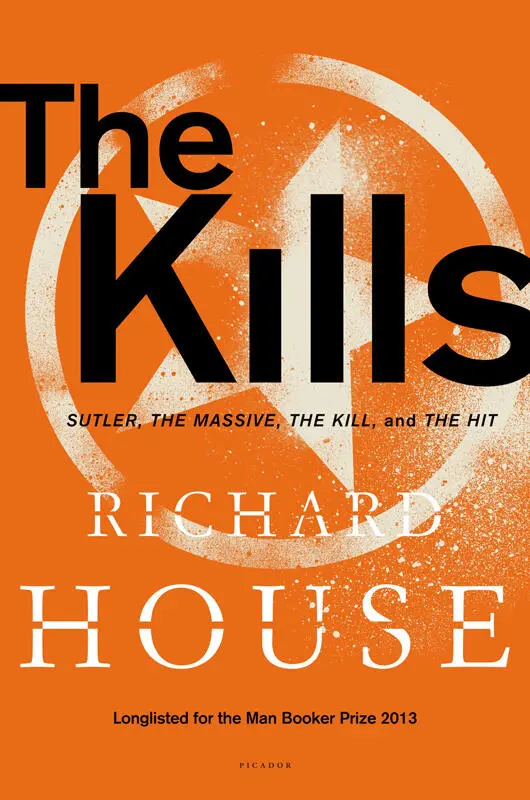
- Название:The Kills
- Автор:
- Издательство:Picador
- Жанр:
- Год:2013
- ISBN:нет данных
- Рейтинг книги:3 / 5. Голосов: 1
-
Избранное:Добавить в избранное
- Отзывы:
-
Ваша оценка:
The Kills: краткое содержание, описание и аннотация
Предлагаем к чтению аннотацию, описание, краткое содержание или предисловие (зависит от того, что написал сам автор книги «The Kills»). Если вы не нашли необходимую информацию о книге — напишите в комментариях, мы постараемся отыскать её.
The Kills — читать онлайн бесплатно полную книгу (весь текст) целиком
Ниже представлен текст книги, разбитый по страницам. Система сохранения места последней прочитанной страницы, позволяет с удобством читать онлайн бесплатно книгу «The Kills», без необходимости каждый раз заново искать на чём Вы остановились. Поставьте закладку, и сможете в любой момент перейти на страницу, на которой закончили чтение.
Интервал:
Закладка:
* * *
With Isa and Henning in bed Rike finds herself confined to her room. It isn’t that she has to stay in the room, but their goodnight was an agreement that the day was over, and while she had felt tired, she isn’t sure that she can sleep now.
Rike lies on top of her bed, fully clothed. A window runs alongside the bed, starting at her knees and ending at her chest. She can’t see why the bed is placed here, right beside the window so that lying down, if she keeps the blind up, anyone in the garden can see her. All she can see is the white wall that makes up one of the sides of the garden, and the edge of a fig tree with its big, deep green, hand-like leaves.
The doors and windows are open to draw in the evening breeze, but the air in the room is still. The rooms are too broad and too empty. She decides to set Tomas assignments. Museums, outings, cultural events organized by the school, she will ask him to eat with her. They will go to the café where she will encourage him to speak, to interact, to open his world a little more every day.
She watches part of a movie on her computer and picks up twenty minutes into the film. She lies on her side, earplugs in, but can’t settle, just isn’t tired. There are no emails, nothing to reply to, no messages to send, so when she opens the browser she types in Damascus and checks the news-streams.
There’s nothing here either, nothing more than conjecture.
She types in Sutler and again finds a long list of sites, some reports from papers, Grenoble, an entry in Wikipedia, his name connected on every hit with a business, HOSCO, now failing because of the contested sum the man has embezzled from them: thirty, fifty, sixty million. Speculation on Parson now focuses, implausibly, on the Mafia, and how, in pursuing Sutler, Parson had exposed himself to dangerous elements. While there is no mention of Sutler Number Three, ideas about Sutler Number Two are rife. The man, positively identified in Grenoble, is connected to crime syndicates in Marseilles. In a separate strand, a car delivery service in Westphalia is accused of providing cover for him. Each strand, hydra-like, generates new heads. With that much money what would you do? It’s no surprise that Henning, the British, and the Americans are interested in him.
* * *
She takes a shower before bed. She binds her hair and pins it back, and watches her reflection in the hallway mirror — and notices a message on her phone. The message is from her brother. Leaving a new local number he asks her to call as soon as possible.
She calls Mattaus and is surprised when he picks up. Her brother keeps the conversation smooth, away from trouble. She catches up with his news. He’s told her all of this, hasn’t he? Surely? When did they last speak?
Rike asks after Franco. She’s sorry, she says, to hear of his breakup.
Mattaus dismisses the comment. It’s history. Ancient.
‘And who is the new man?’
She doesn’t like her brother’s voice. Sour and lazy, deception nests in his slow and calculated intonation. He sounds younger than he is, and smarter. It’s hard to see how men like him, unfathomable. The kind of men they are, journalists, architects, doctors, teachers, all of them affable, clever, handsome. A type. They trust him. They adore him. They even find him funny. And his treatment of them leaves them startled and wounded. Mattaus’s sexual history is a field of debris from which he alone walks free.
Rike checks herself in the mirror. She taps the glass with her fingernail. She is nearly thirty, it will be her birthday in under a month.
‘When are you arriving?’ she asks, making sure there is no measure of welcome in her voice.
‘We’re already here,’ he answers, smug and precise.
Her brother is here already, ready to interfere in any plans she has with Isa, ready to take over — because this is what he does.
‘So when do we get to see you?’
Mattaus gives a vague response. He’ll speak with Isa, speak with his friend. He says friend deliberately — the man won’t be given a name — to keep everything in its compartment. But yes, hasn’t he already explained all of this? They flew in to Paphos, what, four, five days ago. Oh god, he can’t remember, was it last week already or longer? He asks the question to some third party and waits for a response. Must have been. He asks her not to tell Isa just yet. ‘We’re hoping to spend a couple of days on the beach, and take it easy before we bring in any family. No offence, but it’s nice to have time to ourselves.’
No offence taken, she assures him. Take all the time you need. She won’t whisper a word.
Rike can’t wait to tell Isa, to see how it feels to be on the other side of Mattaus’s manipulations for a change. She can’t wait either to see Henning’s reaction. It would be worth bursting into their room right now to share the news. Guess what? He’s here already. Henning would explode. Only she won’t do this. Would never go that far. Besides, Isa has probably had the same conversation with Mattaus. Don’t tell Rike. You know how she is. We just want a couple of days to ourselves. The only person she can be certain to be left out of Mattaus’s complex machinations is Henning. It’s almost worth the trouble.
She wants to ask him more about Franco. Not only because she would like some information, but because she wants to remind him of the damage he’s caused. She would appreciate some acknowledgement, a reference to the man he’s shared his life with for the past five years and dropped for a new, doubtlessly younger flash, an architect no less. She can imagine the scene too easily, Mattaus telling Franco, and probably not face to face.
In the night a helicopter cuts over the house, the sound wavers, bounces so she can’t determine the direction of travel, if it’s coming from the British base or heading toward it.
4.6
A fire alarm at the hotel sends Gibson out to the street halfway through the call.
Geezler isn’t happy at the news, and becomes irritated at the confusion as Gibson moves about to secure a better signal.
‘It’s nonsense—’ that Geezler would have Parson followed. ‘It doesn’t make sense—’ why Parson would invent any of this. The pure aimlessness of his travels, his ambling. To what end would Parson fabricate lies about Sutler? Why would he take advantage of HOSCO, of Geezler, when there is no obvious profit from it?
‘I don’t see why she would lie.’
‘She’s lost her husband. She wants to sow doubt.’ It is, Geezler suggests, an accentuated part of the process. ‘She’s angry at us all.’
Gibson does not explain that he didn’t speak directly with Laura.
He stands separate from the staff, who lean against the blue shutters of the enoteca opposite the hotel, and smoke and look a little intense, like arsonists. There is no fire, he’s assured. The manager, a lean man, unshaven, appears disappointed with the news. The guests bustle out with a little more urgency, wait for a break in the traffic to cross, and stand together at the steps of the church, Purgatorio ad Arco. Some take photographs of the front of the hotel and the long and narrow strip of via Tribunale, of scooters bouncing and skidding across the black street slabs, a few sit at the steps. All of them rub their hands, one at a time, over the four bronze skulls mounted on bollards in front of the church.
Gibson walks to via Mezzocannone, returns to the café where there are fewer students, a place to sit. He sets out the papers and reads each of the hotel bookings to Geezler: the phone numbers, the dates, the reference numbers. He looks up at the long grey wall opposite. The university. ‘These are all in your name. There’s no doubt that this is Parson’s work.’
Читать дальшеИнтервал:
Закладка:
Похожие книги на «The Kills»
Представляем Вашему вниманию похожие книги на «The Kills» списком для выбора. Мы отобрали схожую по названию и смыслу литературу в надежде предоставить читателям больше вариантов отыскать новые, интересные, ещё непрочитанные произведения.






Обсуждение, отзывы о книге «The Kills» и просто собственные мнения читателей. Оставьте ваши комментарии, напишите, что Вы думаете о произведении, его смысле или главных героях. Укажите что конкретно понравилось, а что нет, и почему Вы так считаете.