Richard House - The Kills
Здесь есть возможность читать онлайн «Richard House - The Kills» весь текст электронной книги совершенно бесплатно (целиком полную версию без сокращений). В некоторых случаях можно слушать аудио, скачать через торрент в формате fb2 и присутствует краткое содержание. Год выпуска: 2013, Издательство: Picador, Жанр: Современная проза, на английском языке. Описание произведения, (предисловие) а так же отзывы посетителей доступны на портале библиотеки ЛибКат.
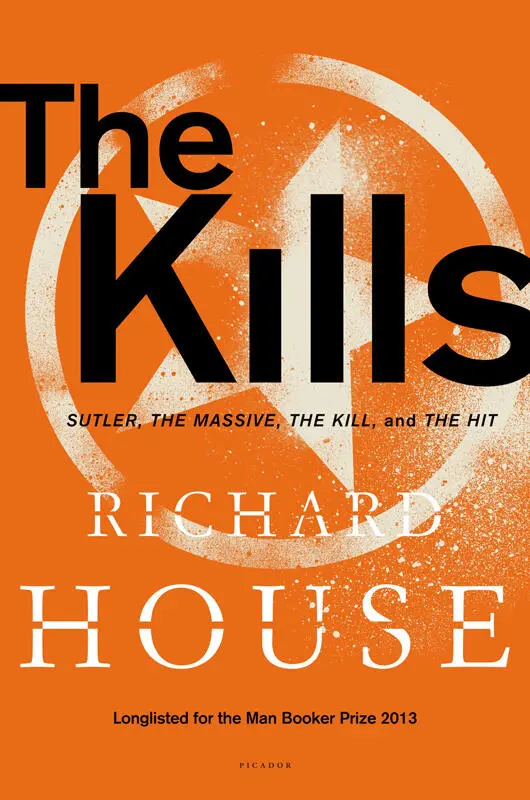
- Название:The Kills
- Автор:
- Издательство:Picador
- Жанр:
- Год:2013
- ISBN:нет данных
- Рейтинг книги:3 / 5. Голосов: 1
-
Избранное:Добавить в избранное
- Отзывы:
-
Ваша оценка:
The Kills: краткое содержание, описание и аннотация
Предлагаем к чтению аннотацию, описание, краткое содержание или предисловие (зависит от того, что написал сам автор книги «The Kills»). Если вы не нашли необходимую информацию о книге — напишите в комментариях, мы постараемся отыскать её.
The Kills — читать онлайн бесплатно полную книгу (весь текст) целиком
Ниже представлен текст книги, разбитый по страницам. Система сохранения места последней прочитанной страницы, позволяет с удобством читать онлайн бесплатно книгу «The Kills», без необходимости каждый раз заново искать на чём Вы остановились. Поставьте закладку, и сможете в любой момент перейти на страницу, на которой закончили чтение.
Интервал:
Закладка:
His office, decorated white and blue, held busts. Heads of state, former kings, and in the corridor also I noticed the bronze likenesses of our philosophers, a great deal of statuary in fact along the corridors and stairwells, none of it particularly fitting the surroundings. Watching me the magistrate’s clerk said that we should go. There was nothing he could do, and nothing either that the magistrate could manage. Without verification of our claim we had no grounds to make a petition.
* * *
(page 50) My sister returned two days later at sunset as we returned, again, from the magistrate’s office. (…)
I called on Dr P—, begged him to come see her, to help. Knocked hard at his door. Saw that his blinds were slightly opened. Called to him. Insisted that I knew he was in. That I would break the door. His voice, feeble but clear, refused to assist, and told me, directly, and with some shame to go away.
I ran to other doors, to other neighbours and asked for water, for towels, for a trough so we could bathe her. Door after door remained unanswered. About the palazzo hung a thick silence. The silence of people hiding, of people holding their breaths, of people closing their eyes and hardening themselves, making themselves as dull as walls and floors and stone. Not one person came to our aid.
* * *
(page 51) The morning after the return of my sister, my brother took himself to the vineyard and used a curved pruning knife to slit the artery in his leg. He lay with his back to the vine and bled himself of life. He left no note or explanation, which did not need to be voiced perhaps. I found him, and held him at the end. I sat with him long after, and thought hard over the facts and realized that everything I had done to this point was driven by coincidence. The opportunities opened to me had come through chance alone. The misfortunes were otherwise, and were driven by situations which I believed I could not control. But now, it seemed to me that I could be less undirected. Less blown. More determined. If I did not I would end up used like my brother and sister. Here, as if to give example to the trouble which I debated, I was found with the knife, covered in blood, and arrested.
And so I was imprisoned for the murder of my brother.
YEAR 3
WEDNESDAY
Yee Jan waited in the cubicle until he could be certain that the students were gone. Some stuck around for extra sessions, one-on-ones that lasted an hour at most. Others dawdled to chat and wrap up the day, and took too long to say goodbye. Tonight they were filming at the marina and Yee Jan didn’t have time to dawdle. They meaning a film crew, technicians, handlers, movers, a mix of lean and professional Americans and Italians (men) from Los Angeles and Rome: people (men) so serious and focused and so used to crowds they saw nothing but the job ahead of them. Yee Jan wanted to watch them for their industry alone. The crew wore military green T-shirts and vests with The Kill printed in white script on the front and the outline of a white star in a white circle on the back. He wanted one of the vests, although he was happy to settle for a photograph. Yee Jan leaned into the mirror and considered how this could be achieved. He pinched his eyelashes to tease out stray hairs. He’d come in early that morning specifically to watch the maintenance crew off-load lights from flat-bed trucks and prepare the cabins (technically trailers) and set them end on end on the broad sidewalk that ran alongside the port, and just as soon as he was ready he’d go back and find them.
Inside his satchel he’d packed another set of clothes and a small zippered make-up bag. He laid the clothes across the sink then picked carefully through the make-up and chose the lighter lipstick, flesh-pink, and a foundation which would erase the small open pores on either side of his nose and the oilier skin around his chin. He leaned toward the mirror, smoothed his hand across his jaw and satisfied himself that there was no sign of stubble. Certain now that no stray students roamed the corridors. he puckered his mouth, tested a line of lipstick, and thought it too much. The staff would stay until the evening and students would return for a film screening, a cooking class, a visit to the crypt or the roof of the Duomo, he couldn’t remember the programme, but it usually started two hours after the final class.
It was a mistake to open the week with the story about the wolf: Lara had made a point of showing her disappointment. No stories about Naples, right from the start. Meaning: no bad stories. No bullshitting the Italians. In fact if you’re going to say something that involves Italy or the Italians you better make it flattering: and best remember that as an American you know less than nothing about food, language, clothes, culture, politics, religion, especially religion, especially with Lara. No shit. Yee Jan practised his shtick in his head: remember, this is a country that voted a prostitute into government and a fat clown as Prime Minister, persistently, for like, eighteen years. Italians know every kind of shit about every kind of shit there is to know. They’ve heard it all. Italians are the Meistershitters. No kidding.
Personally, Yee Jan didn’t understand what was quite so bad about the wolf story. It certainly went down easier than the introductions two weeks earlier when he’d announced himself as Princessa Chiaia. He’d given the word a kick, a little hot sauce, a little yip: Key-yai-ya. Bad idea. But like most ideas it came to him in a moment — and you just never know if it’s going to work until it’s out of your mouth. The group after all were all women, worse, wives, worse, military wives, and they had no sense of style, not one drop, and probably shopped at Target and T.J. Maxx, no Filene’s Basement, not because they were poor but because they didn’t know any better and had No Idea about the pleasures of Chiaia and the boutiques at piazza del Martiri (was it any wonder that their husbands were so fruity?) — besides, they didn’t know him yet, hence, not one laugh. Instead they regarded him with the same kind of horror they might regard a falling phial of smallpox. But this time the tutor, Frau Lara, had taken umbrage, and she seriously couldn’t see that a story about a wolf loose in the city was simply a story about a wolf loose in the city, nothing more. He meant it as a fable, if anything. Nothing more to it than that. Wolves are cute, come on. Who doesn’t like wolves? Yee Jan pouted at the mirror, narrowed his eyes. Didn’t a story about a wild creature slinking through the alleys and piazzas make the city that much more interesting, that little bit sexier, and best of all, didn’t it seem ever so slightly possible? Besides, he’d yet to meet an Italian who didn’t love to bang on about Napoli’s special sense of mystery, a particular ancient unnameable beauty, a special something, a blah-blah-blah-blah-blah-di-blah, all in one breath and then slag it off as terzo mondo in the next? Bad logic, freakopaths. You can’t have it both ways: you’re either something of interest or you’re not.
Yee Jan inspected himself in profile. The light in the toilet wasn’t great but it gave him enough to work with. He squeezed the foundation into his palm first, presented his chin to the mirror and sneered at the sweet stink of the place, a sickly vanilla, somehow worse in the bathroom, which made little sense — the bakery in the front of the building, the toilet at the side, nowhere near the courtyard. What’s that film where the woman rubs her arms with lemons to rid herself of the stink of her job? And what’s her name? The man was Burt Lancaster. No forgetting Burt, who might have had an English name but surely, had to be, somewhere deep down, a pure genetic Italian.
Читать дальшеИнтервал:
Закладка:
Похожие книги на «The Kills»
Представляем Вашему вниманию похожие книги на «The Kills» списком для выбора. Мы отобрали схожую по названию и смыслу литературу в надежде предоставить читателям больше вариантов отыскать новые, интересные, ещё непрочитанные произведения.


Обсуждение, отзывы о книге «The Kills» и просто собственные мнения читателей. Оставьте ваши комментарии, напишите, что Вы думаете о произведении, его смысле или главных героях. Укажите что конкретно понравилось, а что нет, и почему Вы так считаете.