Richard House - The Kills
Здесь есть возможность читать онлайн «Richard House - The Kills» весь текст электронной книги совершенно бесплатно (целиком полную версию без сокращений). В некоторых случаях можно слушать аудио, скачать через торрент в формате fb2 и присутствует краткое содержание. Год выпуска: 2013, Издательство: Picador, Жанр: Современная проза, на английском языке. Описание произведения, (предисловие) а так же отзывы посетителей доступны на портале библиотеки ЛибКат.
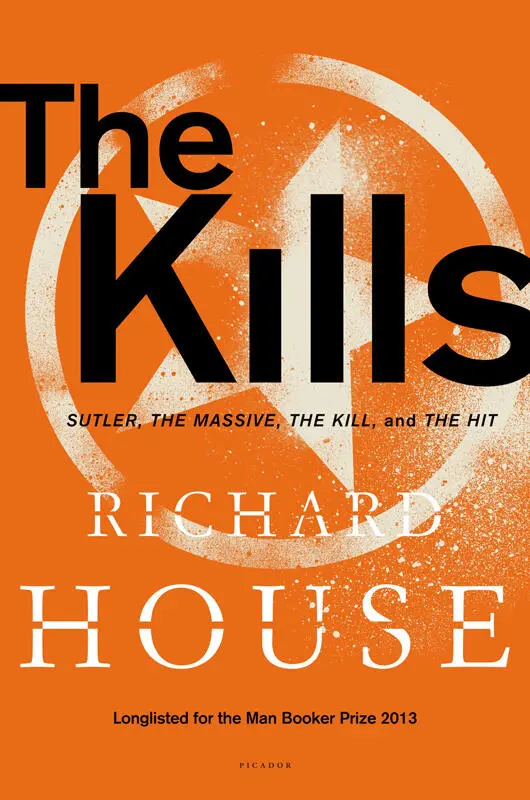
- Название:The Kills
- Автор:
- Издательство:Picador
- Жанр:
- Год:2013
- ISBN:нет данных
- Рейтинг книги:3 / 5. Голосов: 1
-
Избранное:Добавить в избранное
- Отзывы:
-
Ваша оценка:
The Kills: краткое содержание, описание и аннотация
Предлагаем к чтению аннотацию, описание, краткое содержание или предисловие (зависит от того, что написал сам автор книги «The Kills»). Если вы не нашли необходимую информацию о книге — напишите в комментариях, мы постараемся отыскать её.
The Kills — читать онлайн бесплатно полную книгу (весь текст) целиком
Ниже представлен текст книги, разбитый по страницам. Система сохранения места последней прочитанной страницы, позволяет с удобством читать онлайн бесплатно книгу «The Kills», без необходимости каждый раз заново искать на чём Вы остановились. Поставьте закладку, и сможете в любой момент перейти на страницу, на которой закончили чтение.
Интервал:
Закладка:
She found the largest collection of Geezlers in Wisconsin, alongside a collection of Geislers. A website on family genealogy, maintained by Annie F. Geezler and her husband BJ (seriously), clarified the link between the Geislers and Geezlers. Annie F. had devoted much energy into gathering the family’s history and building a website based on the trivial details she’d found. The Geezlers came from Hamburg. They’d bred in moderation. Conceived of businesses (clothing, printing, transportation). They suffered from bad luck, bad timing, and over-ambition (the Great Depression stopped the clothing business, a warehouse fire terminated the printing, loans crippled the transportation). They fought in wars and died pitifully, and with anonymity (in dockyard bombings, warehouse fires, and on Russian Fronts). Anne F. had married into the Geislers, and Cathy wondered why women always carried the memory of a family. Who else would take on the job? A husband called BJ, she figured, could only be useful for lame innuendo. Christ.
She brought the printout back to the apartment.
Nut followed Cathy from room to room, brows tightened, pained, as if in apology, and she found herself unusually affectionate toward him. She fed him scraps. Cuddled him. Spoke endless nonsense, tolerated his need to be close, and found him to be good company. Except, of course, for the gas.
‘Listen to this.’ She read details to Nut. ‘The American Geezlers changed their name in World War Two.’ She looked down at the dog. ‘To Greeves.’ She held out a piece of toast. ‘If I give you this toast I don’t want to be smelling it in a second.’
Cathy had a retentive mind for facts, and hadn’t Rem said that the man was Southern? South Carolina? And hadn’t he mentioned Pittsburgh? She hadn’t found any records for a Geezler, a Geisler, or any other variation from South Carolina, Pittsburgh, or, in case she hadn’t remembered correctly, Philadelphia. The references she did find were for Milwaukee. After the war the Greeves returned to Geislers and Geezlers, respectively.
Cathy dropped the toast.
The only other reference, a slang dictionary, listed geisler as an image of two girls kissing. Something traded, covertly, among adolescent boys.
Done with Geezler, she checked a second set of papers, information found from a metasearch: “burn pit” +lawsuit +exposure +Iraq, +legislation, +“sleep apnea” +sores +asthma +“respiratory problems”.
* * *
Maggie sat with the papers about her, picked at them at random, and said it still didn’t make much sense. So? Loads of veterans come back and get sick. It doesn’t mean anything. And anyhow, wasn’t this all from some rumour she’d heard at the Saturday market? Hardly reliable?
Cathy apologized and Maggie became conciliatory.
‘You know what I mean. You have a habit of running away with ideas. It’s just what you do.’
‘Look, there’s more online, more about the materials they’re burning and how they’re causing all kinds of problems. Headaches, nosebleeds, skin irritations. Healthy people are getting asthma. People who shouldn’t be getting sick are getting skin and respiratory problems. Cancer-like cysts. All this is happening as soon as they get back. People losing weight for no reason, people who have no energy. Problems with their immune system. It’s wrong.’
‘But how do you even know it’s true?’
‘There’s a lawyer in Tucson. Phyllis, at the library, found him. So far he’s contacted thirty men. He has a website, he’s working with doctors. He said all they need to do is prove what’s being burned in those pits.’ She handed Maggie a list. ‘Contaminants. This is what you get from burning plastic and polystyrene. You get sulphuric acid, you get these chemicals, you get carcinogens.’
‘Then why don’t they stop it?’
There was a difference between being wilful and dumb, and Maggie was pushing it.
‘They need proof. They need someone to take samples and photographs. They need documentation of what’s happening out there.’
Cathy itched to smoke. Her fingers lost for activity.
‘The thing is HOSCO have made a public statement about stopping the burning in the camps, so they know something is wrong. Everything is now sent to remote locations and burned, and where they used to classify and separate the waste, now they just burn everything, get rid of it as fast as they can, and they can’t be touched, because they have contractors to do the dirty work, people like Rem who won’t complain.’
She looked at the papers, disorganized now, and wondered why she’d tried to explain anything. It wasn’t that Maggie was stupid, she just didn’t need to care.
‘I found this.’ She held up a separate sheaf of papers. ‘There’s another burn pit in Camp Bravo. The people working there have just walked out. They abandoned the camp.’
‘Why did they do that?’ At last Maggie was interested.
‘Because they were burning illegal waste. HOSCO have said that they closed the camp. Here it says they walked out.’ Cathy offered the papers to Maggie.
* * *
Cathy sat at the kitchen counter and outlined the questions she wanted to ask Rem. Maggie wanted to know what this interest was really about, and the question troubled her. The answer, that this was about making sure that Rem wasn’t messing up his future health, she knew to be only partly true. It’s an occupation, she told herself, a way to organize the day. But this wasn’t quite to the point either.
Nut sat at her feet, satisfaction vibrated through his entire body; he focused completely on her, attentive to every move.
Stacked across the counter, a permanent feature now, were four box folders, each tidily marked: HOSCO/US; HOSCO/Iraq; Burn Pits & Case Examples; ARTICLES. Phyllis, a sharp reader, had made copies of articles from the New York Times, the Washington Post, the New Yorker; she had transcripts of interviews and CDs of podcasts: Alive in Baghdad, American Microphone, This American Life, War News Radio, all of which Cathy now stored.
1. What are you burning? Paper? Plastic? Particle board?
Polystyrene? Plywood? Wood? Rubber?
2. What protective clothes do you wear?
3. What type of masks / breathing apparatus do you use?
4. What kind of ash is produced?
5. How large is the particulate matter (PM)?
6. What are the smells? Compare to other smells, e.g., egg, sulphur, rubber, etc.
7. Does the smoke ever fall across the camp?
8. What are the symptoms, long term / short term (inc. shortness of breath, skin problems, asthma, headaches)?
9. What instructions have you received from HOSCO?
Much of this could be discovered through simple questions, nothing too challenging or direct. Below the questions she wrote a second list:
Dioxins
Lead
Cadmium
Formaldehyde
Fungicides
Hydrochloric Acid
Arsenic
If he hesitated she’d get to these, and outline the conditions they caused, to shake out the details.
* * *
Kiprowski, Chimeno, Samuels, and Clark worked with Sutler to clear out the Quonset. Rem, a little put out that the men had so readily stepped up to Sutler’s request for assistance (his own response was a curt ‘knock yourself out’). Midway through the morning Samuels found a logbook which he brought to Rem.
Rem sat at his cabin’s door with the logbook open on his lap, and guessed he was supposed to keep some kind of record of the fires: which pits were used, the number of vehicles in each convoy, the contents. He smoked as he read through the book, although smoking lately left a bad taste in his mouth. Tucked into the back page he found a copy of a manifest which listed safety grades with ash measured as Particulate Matter.
Читать дальшеИнтервал:
Закладка:
Похожие книги на «The Kills»
Представляем Вашему вниманию похожие книги на «The Kills» списком для выбора. Мы отобрали схожую по названию и смыслу литературу в надежде предоставить читателям больше вариантов отыскать новые, интересные, ещё непрочитанные произведения.







Обсуждение, отзывы о книге «The Kills» и просто собственные мнения читателей. Оставьте ваши комментарии, напишите, что Вы думаете о произведении, его смысле или главных героях. Укажите что конкретно понравилось, а что нет, и почему Вы так считаете.