Raja Rao - The Serpent and the Rope
Здесь есть возможность читать онлайн «Raja Rao - The Serpent and the Rope» весь текст электронной книги совершенно бесплатно (целиком полную версию без сокращений). В некоторых случаях можно слушать аудио, скачать через торрент в формате fb2 и присутствует краткое содержание. Год выпуска: 2014, Издательство: Penguin Publications, Жанр: Современная проза, на английском языке. Описание произведения, (предисловие) а так же отзывы посетителей доступны на портале библиотеки ЛибКат.
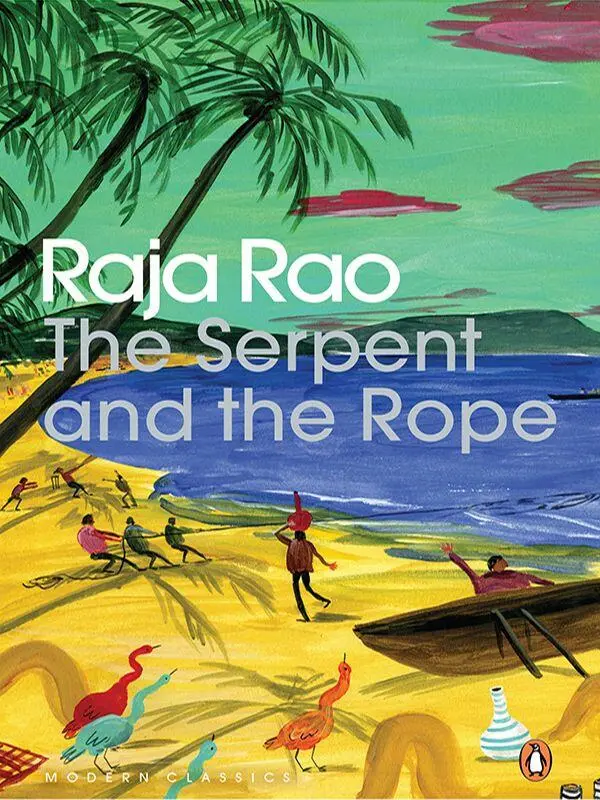
- Название:The Serpent and the Rope
- Автор:
- Издательство:Penguin Publications
- Жанр:
- Год:2014
- ISBN:нет данных
- Рейтинг книги:4 / 5. Голосов: 1
-
Избранное:Добавить в избранное
- Отзывы:
-
Ваша оценка:
The Serpent and the Rope: краткое содержание, описание и аннотация
Предлагаем к чтению аннотацию, описание, краткое содержание или предисловие (зависит от того, что написал сам автор книги «The Serpent and the Rope»). Если вы не нашли необходимую информацию о книге — напишите в комментариях, мы постараемся отыскать её.
The Serpent and the Rope — читать онлайн бесплатно полную книгу (весь текст) целиком
Ниже представлен текст книги, разбитый по страницам. Система сохранения места последней прочитанной страницы, позволяет с удобством читать онлайн бесплатно книгу «The Serpent and the Rope», без необходимости каждый раз заново искать на чём Вы остановились. Поставьте закладку, и сможете в любой момент перейти на страницу, на которой закончили чтение.
Интервал:
Закладка:
There was no answer to give. But just then a jeweller butted in to take a wax impression of Saroja’s palm or finger or wrist, and some flower-seller asked whether she wanted jasmines in the morning and roses in the evening, on the second day.
‘Throw your flowers to the Musa river, and drink a warm cup of milk afterwards,’ Saroja spat back.
‘Don’t say inauspicious things,’ Little Mother admonished from the inner courtyard.
The lizards on the wall were merry. There were lots of flies, for there were piles of rice and jaggery, and bananas, besan for laddus, and pappadams lay drying all over the terrace. Our maid Muthakka’s child, a boy of five, sat noiselessly somewhere saying ‘Hoy-Hoy’ against the crows and the flies. And when the flies went back to their walls to feed on their discoveries, the lizards slowly, without effort, discovered them. Everybody must have their share of marriage.
The guavas became red on the trees — and never was the jasmine so profuse with flowers. ‘A marriage at home,’ quoted Little Mother, ‘maketh well-water rise to lip of earth.’
‘Between a funeral and a marriage,’ said Saroja, ‘there isn’t much to choose. In both you have Brahmins with mantras— whether it is in Benares or here, it makes no difference — and in both you have the pandal first, and then music in front, flowers, bright shawls, fire. The only difference is that in one you are two, and in the other you are alone…’ Saroja was thinking of Father. ‘There, you see,’ she went on, ‘they’re bringing the mango leaves, and they’ll erect the pandal now…’ Little Mother listened to all this and said nothing. She looked towards me for help.
‘God knows,’ she said, when Saroja had gone somewhere, fooling about in her restlessness, ‘God knows, Rama, he’s such a nice person, is Subramanya. Not because he’s my own cousin’s son do I praise him; not because he’s audit officer with the Government of India do I praise him; but he’s so deferential, so clean. True, he’s not refined like you people are, but then all sorts must live in the world to make it a world. If your grandfather had looked at me and my great learning, would he have chosen me for your father, even for a third marriage? A woman has to marry, whether she be blind, deaf, mute, or tuberculous. Her womb is her life, and we cannot choose our men. True, in your part of the globe, in Europe, they say they choose their own husbands, and I’ve seen all this in the cinemas. But we are not Europeans. We are of this country — we are Brahmins. Well, yours was a destiny, strange, magnificent; you were always a favourite of the gods. How like a prince, a god, you looked as you came and stood in the sanctuary, Rama. You are not of this, our earth.’
‘From where am I then, Little Mother?’ I laughed.
‘Well, I do not know. You are made differently. There you are, a boy bright as you, going to Europe, winning big university degrees — and you do not drink, eat meat, or smoke; nor take on those vulgar ways Belur Krishnappa’s third son or Modi Venktaramayyas’s son-in-law had when they came back — with ugly pipes in their mouths and talking to their mothers as if they were charwomen of the household. And they would soon have to eat at tables and wear European clothes even at home. It must have been your mother, that holy lady,’ she said,
pointing to my mother’s big picture on the wall, ‘that made you thus.’ There was a desperate little silence, and then Little Mother continued: ‘This time, Rama, you won’t abandon us, will you? Even the fire knows you are here — from the day you came it has purred and purred… A man at home is like a god in the temple.’ To Little Mother a proverb always meant an incontrovertible truth. ‘You will like Subramanya,’ she added after a moment. ‘He’s just the man to keep under yoke a betwixt-left-and-right girl like Saroja…’
I lay on my bed in the afternoons, aloof and silent; waiting for something to happen — anything.
One afternoon — it must have been some two or three days before the marriage — the postman dropped a letter in through the window. It was from Madeleine, and this is what it said:
‘Rama, mon ami,
In the width of vast and varied spaces, I feel there is always a spot for happiness. Our unhappiness comes from the fact that we do not know what to choose, and when to choose. Life could be filled with pepper-mills — the whole of the equator could be lined up with the silly wooden and iron contraptions, for triturating black pepper over salad or baked potatoes. But one can also stop before a jasmine or a rose (like the one you planted last autumn, which has such lovely red, claret-red roses) and see the pattern of existence — know that all is everywhere, joy is in the instant; that what Georges calls God must be somewhere hereabouts, in the garden, perhaps, between the rows of petits-pois. When I leave the water-hose on near the cypress by the gate, the water gurgles and subsides, flowing evenly to the petits-pois, the jasmine and the roses.
‘This is just to tell you, sad though I am, that I think of you a great deal, and know you in many small things. For example, I miss you when the bathroom is not splashed about with water, or the pencil is not broken as it lies on your table. Women may grumble at their husband’s lack of consideration for them and for things, but our grumbling itself is a form of our love. Look at the letters of Eloise to Abelard, full of grumbles to her Lord in bed and her Lord in Christ. A woman must grumble — it’s her biological defence against the strength of man. I put flowers before your books, and light sandal-sticks at your table.
‘I wonder how you feel back in India, back in your family. We who are brought up in Europe — and especially of late singing Gide’s “Famille, je vous hais” like an incantation, like a mantra— for us any person other than a brother or sister is an outsider, an enemy. Sartre’s “L’ennemi, c’est l’autre”, is the continuance of Gide’s dictum. I know your father did not mean much to you, but your family does, I think. I’ve seen such joy on your face when I said, “A letter from India — from Saroja.” Love them for me — for I can love no one but you.
‘I often ask, lying in my bed, and reaching out in my feeling and touch to that which you have created in me, and which I continue to feed and to fulfil, what it is that brought us together, and what it is that will keep us together. Love is something so indefinable — though we glib Europeans use the word frequently — one cannot possibly love a body (made of the eighteen dhatus, elements, as the Buddhist Nagasena told the Greek King Menander). One cannot love that mirror with a thousand false facets called the mind, which hates what it once adored and fears what it once cared for so dearly. Beyond the body and the mind there may be the heart, but what does it mean? Is it that pumping machine, which feeds our veins with red blood. Can haemoglobules be a proof of love? We are such ignorant people. Every word seems a neologism or a tautology. I often laugh at Georges, who seriously talks of the monads of Leibnitz or the love intellectual of Spinoza as if they were eternal entities, just as Lavoisier thought of oxygen and hydrogen as chemical fundamenta that were preordained in some timeless textbook of God. But as Einstein came and upset the orderly, solid, Monsieur Hommais universe of our ancestors, India may still upset the Saint-Sulpice of Georges Khuschbertieff. Then hurrah to the Himalay!
‘Do I love you, I often ask myself? When I say that I mean, do I love you as Buddha loved Ananda…? “Ananda, dear Ananda do not grieve that the Enlightened One, the one who was like a father unto thee, has gone. Say, rather, ‘I shall be like a flame unto myself,’ and shine.” To help others be — to let the flower flower, let the water flow; to accept that birth and death are cycles, the affirmation of something; that is what love should be. Love should not be different from Truth. But could love be where Truth alone is? Could the sun be tender or the sound gentle? We make tenderness and gentleness. Shine on me, my Rama; as you see I am becoming a good wife.
Читать дальшеИнтервал:
Закладка:
Похожие книги на «The Serpent and the Rope»
Представляем Вашему вниманию похожие книги на «The Serpent and the Rope» списком для выбора. Мы отобрали схожую по названию и смыслу литературу в надежде предоставить читателям больше вариантов отыскать новые, интересные, ещё непрочитанные произведения.









Обсуждение, отзывы о книге «The Serpent and the Rope» и просто собственные мнения читателей. Оставьте ваши комментарии, напишите, что Вы думаете о произведении, его смысле или главных героях. Укажите что конкретно понравилось, а что нет, и почему Вы так считаете.