Raja Rao - The Serpent and the Rope
Здесь есть возможность читать онлайн «Raja Rao - The Serpent and the Rope» весь текст электронной книги совершенно бесплатно (целиком полную версию без сокращений). В некоторых случаях можно слушать аудио, скачать через торрент в формате fb2 и присутствует краткое содержание. Год выпуска: 2014, Издательство: Penguin Publications, Жанр: Современная проза, на английском языке. Описание произведения, (предисловие) а так же отзывы посетителей доступны на портале библиотеки ЛибКат.
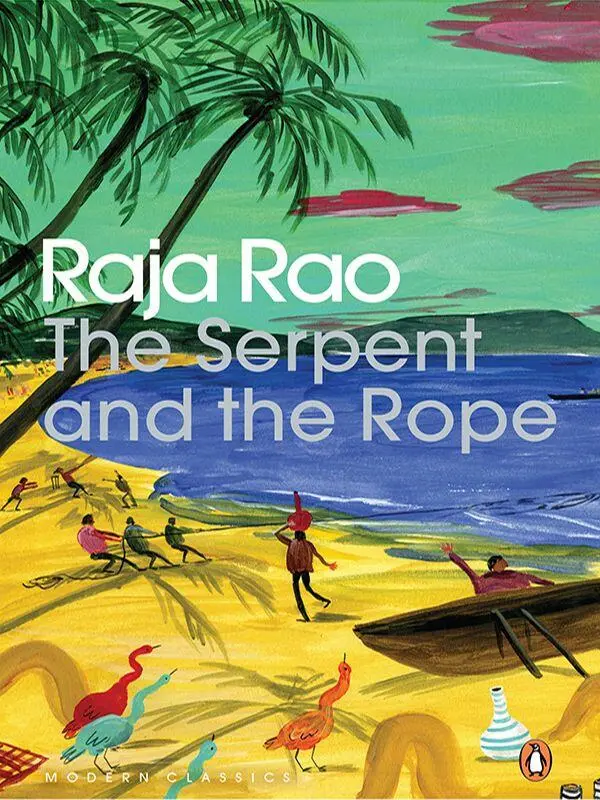
- Название:The Serpent and the Rope
- Автор:
- Издательство:Penguin Publications
- Жанр:
- Год:2014
- ISBN:нет данных
- Рейтинг книги:4 / 5. Голосов: 1
-
Избранное:Добавить в избранное
- Отзывы:
-
Ваша оценка:
The Serpent and the Rope: краткое содержание, описание и аннотация
Предлагаем к чтению аннотацию, описание, краткое содержание или предисловие (зависит от того, что написал сам автор книги «The Serpent and the Rope»). Если вы не нашли необходимую информацию о книге — напишите в комментариях, мы постараемся отыскать её.
The Serpent and the Rope — читать онлайн бесплатно полную книгу (весь текст) целиком
Ниже представлен текст книги, разбитый по страницам. Система сохранения места последней прочитанной страницы, позволяет с удобством читать онлайн бесплатно книгу «The Serpent and the Rope», без необходимости каждый раз заново искать на чём Вы остановились. Поставьте закладку, и сможете в любой момент перейти на страницу, на которой закончили чтение.
Интервал:
Закладка:
I told Lakshmi and Sharifa all about Benares and made them laugh. ‘All of us, that way, are Brahminee — kine, and someone who’s lost his dear ancestor searches for a cow or bull to offer it the pinda, and the bull suddenly remembers the strength in its feet, and rises, comes slowly, condescendingly; and not only eats away all the rice, but even the darbha grass. We, the Indians, abroad, therefore, I repeat, are the Brahminee- bulls. Nobody strikes us because we are so virtuous. Nobody washes us because we are so clean. We get the worship of others, and we have nothing to do. We ferry the dead to the opposite shore…’
The other Indians were not at all amused at the ripples of laughter that came from us: the Punjabees thought it did not sound Punjabee, the Dakhsinees found it irregular — women do not permit themselves to laugh in Maharastra! — the south Indians thought it was a sign of easy widowhood. Only a Muslim here and there enjoyed himself. We were grateful to Islam, that evening, for respecting human freedom.
‘India today,’ I continued, ‘to change the metaphor, is like the Second Empire. Every Indian in Cambridge is the son of a minister, or the daughter of an advocate-general (Sharifa’s father was an advocate-general), and you find sitting opposite the nephew of the prime minister, the son of the minister of finance from Jodhpur, the grandson of Sardar Patel, Rafi Ahmad Kidwai’s cousin, or the chief minister of Travancore’s brother-in-law. You have new maharajas and a new emperor. The first emperor — the Eagle — must die in exile or be shot. I Napoleon Bonaparte, emperor of the French, etc., etc. Then you have a revolution, and there’s his son the gentle duke of Reichstadt, roi de Rome, l’Aiglon, who dies at Schoenbrunn or anywhere else, for that matter. The Revolution of 1848 can come through an economic evolution — history is not concerned with fact-sequence but with a pattern-sequence — and you have a Napoleon again, the Prince-Président. There’s a Victor Hugo in exile and but now in Moscow — Bipin Chatterjee would be his name. There’s a Balzac, and today his name might be Jainenendrakumar Jain. There’s even a Princess Eugénie. She’s not a wife — she’s a Sister.’
Sharifa roared with laughter. ‘When, pray, is the Third Republic? ‘she said.
‘This time, madam, there will be no Third Republic, no Monsieur Thiers. History has changed its mind. We will have a king this time.’
‘Who?’ asked Lakshmi, amused.
‘Some Rathor, of the dynasty of Sri Rama, with a Sage Vasistha behind him. Vedanta must become real again before India can be truly free. You know what Mahatma Gandhi said, “My freedom is not when the British leave India, for that is inevitable and will be soon, but when we become true satyagrahis — when we seek the Truth, humbly, fervently, and with non-violence in our hearts.” That for me is India, not a country, not an historical presence among nations, but a hypostatic presence. Someone before the war wrote a book, Forward from Liberalism. Now someone must write, Forward from Marxism.’
‘Forward to what?’ asked Sharifa.
‘To Vedanta,’ I said, as though I’d murmured to myself ‘Savithri’.
‘You are going back in time?’ remarked Lakshmi.
‘In Vedanta there is no going back or forward — just as in Indian music there can be nothing new, for all that is musical has been included in Indian ragas. You can only sing and create, hour after hour, day after day, as our musicians do — like Fayyaz Khan did when he sang Khelatha nanda kumar for four nights on end. In the same way Indian history plays a melody to itself, creating and recreating itself, standing not against sound but in silence. India is apart, that is why she has no history. India is everybody’s: India is in everybody. It is in that sense, I think, that Mahatma Gandhi said, “When we are free, all will be free.” Let us truly be satyagrahis — graspers of the Truth — and that humbly is my India,’ I said, with almost a failing voice.
I was paying homage not to my country — not to the land of great mountains and big rivers, for these too I love; not to the country of Asoka or Akbar, however great and universal these may be — but to some nameless magnanimity, a mystery that has eyes, a sense of existence, beautiful, beautiful Mother, my land…
I went home and wrote a sweet letter to Madeleine. I told her what to me was a truth. I loved her more than ever, not because of what she was — for that was, as it were, her affair — but because I had changed, had enlarged into myself, I felt thinner, lighter, and with a greater curve of being. I loved her, I told her, because she had borne Pierre, I loved her again for the reality that was shaping itself in her, I loved her for the woman that she was — that was mine, and that I had, for an instant, for a series of instants, seen and was merged in light. I had grown to respect her more, knowing that human love as I knew it then was imperfect, as language is imperfect, but that love was possible, was real: the more real and possible because I was far away — I would go farther away still. Space is the need of love, I had once read somewhere, and she who gives space to one, gives one the permission to love.
I realized by now that I was not in fact writing to Madeleine but to Savithri, and I abruptly brought the letter to an end. ‘I shall be back in Aix, within a week or ten days, and meanwhile grow into beauty, my love, my wife,’ I begged her, as though I had come to a conclusion. The toe-rings remained in my trunk and I knew no peace. All was an absence, like the space over the bare trees and the Cam. Some bell rang the hour, and silence journeyed back among the streets: the proctors had gone to sleep. And one dim, rainy Sunday I left Cambridge for London.
~
In London I could not say whether I was happy or unhappy. I walked back and forth in my room in Kensington — it was on the third floor of an old building, and looked out on a lovely square beyond which one felt the river — I walked up and down the room, stopping sometimes to put a shilling into the gas- meter or to warm myself. Or I would snatch a book and read a quarter of a page, or jump on my bed and go to sleep for a blank quarter of an hour. And I tried thus to formulate myself to myself. I like these equations about myself or of others, or about ideas: I feed on them.
I could see in myself a vastness, as it were a change of psychic dimension, an awareness of a more ancient me. There was no joy in this knowledge, no, no exaltation. There was just a rediscovery, as though having lost a brother in famine or on pilgrimage I had wandered hundreds of miles, had asked policeman and mistress of household for him, had asked barbers, tradesmen, and sadhus for him; as though walking back through time I had asked men with a more antique form of tuft on their heads, with voices more grave, with lips more lecherous; as though from Muslims as they consolidated their ramparts, sentry-chambers, palaces, ‘Brother, have you seen my brother?’ I had asked; from kings, and going beyond, by the Ganges or the Cauvery, from saints and sages I had asked, backwards in history to the times of the Upanishads, even unto Yagnyavalkya and Maitreyi; and as though at each epoch, with each person, I had left a knowledge of myself, a remembered affirmation of myself; and in this affirmation had been the awareness of the Presence that I am, that I am my brother. Thus it was as I walked about in my Kensington room, feeling the cold of London, the dampness of the river, and my own lung twist a little here and there, as though it also was a recognition, a memory.
How much of the time we live in our past: in a Florentine bridge or a kneeling Madonna of Santa Maria Novella; in a breath of thyme and rosemary from the Pyrénées, the face of a child seen at an Easter Service at the Montagne Ste-Genevieve; in the name of a book, the look of a bishop; and far away, in all India, with its little railway stations, with turbaned, beedi- smoking stationmasters — Dhumath Khed, Bhumath Khed, Parusram, Alviya, Medhi Mogharpur — all sounding like some names one has known, one has lived, just as one remembers the names of battles at school in a history book. Then you like cucumber and not the bitter gourd, like the honey of the Vindhyas and not that of the Kuruvai Hills; you like Subramanyam at first sight and you do not bother so much about Subbu, your brother-in-law from Bangalore; you like Little Mother and hate your grandmother; you like Saroja, your sister, not because she is your sister but for something else — you marry Madeleine. Where, I ask you, does history stop, and where do you begin? You can go back through biological constructs and though it be difficult to know yourself you can think yourself a dinosaur, an orang-utan, a bison, heifer or nightingale. You might feel yourself a peacock or a porcupine, then feel the more ancient tall deodar of the Himalaya. Sitting under the deodar you may feel memories that have no age, filling you with continuity. You cannot escape time. But you can escape yourself. And in such an escape, in the dim periphery of yourself you meet with fear, with biological fear. But if like a boar or a dog you dig deeper with your muzzle, you will see with wonder the budumékaye break open on the jungle path — and you enter, the huge rock lifting like a gate, you enter the kingdom of the seven sisters; a Cathar, ‘un Pur’, you enter the Grotte d’Orolac, the Mani, with the Holy Grail in your hand.
Читать дальшеИнтервал:
Закладка:
Похожие книги на «The Serpent and the Rope»
Представляем Вашему вниманию похожие книги на «The Serpent and the Rope» списком для выбора. Мы отобрали схожую по названию и смыслу литературу в надежде предоставить читателям больше вариантов отыскать новые, интересные, ещё непрочитанные произведения.









Обсуждение, отзывы о книге «The Serpent and the Rope» и просто собственные мнения читателей. Оставьте ваши комментарии, напишите, что Вы думаете о произведении, его смысле или главных героях. Укажите что конкретно понравилось, а что нет, и почему Вы так считаете.