Raja Rao - The Serpent and the Rope
Здесь есть возможность читать онлайн «Raja Rao - The Serpent and the Rope» весь текст электронной книги совершенно бесплатно (целиком полную версию без сокращений). В некоторых случаях можно слушать аудио, скачать через торрент в формате fb2 и присутствует краткое содержание. Год выпуска: 2014, Издательство: Penguin Publications, Жанр: Современная проза, на английском языке. Описание произведения, (предисловие) а так же отзывы посетителей доступны на портале библиотеки ЛибКат.
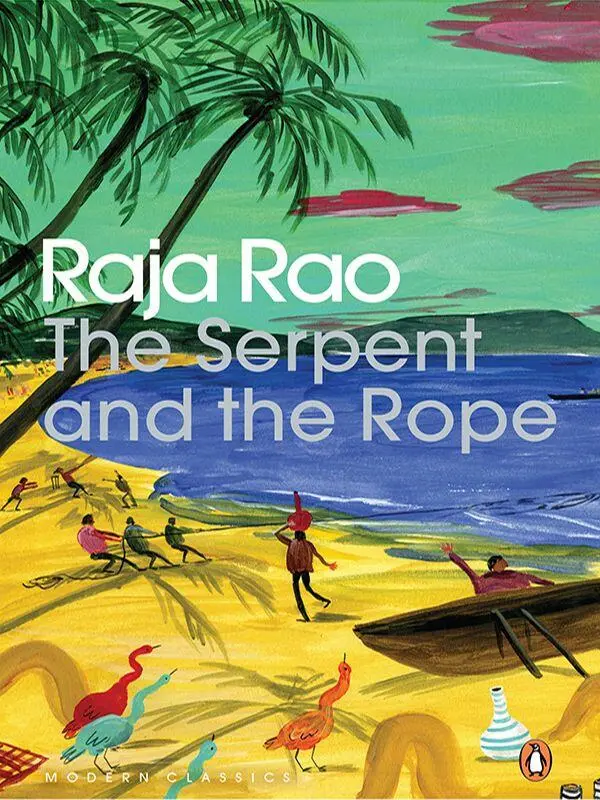
- Название:The Serpent and the Rope
- Автор:
- Издательство:Penguin Publications
- Жанр:
- Год:2014
- ISBN:нет данных
- Рейтинг книги:4 / 5. Голосов: 1
-
Избранное:Добавить в избранное
- Отзывы:
-
Ваша оценка:
The Serpent and the Rope: краткое содержание, описание и аннотация
Предлагаем к чтению аннотацию, описание, краткое содержание или предисловие (зависит от того, что написал сам автор книги «The Serpent and the Rope»). Если вы не нашли необходимую информацию о книге — напишите в комментариях, мы постараемся отыскать её.
The Serpent and the Rope — читать онлайн бесплатно полную книгу (весь текст) целиком
Ниже представлен текст книги, разбитый по страницам. Система сохранения места последней прочитанной страницы, позволяет с удобством читать онлайн бесплатно книгу «The Serpent and the Rope», без необходимости каждый раз заново искать на чём Вы остановились. Поставьте закладку, и сможете в любой момент перейти на страницу, на которой закончили чтение.
Интервал:
Закладка:
‘I’ve seen you look at a flower or stand at the weir and hear the Cam purr till you are absorbed in yourself. You come out after a long, long silence and say, “Have I made you wait too long?” And with what a melting voice!’
‘Tell me then, wise man, what happens when I hear the Cam purr?’
‘The wise man says: When the Cam purrs for a long time Savithri becomes Savithri. First Savithri listens to the river, then she listens to her own heart, then she listens to her own silence — and then she is lost.’
‘Where, sir?’
‘Nowhere, young lady. You are lost to everything — and not to yourself. “Ambo yatha salilam seva tu tat samagram”—that is, “it’s always and forever but water”.’
‘I think I understand. Go on.’
‘I obey. As Proust says, after all we can only know ourselves.’
‘Does it mean, then, that one cannot love another?’ She was in haste, as she wanted to hear it proven that Pratap could love her, but that she might not love him and yet marry him. Pratap was always on her mind.
‘No, you can love another. But love can never be a movement, a feeling, an act. All that acts can only be of the body, or the mind, or the ego. Only the selfish can love.’
‘And the loveless?’
‘They become love.’
‘Meanwhile?’ she asked eagerly, apologetically, like a peasant asking an astrologer when the rains will fall.
‘Meanwhile you sing the song of the Soviet land,’ I said, and we laughed so much that some kind professor’s spouse, taking her pug for its walk, found that the Britannic canine sensibility had been hurt in this, the kingdom of England, by such outrageous behaviour. The halls of Trinity must have heard our laughter and the dog, relentlessly, continued to bark.
‘Pugs, Madame,’ I said to Savithri, ‘are a bourgeois conception, and would not therefore be allowed in the fatherland of Socialism. You can say “psh — psh — psh” (like our peasants call back dogs in India) to most people in the Soviet land — anyway they carry labels, chains, and municipal hygiene certificates, allow their tails to be cut or have muzzles put on their beakers — so dogs are not allowed.’
‘That’s sheer American propaganda!’ she protested.
‘Don’t you know I’m in the pay of America,’ I laughed. ‘Except that the Americans are anti-George the Third, so they’re confirmed anti-royalists, and they’d have nothing but laughter for my kingless royalism or for my Vedanta. I should have been born in the seventeenth century, should have called myself Rama Bhatta and written complicated panegyrics on some obscure prince, like the great Jagannatha Bhatta did.’
‘Not on a princess?’ she asked.
‘No, a Brahmin in those days could never have married a princess.’
‘But Jagannatha Bhatta did.’
‘Well, so they say…’
‘He married Shah Jehan’s own daughter,’ she continued, half in fun and half seriously. ‘Or rather he took her to Benares, and the whole populace rose in anger that a Muslim, even a Mogul princess, should enter the great temple of Kalabhairava Himself. So the poet led her through lanes and by gutters to the ghats of the Ganges, and said, “Mother Ganga, great Mother Ganga, I bring thee my bride, my princess…”
‘The River Ganga rose, she rose wave after wave upwards, and washed the feet, did Mother Ganga, of the holy bride…’
‘And Jagannatha Bhatta thereupon composed those celebrated verses of the Gangalahari:
Nidhānam dharmanām kimapi cha vidhānam
Navasudām tirhanām amala paridhānam trijiagatah
Abode of all dharma,
Sole giver of pleasure to the young;
Centre of holy waters,
Bright garland of the three worlds.
‘He might at least have praised her too?’ she added.
‘Well, I shall myself. And may I then write a Sanskrit verse, in Cardulā vikridïta 1about you?’ I asked. ‘Will you permit me?’
‘Since my eighteenth-century ancestor perhaps no one has had a panegyric addressed to him in Sanskrit, so why not! My more recent ancestors employed Mogul poets to write of Alexander the Great or of Suhrab and Rustam, and at best some bulbul might drink teardrops from a princess’s marble hand. If you went further you were tied to a pillar, and your skin peeled off your back. I didn’t tell you the end of the story. My father wept the whole night with the father of the boy, and gave the young Muslim a scholarship and sent him to study in Aligarh. The verse wasn’t bad; I can still remember it:
The dew waking asked the Sun, O thou all — seeing,
Give me the eye that sees, the red lamp that illumines
So that before the bulbul has begun to sing her lamentations
I will have looked on the curve of her eyebrows.’
‘True,’ I said, ‘your eyebrows are the most beautiful part of your face.’
‘A nasty thing to say, but go on.’
‘Your skin is perhaps even more wondrous. Five hundred years of being shut away in the zenana.’
‘Seven hundred, please, for it was Altamash that conquered us first.’
‘Well then, seven hundred years of zenana life has given your skin the texture of self-luminescence.’
‘And so?’
‘And so when you fall into your silence, it’s as though you contemplate a crystal from inside.’
‘And what a roundsome bowl too!’ she added, hilarious.
‘Roundsome, true, but a jaltarang 2on which a musician could play.’ Suddenly the hilarity stopped, the eyelashes fell on themselves, and any professor’s pug, mesmerized into the orbit of Savithri’s knowledge, might have sat as some dogs do, in the tapestries of Bayeux, their ears stretched back, their tail out, their hind quarters from which rises a conviction, a strength that illumines their eyes.
When Savithri went into this state I fell into myself, and forgot all but the feel that existence is I. I am, therefore the world is. I am, therefore Savithri is. How I would have loved to have taken Savithri into my arms; how natural, how true it would have been! But we were not one silence, we were two solitudes. What stood between Savithri and me was not Pratap, but Savithri herself. Meanwhile she had her gods and her holy land, and she was happy with the comrades, and the Union of Soviet Socialist Republics. Mao was still unfamiliar, and too near the Indian frontiers: she had given him no official recognition in herself yet.
On this particular afternoon, however, she suddenly appeared, unusually late, her high heels making her look more unsettled on her feet than ever. As she came running up, with her two companions following almost behind her, and stood before me, I must have looked so lonely and angry that she just laid her hand on mine as it lay on the wall of the bridge. Nothing was said, nothing needed to be said: her sorrow just gurgled out of her, as she breathed a long and heavy sigh. Her companions stood on the opposite side of the bridge, looking down into the waters. She knew damp was no cure for my lungs and said suddenly, like a nanny might to a child, ‘I’ve not heard you cough for a long time, for such a long, long time. It’s true, isn’t it?’ It was true indeed, and she knew it was she that made my breath regular and rested.
‘I’m sorry,’ she said, as we all walked through Senate House Passage towards the Adelphi. ‘Come, Ramaswamy, let’s have dinner together — all of us — and then you can go back to work. I’d completely forgotten I’d told Jack I would keep this Wednesday evening free for a dance. He’d bought the tickets, and I was starting out here when he suddenly appeared.’
‘Ah,’ said Jack Hollington as though apologetically coming towards us, ‘if I’d been a minute late I couldn’t have known where Savithri was unless I’d gone round with a loudspeaker van.’ How heavy British humour looked after the niceties of French wit. ‘Yes,’ he continued, as though speaking of a rugby match, ‘and we’d hardly gone ten yards when Michael Swanston appeared at the gates of Girton, saying ‘Hullo, Miss Rathor! I’ve a date with you. Don’t you remember we promised to go to that Kingsley Martin lecture?’ But Swanston hadn’t bought his tickets yet, and as he’s a comrade he hadn’t dressed, as I had.’ And Hollington looked himself up and down.
Читать дальшеИнтервал:
Закладка:
Похожие книги на «The Serpent and the Rope»
Представляем Вашему вниманию похожие книги на «The Serpent and the Rope» списком для выбора. Мы отобрали схожую по названию и смыслу литературу в надежде предоставить читателям больше вариантов отыскать новые, интересные, ещё непрочитанные произведения.










Обсуждение, отзывы о книге «The Serpent and the Rope» и просто собственные мнения читателей. Оставьте ваши комментарии, напишите, что Вы думаете о произведении, его смысле или главных героях. Укажите что конкретно понравилось, а что нет, и почему Вы так считаете.