Paul Beatty - Slumberland
Здесь есть возможность читать онлайн «Paul Beatty - Slumberland» весь текст электронной книги совершенно бесплатно (целиком полную версию без сокращений). В некоторых случаях можно слушать аудио, скачать через торрент в формате fb2 и присутствует краткое содержание. Год выпуска: 2009, Издательство: Bloomsbury USA, Жанр: Современная проза, на английском языке. Описание произведения, (предисловие) а так же отзывы посетителей доступны на портале библиотеки ЛибКат.
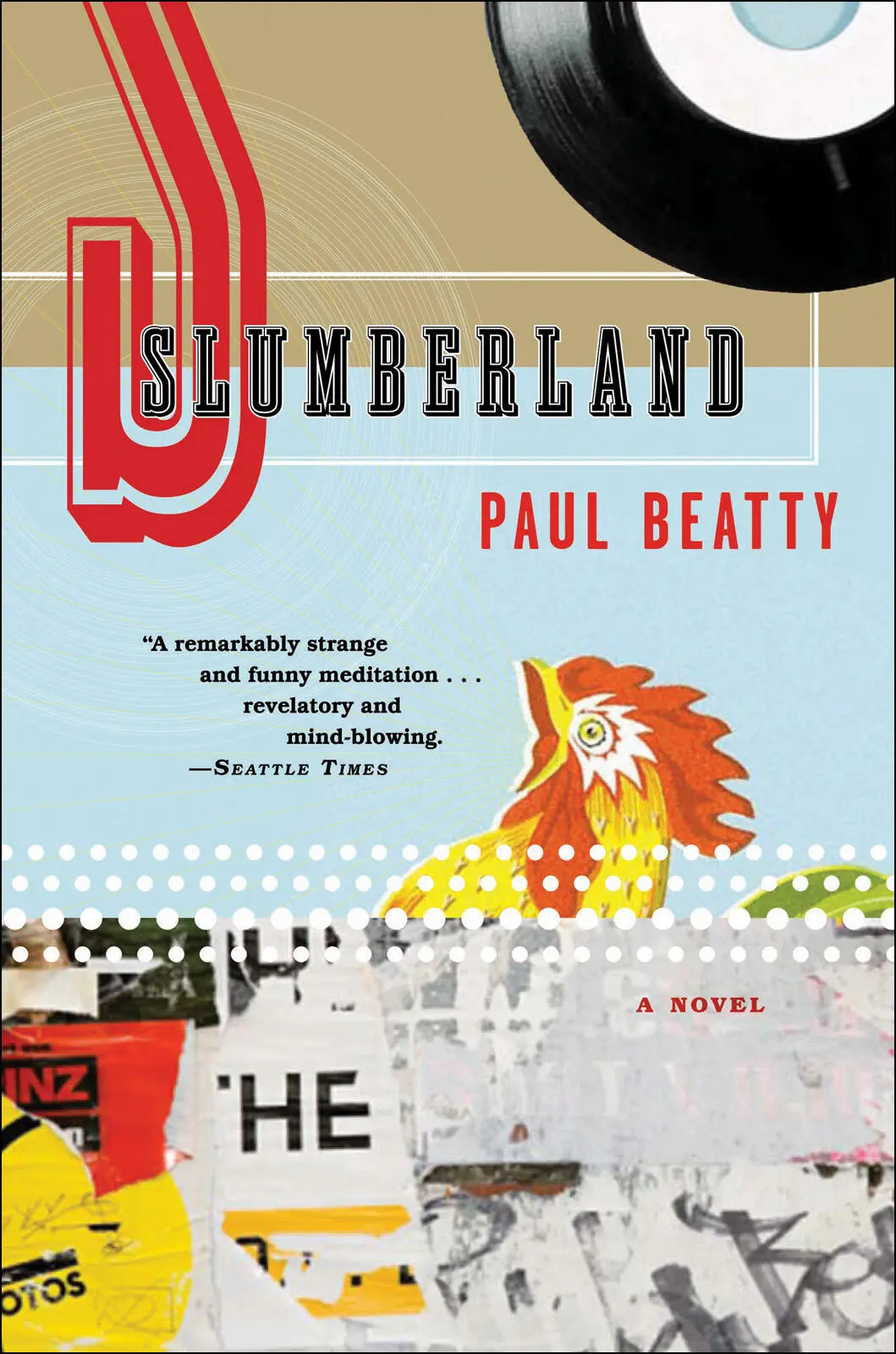
- Название:Slumberland
- Автор:
- Издательство:Bloomsbury USA
- Жанр:
- Год:2009
- ISBN:нет данных
- Рейтинг книги:4 / 5. Голосов: 1
-
Избранное:Добавить в избранное
- Отзывы:
-
Ваша оценка:
Slumberland: краткое содержание, описание и аннотация
Предлагаем к чтению аннотацию, описание, краткое содержание или предисловие (зависит от того, что написал сам автор книги «Slumberland»). Если вы не нашли необходимую информацию о книге — напишите в комментариях, мы постараемся отыскать её.
is laugh-out-loud funny and its wit and satire can be burning…There are incredible moments of tenderness…Beatty is a kind of symphonic W. E. B. Du Bois.”—
Ferocious, bombastic, and hilarious,
is vintage Paul Beatty and belongs on the shelf next to Jonathan Lethem, Colson Whitehead, and Junot Diaz. In this widely praised novel of race, identity, and underground music, DJ Darky has created the perfect beat. Now, he must seek out Charles Stone, a little known avant-garde jazzman, who can help bring his sonic masterpiece to fruition.
Slumberland — читать онлайн бесплатно полную книгу (весь текст) целиком
Ниже представлен текст книги, разбитый по страницам. Система сохранения места последней прочитанной страницы, позволяет с удобством читать онлайн бесплатно книгу «Slumberland», без необходимости каждый раз заново искать на чём Вы остановились. Поставьте закладку, и сможете в любой момент перейти на страницу, на которой закончили чтение.
Интервал:
Закладка:
“So the Schwa’s alive?”
“Very much so. I don’t know where he is, but you’ll find him. That’s why I put the Slumberland’s address on the envelope. He’ll come through there — all you soul brothers do.”
“So why shoot yourself?”
“That was my dick in the chicken.”
“Fire at will, motherfucker.”
The chickenfucker laughed and lowered his gun. I scrambled out.
“One more thing,” he said, starting the engine. “In time you will meet a woman named Klaudia von Robinson.”
“Von Robinson?”
“It’s not part of the master plan, but marry her anyway.”
Blaring its horn, the Benz parted the crowd and drove through the gate. The Spy Who Loved Chickens flashed his ID and the guards scrambled to their wobbly feet and bowed and scraped and saluted and raised the tailgate all at the same time. I wondered what the Schwa had to do with East German scat porn and the collapse of Communism.
The parade of returnees was thicker now. So was the crowd watching them return to the other side of the Iron Curtain. A large middle-aged man wearing a tweed blazer with suede patches peeling from the elbows, faded from liquor, three fingers of perestroika, and a jigger of glasnost, spotted my black face in the overwhelmingly white crowd. He stumbled up to me and ensnarled me in a big bear hug. When he released me, he threw up his arms and shouted, “Ich bin frei!” I am free! Then, cribbing from Kennedy’s famous speech, he whispered in my ear, “Ich bin ein Negro. Ich bin frei jetzt.”
The claim was heartfelt. For him, being black and free was a boast, not a conundrum or an oxymoron. I, however, believed him more black than free. I thought of something my father would say whenever he’d come across a hard-luck colored person in a witness box, cardboard box, or coffin box before his time. He’d say, “Lincoln freed the slaves like Henry Ford freed the horses.”
I suppose being East German was a lot like being black — the constant sloganeering, the protest songs, no electricity or long-distance telephone service — so I gave the East German Negro a hearty soul shake and a black power salute and wished him luck with the minimum-security emancipation he’d no doubt serve in the new German republic.
Full of the wonders of brotherhood, I approached the only other black face on the street. It was the security guard from the Amerikahaus, still in uniform and standing stolidly among the revelers. Eager to discuss the geopolitical ramifications of the breakup of the Soviet Bloc with a fellow member of the reified oppressed, I asked him what he thought about the goings-on.
“What do I think?” he sneered. “More white pussy. That’s what I think.”
The black man’s burden had never been heavier than it was at that moment. And I was more convinced than ever that the only thing that mattered was good music. Everything else was dead weight.
I took out my minirecorder and taped the sounds of freedom. Cars horns blared. A woman slammed a pickax into the Wall, grew tired, and then began to spit at the bricks. Chanting. Clapping. People said, “Wunderbar!” whenever a reporter shoved a microphone in their faces. Cameras clicked. Singing. Flashbulbs popped. A beer-hammered young man, too inebriated to lift his head, vomited his first Big Mac onto his first pair of Air Jordans. His boys teased him about wasting a month’s pay on sneakers that didn’t even last him a day. All in all, freedom sounded a lot like a Kiss concert.
CHAPTER 2
AFTER THE BERLIN WALL fell I never told anyone about my encounter with the chickenfucker and his internecine plans for my future. Despite his prognostications concerning the Schwa and a Klaudia von Robinson, nothing really much changed for me, except that I spent an inordinate amount of time watching syndicated broadcasts of The All-New Mickey Mouse Club . Every afternoon at one o’clock I’d flip on the TV and grouse to the unlucky woman who’d accompanied me home the previous evening that the little blond cutie-pie cabal of Justin, Christina, and Britney was evil incarnate. When the trio would be introduced for their next number I’d whine, “They might as well say, ‘P. W. Botha, Imelda Marcos, and Eva Braun will now sing “Love Me Tender.” ’ ”
When I wasn’t decrying the future of pop music, I was at the Slumberland. Liter of beer in hand, I’d wander from table to table drunkenly prophesizing about a reunited Fatherland’s return to world supremacy. If not militarily, then cinematically, and if not that, a resumption of dominance on the soccer pitch at the very least. Unlike the chickenfucker’s predictions, none of my divinations have come to pass, of course, but it’s still early yet.
Klaudia von Robinson was the first of his presages to come true. I met her at a party I DJed at the Torpedo Käfer, a quaint six-table bar, two burly speed-metal musicians short of being trendy, in an East Berlin neighborhood two Thai restaurants short of being gentrified.
My pay was forty deutschmarks and a fold of shitty discotheque blow left over from the seventies. I did the lines in the bathroom, half expecting to see Ziggy Stardust come stumbling out of a toilet stall, rubbing his gums for a freeze, complaining to anyone who’d listen that the coke was more stepped-on than Sacco and Vanzetti’s civil rights.
I don’t remember how long the Wall had been down, but I remember bringing more records to that gig than usual. Other than the time I took a photo at Checkpoint Charlie wearing a fur Russian Red Army hat, earflaps down, to send to my mother, I don’t think I’d yet visited East Berlin with any sense of purpose. I had no idea what to play, and the cab driver waited patiently as I filled his backseat and trunk with milk crate after milk crate of records.
In order to fulfill my part in the resurrection of the black man, Lars determined to keep me alive by using his many connections to get me DJ and jukebox-sommelier gigs. I’d worked most of the clubs in West Berlin and had long since stopped measuring time in days of the week. Tomorrow was the day after South African pop night at Abraxas. Yesterday was Jazz Brunch at the Paris Café, pre-1935 Dixieland played by all-white bands with an allowance for any colored nostalgia about the Confederacy or lazy Negroes and rivers. The day before that it was Celia Cruz and more Celia Cruz at the Boogaloo. What music do the economically and politically subsumed listen to? Do they want punk rebellion or blue-jean conformity? Do they want to forget or remember? Do they want to dance or fight? I got in the taxi thinking compromise: the Pogues, Sham 69, the Buzzcocks, and some Wasted Youth and Neighborhood Watch demos, two Southern California bands I followed from backyard to backyard in the early eighties.
The cabbie didn’t know the eastern half of the city very well, but as he slowed in front of a frosted plate glass window on a dark cobblestone street, he pointed to an electric chalkboard hanging on the front door. The question of what to play was answered in Day-Glo orange.
To-nite
BLACK MUSIC!
That narrowed it down.
“No worries,” I said to myself, “I’m prepared. I’ll spin the black classicists — Marion Anderson, Samuel Coleridge-Taylor, André Watts, Kathleen Battle, some Malinké fourteenth-century circumcision chants, maybe a bit of that Negro klezmer all those bored jazz musicians are playing.” I did the cocaine in the water closet and knew immediately something was off. The bar was too crowded. The tables full. Every stool occupied. I checked my watch. I wasn’t late. People weren’t even due to trickle in for at least another hour or so. As I set up my console under the sneak peeks and unblinking stares, it dawned on me that I and not my music was the entertainment, the atmosphere. That night I spun mostly the unsung American and German funkateers: Shuggie Otis, Chocolate Milk, Xhol, Manfred Krug, and Veronika Fischer, throwing in a dash of sing-along grooves here and there for the uninitiated — the Bar-Kays, AWB, Slave, Gil Scott-Heron.
Читать дальшеИнтервал:
Закладка:
Похожие книги на «Slumberland»
Представляем Вашему вниманию похожие книги на «Slumberland» списком для выбора. Мы отобрали схожую по названию и смыслу литературу в надежде предоставить читателям больше вариантов отыскать новые, интересные, ещё непрочитанные произведения.







Обсуждение, отзывы о книге «Slumberland» и просто собственные мнения читателей. Оставьте ваши комментарии, напишите, что Вы думаете о произведении, его смысле или главных героях. Укажите что конкретно понравилось, а что нет, и почему Вы так считаете.