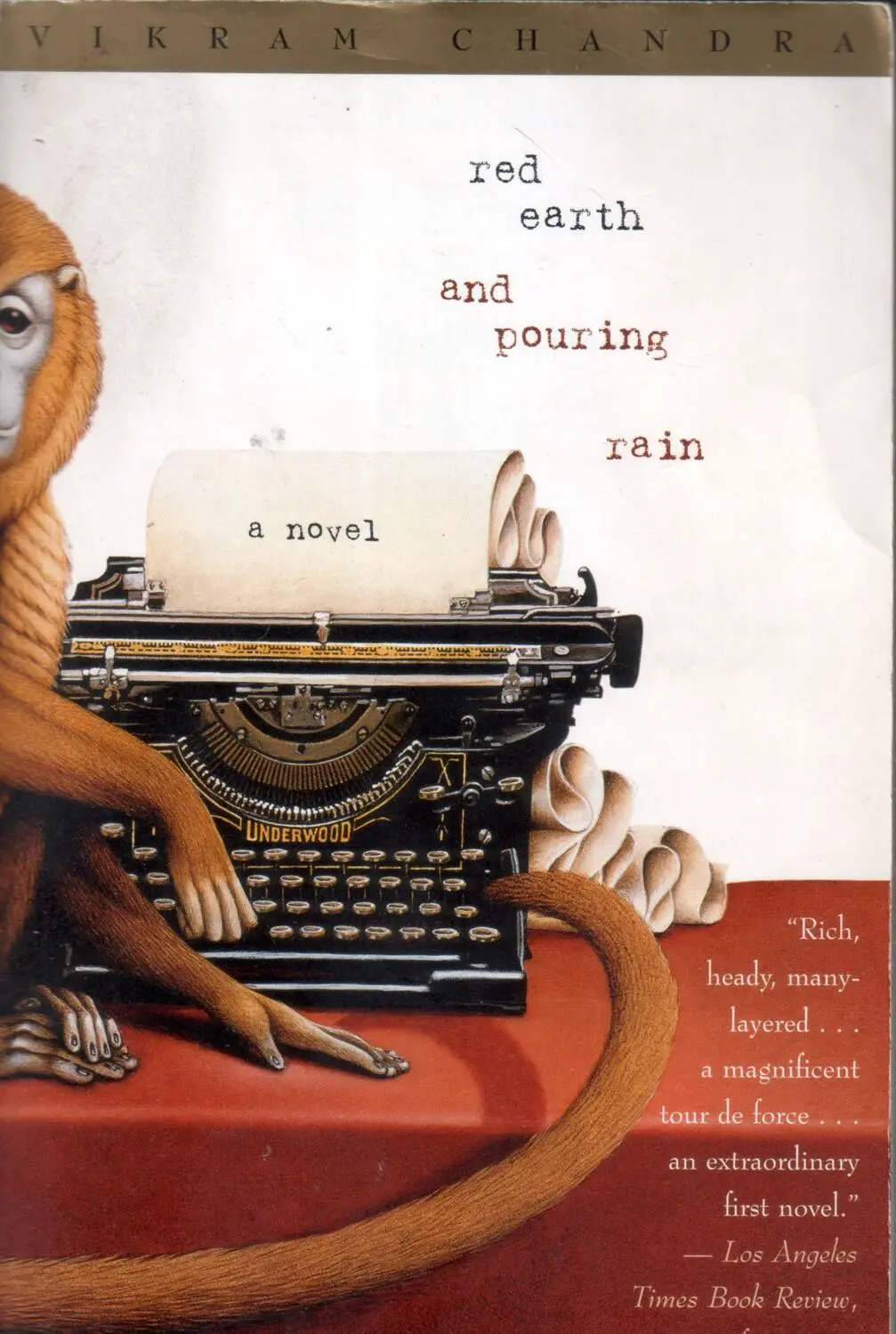
Vikram Chandra - Red Earth and Pouring Rain
Здесь есть возможность читать онлайн «Vikram Chandra - Red Earth and Pouring Rain» весь текст электронной книги совершенно бесплатно (целиком полную версию без сокращений). В некоторых случаях можно слушать аудио, скачать через торрент в формате fb2 и присутствует краткое содержание. Год выпуска: 2006, Издательство: Penguin Books,India, Жанр: Современная проза, на английском языке. Описание произведения, (предисловие) а так же отзывы посетителей доступны на портале библиотеки ЛибКат.
- Название:Red Earth and Pouring Rain
- Автор:
- Издательство:Penguin Books,India
- Жанр:
- Год:2006
- ISBN:нет данных
- Рейтинг книги:4 / 5. Голосов: 1
-
Избранное:Добавить в избранное
- Отзывы:
-
Ваша оценка:
Red Earth and Pouring Rain: краткое содержание, описание и аннотация
Предлагаем к чтению аннотацию, описание, краткое содержание или предисловие (зависит от того, что написал сам автор книги «Red Earth and Pouring Rain»). Если вы не нашли необходимую информацию о книге — напишите в комментариях, мы постараемся отыскать её.
is an unforgettable reading experience, a contemporary
— with an eighteenth-century warrior-poet (now reincarnated as a typewriting monkey) and an Indian student home from college in America switching off as our Scheherazades. Ranging from bloody battles in colonial India to college anomie in California, from Hindu gods to MTV, Chandra's novel is engrossing, enthralling, impossible to put down — a remarkable meditation on quests and homecomings, good and evil, storytelling and redemption.
Red Earth and Pouring Rain — читать онлайн бесплатно полную книгу (весь текст) целиком
Ниже представлен текст книги, разбитый по страницам. Система сохранения места последней прочитанной страницы, позволяет с удобством читать онлайн бесплатно книгу «Red Earth and Pouring Rain», без необходимости каждый раз заново искать на чём Вы остановились. Поставьте закладку, и сможете в любой момент перейти на страницу, на которой закончили чтение.
Интервал:
Закладка:
The next morning Kyrie called. “We’ve found my grandfather.”
“No!”
“Yeah. Or actually he found us. He heard from somebody at a bar that we were looking and called us.”
We met them at a bar downtown, under the massive lengths of the buildings. Kyrie’s grandfather was a short man in a worn denim jacket, shapeless pants torn at the knee, and yellow sneakers. He had thick white hair, and his hands were so seamed they looked like implements wrapped around the glass he was drinking rapidly from. His nose was thick and prominent and cracked. He put down his glass, looked at me for a long moment, then said, “I am White Eagle.”
I took Kyrie by the elbow, and we walked away from the table, to the bar. “Look,” I said. “You don’t really think this guy is your grandfather?”
“He says he is.”
“He’s looking for a drink, that’s about all. Really. ‘I am White Eagle?’”
She shrugged and smiled, a little puzzled. We went back to the table, where Tom was laughing and patting White Eagle on the back. “You hunted buffalo once?” said Tom.
“I am a hundred and twenty two and a half years old,” White Eagle said.
Amanda giggled. His eyes were sharp and black and set deep behind an enormous nose. I knew I was supposed to enjoy his air of cunning and the picturesque blue bandanna around his neck, but I felt only resentment. “Tell it to the tourists.” I said into my drink, and Tom punched me lightly in the ribs.
“Listen to the man.” He turned to White Eagle. “Tell us about it. Tell us about the hunt.”
So the man starting telling a story about a buffalo hunt, complete with thundering hooves and blue-coated soldiers. I listened, and it all sounded vaguely familiar, and I wondered why. Then I remembered the Saturday night movies at Mayo, all of us sitting on the rising steps of the cricket pavilion, the canvas screen planted on the boundary line, the beam of light from the projector piercing the darkness, the desert breeze across our faces, the Indians on the screen, and us cheering for the cowboys.
Amanda and I left them still buying White Eagle drinks. He was drinking bourbon and water, and Kyrie was wearing his hat, which was brown and had a leather thong around it. When we got home I sat on the bed and had started to take off my shoes when I noticed a note on the pillow with my name on it. The name was written in a flowing black script inked with a fountain pen, and under it was a little flourish and a dot. The paper was heavy and dense, and inside it had William James’s letterhead in gold, under which he said, “The Cricket League plays a one-day match tomorrow. Would you like to bat for us, or the other side?”
now
TODAY THE TELEVISION CAMERAS CAME, and also the death threats. We have been warned by several organizations that the story-telling must stop. The groups on the very far right — of several religions — object to the ‘careless use of religious symbology, and the ceaseless insults to the sensitivities of the devout.’ The far-left parties object to the ‘sensationalization and falsification of history, and the pernicious Western influences on our young.’ Everyone objects to the sex, except the audience.
We have become a national issue. Questions have been raised in parliament. Sir Patanjali Abhishek Vardarajan, the grand old man of Indian science, has offered a reward of fifty thousand rupees to ‘anyone who can demonstrate the existence of a typing monkey under laboratory conditions.’ We are besieged by reporters and photographers trying to climb over the walls into the house, so now guards are posted on the perimeter of the roof and in the garden behind the house.
And in the maidan, during the story-telling, and before it and after, Janakpur goes about its business: there have been marriages arranged, love-affairs sabotaged, fights started and simmered down, money made, deals struck and deaths from old age.
‘We will not be bullied,’ Saira said. ‘Type on.’
‘Brave child,’ Hanuman said. ‘Fearless.’ When I told Saira that he had said this she had a question for him.
‘Ask him why there are hypocrites in the world.’
‘Because it is hard to bear the happiness of others.’
‘When are we happy?’
‘When we desire nothing and realize that possession is only momentary, and so are forever playing.’
‘What is regret?’
‘To realize that one has spent one’s life worrying about the future.’
‘What is sorrow?’
‘To long for the past.’
‘What is the highest pleasure?’
‘To hear a good story.’
‘Good answers, Hanuman,’ Saira said, and tossed up an apple, which disappeared somewhere between her hand and the rafters.
‘Go on,’ Hanuman said, dropping down to sit beside me with a smile on his face. I could feel his monkey-heart beating against my side. Saira sat on the other side, an arm over my shoulders, eating an apple.
‘Don’t be afraid of what you have to tell,’ Hanuman said. ‘Tell the story’
And so I began again. Listen.…
Sikander Learns the Art of War
AFTER BEGUM SUMROO WELCOMED Sikander and Sanjay to her house in Lucknow, she had them put straightaway to work. The Begum, although elegant, was not a woman for coddling guests, young ones in particular; ‘What are you?’ she asked, and the same afternoon she found a soldier’s berth for Sikander, and a poet’s apprenticeship for Sanjay. ‘I believe in application,’ she said. ‘Be what you are, young men, be what you are. This is the important thing.’ In spite of her love for travel incognita, her taste for intrigue, the reputation for poison-use and seductions that followed her around the country (the wicked Begum Sumroo), she was obviously a woman who knew what she was; it was her comfortableness that impressed Sanjay, her certainty that whatever she did was right. She screamed at her girls and it was imperial, she arrowed paan juice into a spittoon, pth-oooo, and it was somehow carelessly urbane. Meanwhile, it was as if he were made up wholly of doubts: the cut of his pajamas was obviously wrong, his hair crudely tied, his speech unutterably provincial; so when she told them that she had found positions for them Sanjay was completely unable to speak the delicate formula of gratitude he had been thinking up, and instead he blushed brightly.
They were given a small room to the back of the house, far from the women’s quarters; from where they were they could hear the long bellows of the milch-buffalos somewhere to the rear, and the games of the servants’ children.
‘This is strange,’ Sanjay said. ‘Are we her sons?’
‘I don’t know,’ Sikander said. ‘Sleep. It’ll be a long day tomorrow’
But Sanjay gazed into the darkness for a long time, and he knew from Sikander’s breathing that he was awake too; there was now in Sanjay’s heart an eagerness he had not felt for a long time, a desire to see the morning, a gratitude for what the day would bring. He lay with his eyes open and thought of fame.
In the morning they were awakened early to a simple breakfast of parathas and milk, after which Sikander was led off by an armed guard; Sanjay sat in front of the room and waited. Finally, at noon he was beckoned by one of the minor servants and led on a twisting course through the lanes of the city; they emerged by the Gomti, and walked along a sandy beach, and turning a promontory of the river they were confronted suddenly by a huge white palace that sat improbably poised over the water. It was a fantastic place, overladen with red turrets, arches, battlements that went from nowhere to nowhere, vast sweeps of walls that cut each other at odd angles, and, here and there, a gold dome shining, and everywhere there were traditions mixed, architectures mingled. The servant motioned Sanjay through a huge gate (topped with a sunburst of steel spikes), and turned to go.
Читать дальшеИнтервал:
Закладка:
Похожие книги на «Red Earth and Pouring Rain»
Представляем Вашему вниманию похожие книги на «Red Earth and Pouring Rain» списком для выбора. Мы отобрали схожую по названию и смыслу литературу в надежде предоставить читателям больше вариантов отыскать новые, интересные, ещё непрочитанные произведения.






Обсуждение, отзывы о книге «Red Earth and Pouring Rain» и просто собственные мнения читателей. Оставьте ваши комментарии, напишите, что Вы думаете о произведении, его смысле или главных героях. Укажите что конкретно понравилось, а что нет, и почему Вы так считаете.