Vikram Chandra - Red Earth and Pouring Rain
Здесь есть возможность читать онлайн «Vikram Chandra - Red Earth and Pouring Rain» весь текст электронной книги совершенно бесплатно (целиком полную версию без сокращений). В некоторых случаях можно слушать аудио, скачать через торрент в формате fb2 и присутствует краткое содержание. Год выпуска: 2006, Издательство: Penguin Books,India, Жанр: Современная проза, на английском языке. Описание произведения, (предисловие) а так же отзывы посетителей доступны на портале библиотеки ЛибКат.
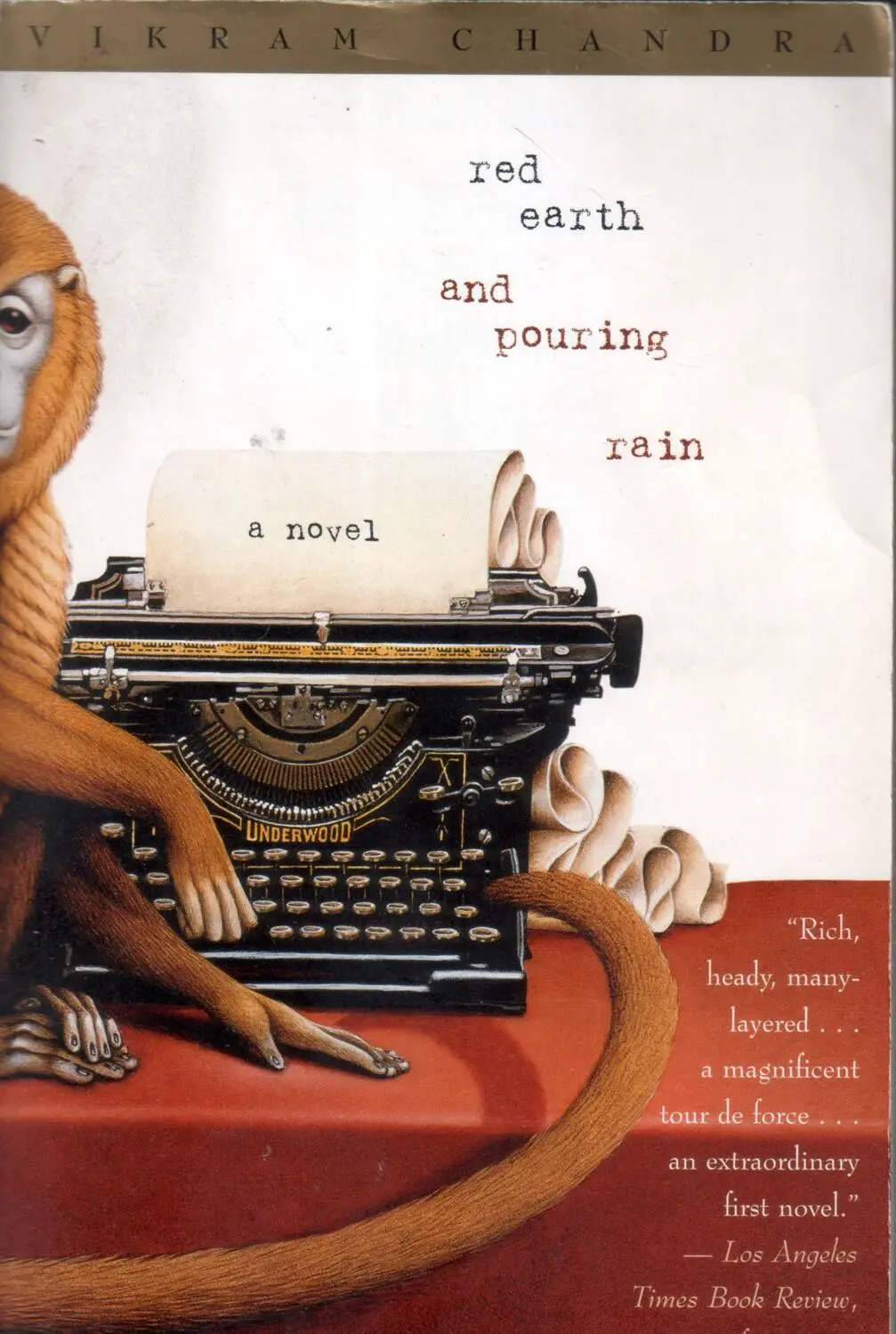
- Название:Red Earth and Pouring Rain
- Автор:
- Издательство:Penguin Books,India
- Жанр:
- Год:2006
- ISBN:нет данных
- Рейтинг книги:4 / 5. Голосов: 1
-
Избранное:Добавить в избранное
- Отзывы:
-
Ваша оценка:
Red Earth and Pouring Rain: краткое содержание, описание и аннотация
Предлагаем к чтению аннотацию, описание, краткое содержание или предисловие (зависит от того, что написал сам автор книги «Red Earth and Pouring Rain»). Если вы не нашли необходимую информацию о книге — напишите в комментариях, мы постараемся отыскать её.
is an unforgettable reading experience, a contemporary
— with an eighteenth-century warrior-poet (now reincarnated as a typewriting monkey) and an Indian student home from college in America switching off as our Scheherazades. Ranging from bloody battles in colonial India to college anomie in California, from Hindu gods to MTV, Chandra's novel is engrossing, enthralling, impossible to put down — a remarkable meditation on quests and homecomings, good and evil, storytelling and redemption.
Red Earth and Pouring Rain — читать онлайн бесплатно полную книгу (весь текст) целиком
Ниже представлен текст книги, разбитый по страницам. Система сохранения места последней прочитанной страницы, позволяет с удобством читать онлайн бесплатно книгу «Red Earth and Pouring Rain», без необходимости каждый раз заново искать на чём Вы остановились. Поставьте закладку, и сможете в любой момент перейти на страницу, на которой закончили чтение.
Интервал:
Закладка:
Abruptly, Hercules snapped out of his chair, and left the room (when he drew back the curtain at the door, the light filled Sanjay’s head with painful, luminous circles); Sanjay let his head loll back, exhausted, and listened to the voices outside — Hercules’, Sikander’s, his father’s — listened, frustrated by the distance and the intervening, muffling cloth, but still catching some of the guarded tension of the conversation in the voices, by the rhythms and the pitch. He shut his eyes to listen better, and sensed, further away, the presence of his mother (shuffling steps, nasal and slightly-liquid breathing), his uncle Ram Mohan (a click of bone against bone at a joint, frequent swallowing), and Sikander’s mother (something almost unheard; what was it?); they entered through the door which led deeper into the house, huddling together, pushing aside the red curtain.
‘Has he gone?’ Sikander’s mother whispered. ‘Has he?’
‘I can hear him outside,’ Ram Mohan said.
‘What did he want with you?’ Sanjay’s mother said to him, running a palm over his cheek. He squinted, trying to fuse the two parallel images of her, and tears rolled slowly down her cheeks. ‘Oh, child. Oh, child.’
Sanjay grunted, a ball of muscle moving up and down his throat, trying to bring the words up, and he could see the words, the forms they would take, and feel them, the emotional weight each would carry, but for all the gasping concentration he could bring to bear on it, his tongue flopped about his mouth, reptilian and trapped, uncontrollable. He gathered himself and tried again — the others watched, mournful but encouraging — and drool ran down his chin. He swallowed (Ram Mohan reached forward to wipe), compressed his lips, focussed every last iota of his being at the front of his face (lips and nose, eyes and chin), then released, and one word emerged: ‘Mmmmm-Mah.’ His mother, kneeling beside the bed, let her head droop until it was leaning on his chest and wept, her shoulders shaking (but above, the other image hovers, miming her), and then Sanjay’s father entered, followed by Sikander and Chotta.
‘He wants me to give him the Vedas,’ Arun said, flinging his hands about. ‘That’s what he really came for, the Vedas and the Geeta.’
‘What do you mean, give him the Vedas?’ Ram Mohan said. ‘How can you just give anybody the Vedas?’
‘That’s what he said. There’s a man staying in his house, some Englishman with red hair, some Sartha or Partha or something like that…’
‘Sarthi,’ Janvi said.
‘That’s the one,’ Arun said. ‘And he’s supposed to be a scholar or teacher or something, isn’t that what he said, Sikander?’
‘That’s right, Uncle,’ Sikander said. ‘He told me to translate. And he said that Sarthi was a scholar who wanted to study the Vedas — only he called them the Beds — so Uncle here should give them to him.’
‘Don’t you give anything to him,’ Janvi said.
‘But how?’ Arun said. ‘Oh, he came very politely, in sympathy with our child and all that, and when he spoke to me it was a request all right, but he knew and I knew that I was expected to give them what he wanted. “If you would be kind enough to supply my friend with the necessary…,” he said; no, Sikander? And how he looked at me. Standing with legs apart in my house as if he knew who was really master. How will we say no?’
‘The Vedas are for the twice-born,’ Janvi said. ‘They are not twice-born.’
‘In truth whoever has the power to take the Vedas takes them, never mind twice-born or thrice,’ Arun said.
‘Power has nothing to do with it,’ Janvi said, her voice rising. ‘You say no to them.’
‘The powerful are the twice-born,’ Ram Mohan said, very softly, ‘and the powerful take everything.’ Janvi glanced at him, startled, and then lowered her head.
‘They are very powerful now,’ Arun said. ‘For everything, the Raja looks to him. Their agents, the men of the Company, control every article of trade that we send out, every commodity that comes in. On everything they have a monopoly. And so the Raja looks to him. And this man comes now to my house, and tells me he wants the Vedas, that he needs the Geeta, that I must give it to him. Will he listen to you?’
‘No,’ Janvi said. ‘And I would say nothing to him.’
‘Then we must find something to give him.’
‘He already has my daughters. And he wants my sons. How much must we give him?’
‘The question is how much taking he can be satisfied with,’ Arun said. ‘I don’t know what to do.’
‘Our son is like this, and he comes to our house demanding things,’ Shanti Devi said. ‘What kind of man is this?’
Sanjay had been concentrating his strength again, and this time he managed two whole, difficult syllables: ‘Ve-dah… Ve-dah…’; he wanted to advise them to effect an exchange — the sacred books (if they must be given) for the sacred books of the firangi, one language for the other, secret for secret, a dialogue, but his injuries — raw, leaking — stifled the suggestion, and so what emerged was mistaken for a precocious desire for theological learning.
‘I’ll teach you,’ Ram Mohan said. ‘I’ll teach you everything.’
‘You’ll teach him everything,’ Arun said. ‘Yes, in this room, among the women, everything is fine, but out there, in the court, he will be on my back. What will I do? I’ll have to give him what he wants. And I don’t even know where to get a copy of any of the Vedas.’
‘Fight him,’ Janvi said.
‘How?’
‘Oh, make something up, can’t you?’ Shanti Devi said, wiping her face with the end of her sari. ‘You’re good at that.’
‘Tell him we’ve sent for it,’ Ram Mohan said.
‘Yes, I’ll tell him that,’ Arun said. ‘But finally we’ll have to give him something, at least something.’
‘I remember,’ Ram Mohan said. ‘I can recite most of it, some of it, at least something.’
‘You can?’
‘I learned it from my father, and it was the one thing I could do well.’
‘So you’ll recite. Who’ll write down?’
At this Sanjay let forth an incensed growl, and thrashed his limbs about on the bed; the others watched him, a little frightened, till Ram Mohan clapped a hand to his mouth and said, ‘Of course, child, of course, you will write down. Who else but you?’ He turned to the others. ‘Who else? He has known how to write without being taught, and Sanskrit without a single lesson. How and why, we used to ask, and perhaps it was only for this. I will recite and he will write down.’
And so Sanjay wrote it down, but before that could happen, there was the matter of his initiation, because of course the Veda could be studied only by one twice-born; so even before he could get up from the bed his head was shaved, and Sikander and Chotta carried his cot about the court-yard, where he ritually begged alms from assembled Brahmins and relatives, and then he was wrapped in a deer-skin, enclosed in heat, darkness.
At first he lay quiet, rather enjoying the soft, finely-grained texture of the skin, but soon he noticed a faint luminosity skipping in and out of sight, dancing at the edges of vision; he turned his head slightly and it disappeared, only to re-form at the other periphery. This time, he carefully avoided looking at it directly, and soon it resolved itself, the borders shifting and hardening until he could make out the shape of a gigantic fish, its size signalled by the lazy back and forth of its body and slow movements; it seemed to be drawing closer, and he felt the beginnings of panic when suddenly its contours fell in on themselves, closing and expanding, and then it was a boar, white, bristly and pawing, and now Sanjay fought to get the hide off his head, coming out sputtering, scrambling, into the harsh sunlight which he welcomed even as his eyes teared, his relatives gathering round, Ram Mohan clucking, running his hand over the smooth bald skin, touching even the thin pearly membrane on Sanjay’s forehead, soothing with a delicate touch.
Читать дальшеИнтервал:
Закладка:
Похожие книги на «Red Earth and Pouring Rain»
Представляем Вашему вниманию похожие книги на «Red Earth and Pouring Rain» списком для выбора. Мы отобрали схожую по названию и смыслу литературу в надежде предоставить читателям больше вариантов отыскать новые, интересные, ещё непрочитанные произведения.






Обсуждение, отзывы о книге «Red Earth and Pouring Rain» и просто собственные мнения читателей. Оставьте ваши комментарии, напишите, что Вы думаете о произведении, его смысле или главных героях. Укажите что конкретно понравилось, а что нет, и почему Вы так считаете.