Ivan Vladislavić - The Restless Supermarket
Здесь есть возможность читать онлайн «Ivan Vladislavić - The Restless Supermarket» весь текст электронной книги совершенно бесплатно (целиком полную версию без сокращений). В некоторых случаях можно слушать аудио, скачать через торрент в формате fb2 и присутствует краткое содержание. Год выпуска: 2014, Издательство: And Other Stories Publishing, Жанр: Современная проза, на английском языке. Описание произведения, (предисловие) а так же отзывы посетителей доступны на портале библиотеки ЛибКат.
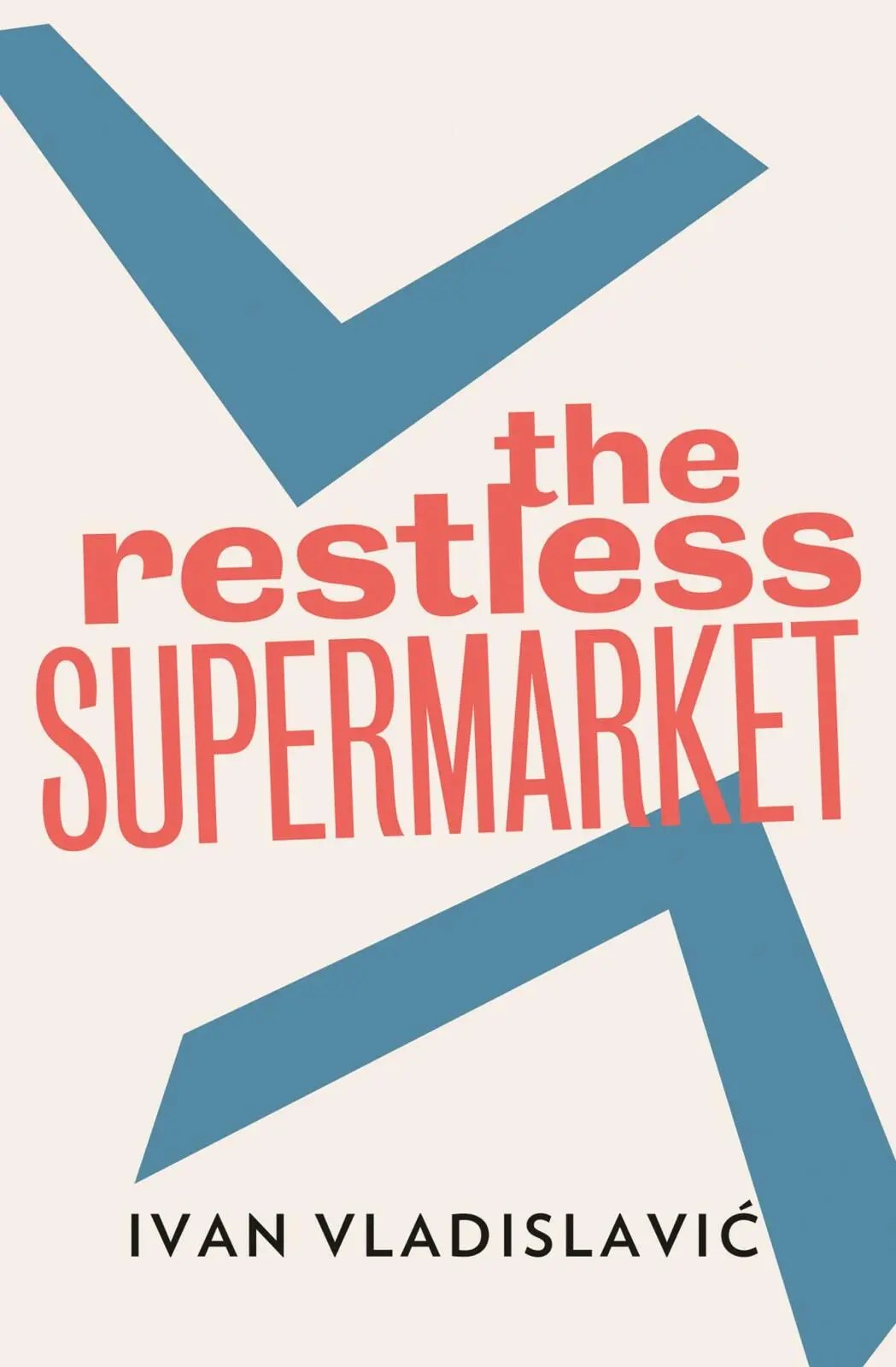
- Название:The Restless Supermarket
- Автор:
- Издательство:And Other Stories Publishing
- Жанр:
- Год:2014
- ISBN:нет данных
- Рейтинг книги:4 / 5. Голосов: 1
-
Избранное:Добавить в избранное
- Отзывы:
-
Ваша оценка:
The Restless Supermarket: краткое содержание, описание и аннотация
Предлагаем к чтению аннотацию, описание, краткое содержание или предисловие (зависит от того, что написал сам автор книги «The Restless Supermarket»). Если вы не нашли необходимую информацию о книге — напишите в комментариях, мы постараемся отыскать её.
It is 1993, and Aubrey Tearle's world is shutting down. He has recently retired from a lifetime of proofreading telephone directories. His favorite neighborhood haunt in Johannesburg, the Café Europa, is about to close its doors; the familiar old South Africa is already gone. Standards, he grumbles, are in decline, so bad-tempered, conservative Tearle embarks on a grandiose plan to enlighten his fellow citizens. The results are disastrous, hilarious, and poignant.
Ivan Vladislavic
The Restless Supermarket — читать онлайн бесплатно полную книгу (весь текст) целиком
Ниже представлен текст книги, разбитый по страницам. Система сохранения места последней прочитанной страницы, позволяет с удобством читать онлайн бесплатно книгу «The Restless Supermarket», без необходимости каждый раз заново искать на чём Вы остановились. Поставьте закладку, и сможете в любой момент перейти на страницу, на которой закончили чтение.
Интервал:
Закладка:
That useless letters editor at the Star had still not seen fit to publish my letter of 7 December, concerning my close shave with an Atlas Bakery van.
Later that afternoon, Errol and Floyd slunk out with their booty. Floyd, the stouter of the two, had the tower under his arm, swathed in the greatcoat again. I couldn’t help thinking of resurrection men, the descendants of those infamous Williams, Burke and Hare, stalking my city in the wall, and I held my peace. But Errol in passing patted his duffel bag with his long fingers and said: ‘The sack of Johannesburg.’ One of his sleepy, soft-lidded eyes closed and opened in a parody of a wink. What Spilkin would have called a nictitation. What does he have in there? The Botanical Gardens? The Supreme Court? The War Memorial? Zoo Lake? Then again, why should it be landmarks he’s carrying off? Why not a jumble of street corners and parking garages — let’s say the north-east corner of Tudhope Avenue and Barnato Street in Berea, or the south-west corner of Rissik and Bree — paving-stones and bus-stop benches — say the bus stop in Louis Botha, opposite the Victory Theatre in Orange Grove, where you might wait all day for a smoke-filled double-decker to take you to the city — trees — the avenue of oaks in King George Street on the western edge of Joubert Park — why not municipal swimming pools, parks, skylines, lobbies, doorways, vistas — say the view from the gardens of the Civic Centre, from the first bench to the right of the path that slopes down to Loveday Street, looking along Jorissen into the sunset …
After a while, I turned my attention to the sack of Tearle, the sacks . I couldn’t possibly drag them through the streets again. I had Moçes summon me a taxi, one of Rose’s, a compulsory treat. Moçes carried my bags down for me — a ‘madala’, he said, shouldn’t have to stoop — and I felt moved to give him a small gratuity. He offered to wait with me at the kerbside, until the taxi came, to shoo away the artless dodgers who had gathered like mosquitoes, but I didn’t think it was necessary.
I shall lift up mine eyes. At least the Hillbrow Tower was still there, the real thing I mean, ugly as it is. It was a shame one couldn’t go up there any more. Dinner dancing, and so on. Cheek to cheek, with the world at one’s feet. Or if not the world, at least the most densely populated residential area in the southern hemisphere. And there was Wessels, leaning on the Eiffels of the balcony railing and smoking a Peter Stuyvesant, moored, I should say, like a blimp in a cloud of blue smoke above that echoing Parisian scene, looking down on me, with me at his feet. I fancied I could see his crooked teeth glinting. That I should have ended up with Empty Wessels, whom I had never even liked. It was a bitter irony. How could I have foreseen such an outcome, in the gold-flecked afternoons of my past, how imagined that I would become a stranger in my home away from home, beset on all sides by change and dissolution? Or imagined: a pink elephant with its ear on backwards standing on a street corner, as if it were the most natural thing in the world, a dead body lying in an empty plot on a Sunday morning, burnt beyond recognition, a man of advanced years bearing what is left of his life in two paper shopping-bags. Then, as now, the television was full of experts, little people standing on tiptoe, touting their ‘scenarios’ of the future. As if tomorrow could be scripted. As if one might have expected to see the hammer and sickle trampled underfoot on Red Square and hoisted on the steps of the Union Buildings. The inconceivable times of our lives!
But I’m getting ahead of myself.
*
Bogey came to us in a cement-grey suit of communistic cut. It was single-breasted and ill-proportioned for his squat frame: too broad in the shoulder, too wide in the lapel, too long in the drop. The jacket pockets were shaped like shovels and the legs of the trousers were thick and round as traffic bollards. What material it was made of I couldn’t say, something Victorian, approaching sackcloth. A black patent-leather hat. In this case, the material was plain, but the shape was puzzling. Not enough altitude to be alpine. More like a trilby that had had the spirit knocked out of it.
‘Trilby O’Ferrall,’ Merle said in answer to my question. ‘Miss.’
‘Slobodan Boguslavić,’ said the concrete-clad one underneath the hat, conjuring a fleshy hand from the end of his sleeve. He sounded as if his mouth was full of olives. ‘Dan for short.’
‘Why not Slob?’ said Spilkin, shaking the hand.
‘Or Zog,’ I put in nimbly. ‘There’s a name I always fancied.’
‘Thank you very much,’ said Bogey. And with that, he more or less exhausted his conversational English. We discovered later that his words of introduction had been taught to him by a Swissair hostess on the flight from Zürich.
After he had shaken hands with Merle and me, and pressed his lips to Mevrouw Bonsma’s knuckles, with an elaborate pantomime of applause and gestures towards the piano, he reached for a chair at an adjoining table and drew it up between Spilkin and Mevrouw Bonsma. There was a moment of resistance, in which they both held their positions, while the arm of Bogey’s chair nudged insistently against Spilkin’s. I glowered at him, and saw nothing but the crown of his hat, deeply creased and puckered like a toothless mouth. It reminded me of a whelp mumbling for the teat. More and more in those days, as ‘The Proofreader’s Derby’ continued to disturb my mental equilibrium, I was seeing things, thinking oddities, making morbid associations that would once have seemed quite mad to me. Nudge, nudge. Then Mevrouw Bonsma moved anticlockwise and bumped into me, and Spilkin moved clockwise and bumped into Merle, and then Merle and I, like elements in a physics experiment, with no option despite our specific gravity but to transmit the momentum, both moved and bumped into one another, and moved back and bumped into the others, and so on, until in this convulsive fashion, clutching our cushions to our backsides, moving furniture and fundament together, the five of us finally came to rest with equal spaces between our chairs.
‘There,’ said Spilkin, ‘order has been restored.’
Choosing to ignore the fact, of which he must have been keenly aware, that what had been restored was an entirely different order. In a minute of unseemly shuffling and pardon-begging, a quaternion of equals had been transformed irrevocably into a circle. What was it Spilkin had said about the pentagon? How I regretted then my failure to insist upon a wiser seating arrangement at the outset. A square table, at which each person had a side, clearly demarcated, would have exposed how undesirable this shapeless new arrangement was. Might have deterred it altogether. But a round table was so accommodating, made it seem so matter-of-course. A stranger walking into the Café at that moment might have thought that the five of us had been sitting there all our lives.
When he had made himself comfortable, Bogey unbuttoned the jacket of his suit, revealing a comical pot belly and a candy-striped shirt with an immense collar. He transferred his hat from his head to his left knee. His hair was thickly pomaded and swept back from the forehead; an indentation like a plimsoll line encircled his head where the hat had pressed. The extraordinary thing about the pomade, from an etymological point of view, was that it smelt of apples. I caught a whiff and it turned my stomach. As for the skull, Johann Friedrich Blumenbach would have loved it. For the moment, he produced his passport and showed us the syllables of his name, thickly sliced, like one of the sausages I had recently discovered at the Wurstbude in the course of researching the cuisines of the world. 
Интервал:
Закладка:
Похожие книги на «The Restless Supermarket»
Представляем Вашему вниманию похожие книги на «The Restless Supermarket» списком для выбора. Мы отобрали схожую по названию и смыслу литературу в надежде предоставить читателям больше вариантов отыскать новые, интересные, ещё непрочитанные произведения.




Обсуждение, отзывы о книге «The Restless Supermarket» и просто собственные мнения читателей. Оставьте ваши комментарии, напишите, что Вы думаете о произведении, его смысле или главных героях. Укажите что конкретно понравилось, а что нет, и почему Вы так считаете.