T. Johnson - Welcome to Braggsville
Здесь есть возможность читать онлайн «T. Johnson - Welcome to Braggsville» — ознакомительный отрывок электронной книги совершенно бесплатно, а после прочтения отрывка купить полную версию. В некоторых случаях можно слушать аудио, скачать через торрент в формате fb2 и присутствует краткое содержание. Год выпуска: 2015, Издательство: William Morrow, Жанр: Современная проза, на английском языке. Описание произведения, (предисловие) а так же отзывы посетителей доступны на портале библиотеки ЛибКат.
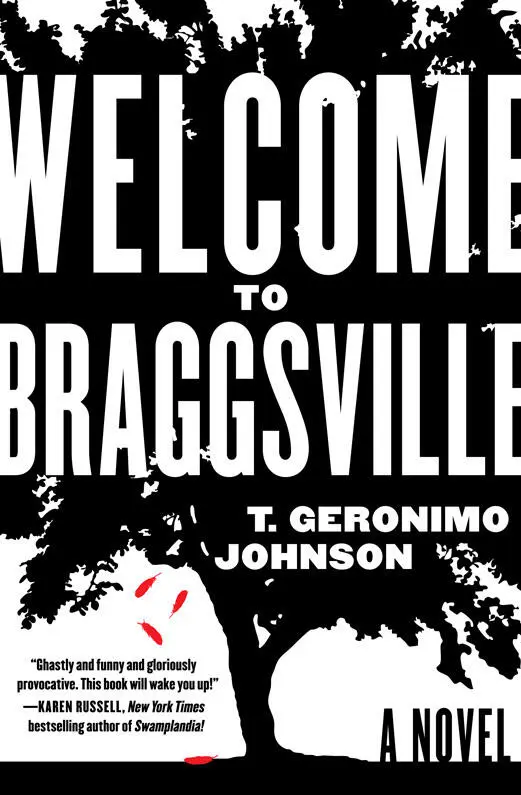
- Название:Welcome to Braggsville
- Автор:
- Издательство:William Morrow
- Жанр:
- Год:2015
- ISBN:нет данных
- Рейтинг книги:3 / 5. Голосов: 1
-
Избранное:Добавить в избранное
- Отзывы:
-
Ваша оценка:
Welcome to Braggsville: краткое содержание, описание и аннотация
Предлагаем к чтению аннотацию, описание, краткое содержание или предисловие (зависит от того, что написал сам автор книги «Welcome to Braggsville»). Если вы не нашли необходимую информацию о книге — напишите в комментариях, мы постараемся отыскать её.
comes a dark and socially provocative Southern-fried comedy about four UC Berkeley students who stage a dramatic protest during a Civil War reenactment — a fierce, funny, tragic work from a bold new writer
Welcome to Braggsville. The City That Love Built in the Heart of Georgia. Population 712. Born and raised in the heart of old Dixie, D'aron Davenport finds himself in unfamiliar territory his freshman year at UC Berkeley. Two thousand miles and a world away from his childhood, he is a small-town fish floundering in the depths of a large hyperliberal pond. Caught between the prosaic values of his rural hometown and the intellectualized multicultural cosmopolitanism of "Berzerkeley," the nineteen-year-old white kid is uncertain about his place, until one disastrous party brings him three idiosyncratic best friends: Louis, a "kung fu comedian" from California; Candice, an earnest do-gooder from Iowa claiming Native roots; and Charlie, an introspective inner-city black teen from Chicago. They dub themselves the "4 Little Indians."
But everything changes in the group's alternative history class, when D'aron lets slip that his hometown hosts an annual Civil War reenactment, recently rebranded "Patriot Days." His announcement is met with righteous indignation and inspires Candice to suggest a "performative intervention" to protest the reenactment. Armed with youthful self-importance, makeshift slave costumes, righteous zeal, and their own misguided ideas about the South, the 4 Little Indians descend on Braggsville. Their journey through backwoods churches, backroom politics, Waffle Houses, and drunken family barbecues is uproarious at first but has devastating consequences.
With the keen wit of
and the deft argot of
, T. Geronimo Johnson has written an astonishing, razor-sharp satire. Using a panoply of styles and tones, from tragicomic to Southern Gothic, he skewers issues of class, race, intellectual and political chauvinism, Obamaism, social media, and much more.
A literary coming-of-age novel for a new generation, written with tremendous social insight and a unique, generous heart,
reminds us of the promise and perils of youthful exuberance, while painting an indelible portrait of contemporary America.
Welcome to Braggsville — читать онлайн ознакомительный отрывок
Ниже представлен текст книги, разбитый по страницам. Система сохранения места последней прочитанной страницы, позволяет с удобством читать онлайн бесплатно книгу «Welcome to Braggsville», без необходимости каждый раз заново искать на чём Вы остановились. Поставьте закладку, и сможете в любой момент перейти на страницу, на которой закончили чтение.
Интервал:
Закладка:
Daron nodded, Yes, sir, and followed after his friends. When only a few feet from the car, he slipped in mud slick as oil where one of The Charlies had once stood and landed with his feet in the air. Hobbling through the front door, he found that inside felt like those afternoons when his parents fought in silence, everyone dispersed through the house like rival gangs, each spraying their territory not with graffiti, but with music. Tool on the living room stereo. Dixie Chicks on the under-cabinet receiver. Their dialogue a call-and-response of banging doors, slamming cabinets; stomping feet, scraping chairs; drill and vacuum. Today everyone wore headphones, but Daron knew Charlie was looping There for You by Flyleaf and Candice was listening to Cute Without the E on repeat. Candice vanished in the direction of Daron’s bedroom. Charlie went outside. Daron sat in the kitchen scrolling through pictures of Louis on his phone until it was unbearable. Then forced himself to start over again.
In between, he watched the activity in the backyard. He focused only on what he could see through one vinyl mullion, as if confining perception meant controlling emotion. He couldn’t see where Candice had climbed the fence, or where Louis had delivered his routine. He could see the six-pillared gazebo, built of wood, not the more durable synthetic lumber because, The doctor’s office and schools are the only places to sit on plastic. Charlie was drinking a glass of boxed wine with his mother, who had sparked the grill. She hoped it didn’t seem festive, but, he heard her say, People still have to eat, and it just doesn’t feel like a night for cooking. When she’d poured the wine, she and Charlie had held it to the sky like connoisseurs, and it occurred to Daron that his mom might be joking, but Charlie probably did know a thing or three about wine. His mother gave a sweet wave in the direction of the house. Daron returned the gesture, and was disappointed when his response didn’t spark an enthusiastic uptick in his mom’s flutter. The back door slammed, and he understood that she had not been waving to him. He expected to see Candice, but it was his father’s legs stamping grass across the yard.
The three — Charlie and his parents — sat like friends, like three old friends at a wake, his mother running her fingernails along his father’s jeans seam, Charlie across from them, where Daron usually sat, shielding his eyes from the sun whenever he tilted in to hear Daron’s mother. They looked to be giving advice. Each time they spoke, Charlie leaned in, listened silently, sat back and bowed his head with understanding, two fingers anchoring the foot of his wineglass to the table.
When his parents fought, after a half hour to an hour of baking, tinkering, adjusting hinges, and other cacophonous domestic penitence, they would reconvene in the bedroom (Bang! Click! Listen up!), and start all over: muffled exclamations, roars, yellow bawling, silence. Next, rhythmic quaking pulsed optimistically, eagerly into shameless and squeaky clamor, followed by giddy, barefoot reemergence (and cigarette smoking). That was the enigma: argument fired hearts into crucibles of flesh. That was the mystery that drew Daron into the shadowed hall and kept him there watching Candice, kept him standing there even after working up the nerve to talk, even after taking several mental dry runs, even after he heard her shuffling toward the hall and he saw Charlie loping toward the house, even after he knew he had to talk to her before Charlie did, to have it out with her before Charlie did, even after he felt certain that having it out was part of adulthood, having it out strengthened bonds, having it out was his performative intervention. He was glad it was Sheriff who’d contacted the Changs. He couldn’t even start this conversation.
From his bedroom doorway he watched her work. Half of Louis’s stuff was still strewn across the corner he had claimed as his own, the other half across Charlie’s corner. Candice was trying to clean it up. Her foot propped on Daron’s chair, she sat perched on the edge of the bed, turned three-quarters away from him, the soft line of her cheek and bend of her breast wavering in and out of visibility as she worked. At the hospital they had outfitted her with a fracture boot for her right foot, and with her sweats and tank top and faint tan, she resembled a skier reluctant to disrobe. So meticulous. Socks she sausaged like everyone else, but T-shirts she folded and stacked like a factory worker. She laid each one out on the bed, smoothed it gently, tucked the arms in first, then the collar, then the bottom, and flipped it over so the logo was framed in the center and no seams were visible. Louis’s DonkeyPunchLove shirt was thrown over the bed. Another one read, MY MOM WORKS AT WALMART, SO ALL I GET FOR XMAS IS THIS T-SHIRT, AGAIN. After folding each garment, she straightened and drew in her chin as if admiring her handiwork, patting each one like baby clothes.
Charlie’s shadow plunged into the hallway. Not now, Charlie.
Not now what?
I need the bedroom.
I’m going to the bathroom. He paused, obviously expecting Daron to explain himself, but wore so exasperated an expression as to appear wary of the same. When Daron said nothing, he walked on with a loud sigh.
Okay. Daron slammed the door behind him. Locked it. Yelled.
(Bang! Click! Listen up!)
This isn’t time to clean.
This isn’t time to barbecue, either. Candice didn’t bother turning to look at him.
At every funeral or wake he could remember there was a grill burning, and it had never occurred to him as strange until today. After a moment’s thought, still didn’t. Daron snatched the shirt from her hand. She snatched it back.
You can’t fix this. You can’t fix this. Not even you .
How about you tell me something I don’t know. How about we let his stuff lie all around and get stepped on and messed up? That’s your plan? What’s happened isn’t enough? Your mom shouldn’t have to do it. Or are you going to fix it with a gun? The hillbilly cure?
Fuck you.
She turned to face him fully, to stare her challenge. Her lids were raw, but her face was swept smooth by grief, giving her a dignity. Her fingernails were chocked with black crescents of shoe polish. Do you mean You? Or You People?
The thing about women, his father always said, is that what they say they’re upset about is never what they are really upset about.
Just get out.
You get out.
It’s my room, and my house.
That’s why you should leave. She turned back to her work, facing fully away from him.
Daron said nothing.
I know they let you see him.
Daron said nothing. She peeked back at him while saying it, as if to see if he would tell the truth.
Who identified him?
Daron said nothing.
Candice clutched the shirt she held to her stomach. Charlie told me. I know you saw him. They wouldn’t let me see him. And they were the same people who took him. Her voice rose at the end.
What do you mean?
The soldiers who took him and the deputies who said I couldn’t see him are the same people.
Everyone in town is part of the reenactment.
I know.
So you know it’s just what they do.
They wouldn’t let me see him, she screamed, burying her face in the shirt.
As much as he wanted to go to her, he seethed at the implication that Sheriff or the deputies had somehow caused Louis’s death, enraged because it was an absurd notion, a mockery of logic, so far-fetched and ridiculous as to only reinforce Daron’s own sense of culpability. It was as if she blamed them to avoid stating the obvious: Louis’s death was Daron’s fault. The thing about women to understand, his father always said, is that they never directly tell you what they’re upset about.
Читать дальшеИнтервал:
Закладка:
Похожие книги на «Welcome to Braggsville»
Представляем Вашему вниманию похожие книги на «Welcome to Braggsville» списком для выбора. Мы отобрали схожую по названию и смыслу литературу в надежде предоставить читателям больше вариантов отыскать новые, интересные, ещё непрочитанные произведения.





Обсуждение, отзывы о книге «Welcome to Braggsville» и просто собственные мнения читателей. Оставьте ваши комментарии, напишите, что Вы думаете о произведении, его смысле или главных героях. Укажите что конкретно понравилось, а что нет, и почему Вы так считаете.