Robert Stone - A Flag for Sunrise
Здесь есть возможность читать онлайн «Robert Stone - A Flag for Sunrise» весь текст электронной книги совершенно бесплатно (целиком полную версию без сокращений). В некоторых случаях можно слушать аудио, скачать через торрент в формате fb2 и присутствует краткое содержание. Год выпуска: 2012, Издательство: Vintage, Жанр: Современная проза, на английском языке. Описание произведения, (предисловие) а так же отзывы посетителей доступны на портале библиотеки ЛибКат.
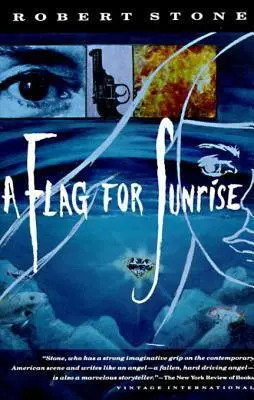
- Название:A Flag for Sunrise
- Автор:
- Издательство:Vintage
- Жанр:
- Год:2012
- ISBN:нет данных
- Рейтинг книги:4 / 5. Голосов: 1
-
Избранное:Добавить в избранное
- Отзывы:
-
Ваша оценка:
A Flag for Sunrise: краткое содержание, описание и аннотация
Предлагаем к чтению аннотацию, описание, краткое содержание или предисловие (зависит от того, что написал сам автор книги «A Flag for Sunrise»). Если вы не нашли необходимую информацию о книге — напишите в комментариях, мы постараемся отыскать её.
A Flag for Sunrise — читать онлайн бесплатно полную книгу (весь текст) целиком
Ниже представлен текст книги, разбитый по страницам. Система сохранения места последней прочитанной страницы, позволяет с удобством читать онлайн бесплатно книгу «A Flag for Sunrise», без необходимости каждый раз заново искать на чём Вы остановились. Поставьте закладку, и сможете в любой момент перейти на страницу, на которой закончили чтение.
Интервал:
Закладка:
“Intense.”
“Me, I’m shit scared. I know this is happening. Stew knows I know. His friend is a big pinhead.”
“Poor baby.”
“The cops are finding these children, Olga. Blipped. Bitty kids almost. Sans parts. It’s big in the paper.”
“The parents don’t care,” Olga said. “They sell them.”
“Snuff pix, chickens, that was Stew. He was obnoxious about it. He said it was big.”
“Did he say he liked it?”
“He never said. I figure he liked it, right? I was scared, Olga. I left town.”
“The kids ask for it sometimes,” Olga said. “They’re lousy at that age.”
“That’s what Stew says. I says: See you, Stew. I was scared.”
“This,” Olga said, “is why I won’t live in Los Angeles today.”
When they stood up, Heath gave them a friendly nod. Holliwell forced himself not to turn around.
“Do you know how I came to notice them?” Heath asked. His florid face held the polite amiable smile. “It was a way of laughing that bastard had. When I heard him laugh I knew what I had before me.”
“Not your ordinary run of tourist,” Holliwell offered.
“Yes … well, what’s ordinary today? There’s a very rubbishy sort of American loose on the world these days. If you don’t mind my saying so.”
“All kinds of people have money and leisure in the States. Surely you know that.”
“I thought the American of thirty years ago was a better type,” Mr. Heath said. “Not much savoir-faire but a sounder sort of chap.”
“I know who these people are,” Holliwell said. “I know what they come out of. I know more than I want to about them.”
“So their dinner conversation doesn’t shock you?”
“Does it shock you?”
“Not me, mate. I was there when we went into Belsen and quite honestly that didn’t shock me either.”
“What did it do for you?”
“It aroused my workmanlike instincts,” Mr. Heath said. “I have the same reaction to … them.”
“Olga and Buddy.”
“Yes. Olga. And Buddy. They make me think — ha, boyo. Time to go to work.”
“It is the same,” Holliwell insisted. “Up here and down the wall. It’s the same process.”
“That’s very tender-minded of you. Are you going to tell me all that lives is holy?”
“Not me,” Holliwell said. “But even Olga and Buddy have a kind of innocence, don’t they? And their friend in the story?”
“Holliwell,” Heath said. “Holliwell — God may forgive Olga and Buddy and company — he doesn’t have to share the world with them. You have children, I suppose?”
Holliwell confessed that he did.
“There’s someone murdering children in the villages here, did you know that? He’s killed five kids already.”
“I didn’t know. But that has nothing to do with these people.”
“Don’t you know your own side, man? I can assure you that I do. And when I hear that laugh — when I catch that pong in the air I feel like our good missionary friends, ready to go into my cure of souls. I believe that God gave the likes of Olga and Buddy and the late Rudolf Hoess into my especial keeping. But because this civilization is corrupt and cowardly, because it insists on being tyrannized by weak, bent neurotics who don’t know the fucking meaning of self-respect or mercy — I can’t do my job.”
His knuckles were white on the glass of gin. He blinked and sipped of the drink and smiled again. “So I feel frustrated, you see.”
The officers of the Guardia were leaving the bar. The last to go whistled unpleasantly for the shy black barmaid who had been nervously serving them; when she came up to him, he stuffed a wad of bills under the bodice of her bright tight dress. Then he turned and watched the two men at the table across the hall.
“I’m a copper, really,” Heath said.
“Why did you ask me if I was frightened down the wall?”
“Ah,” Heath said, “rude of me. Sorry.”
“I didn’t think it was rude. Just a little peculiar.”
“My manners are dreadful,” Mr. Heath said. “I expect I’ll have trouble in the resort business.”
At Serrano on the windward shore, the frayed ends of a norther whipped the winch chains against the stabilizers and set the mooring lines to groaning. The dock lights showed soiled whitecaps speckling the milky harbor. Pablo worked the fuel line with one of Naftali’s pier hands. Freddy Negus leaned against the bridge housing, smoking, staring into the darkness beyond the lights. He was waiting for Tino.
Naftali’s men worked quickly. The crates of weapons, greased in creosote, were loaded in the holds on a waterproof tarp; the tarpaulin’s ends were tucked down and the holds half filled with sixteen-pound blocks of ice. Within an hour of tying up, the Cloud was nearly ready to get under way again.
In other circumstances, Negus would have kept a close eye on the loading, but on this night he let the dockers go about their work unsupervised. His attention was fixed on the unlighted road that led to the pier. Across the bay, the lights of an oil refinery glowed like the towers of a phantom city. Slightly above them, on a cactus-covered hillside deep in darkness, were the dim, scattered lights of Serrano Town. A wall of barbed fencing and thorny acacia divided Naftali’s marina from the desert wilderness outside.
The dirt road that led to the pier was blocked by two Dodge trucks parked head to head across it; fifty yards beyond them was a steel hut lit by a single naked bulb over its doorway. A man with a holstered pistol stood under the light watching the loading operation. Negus cursed and went into the cockpit.
“I reckon he’s not coming,” Negus said.
Mrs. Callahan was stocking the galley shelves; Callahan himself was bent over his charts.
“And what does that mean?” Deedee Callahan asked.
“He never done this before,” Negus said.
Callahan said nothing.
“Listen,” Negus said, leaning on Callahan’s chart table. “Put it together, man. We’ve got this punk off the coast on our hands. Then Tino goes over and he doesn’t come back.”
“What are you suggesting?” Callahan asked. “That the kid did away with him?”
“By Christ, I wish I knew. But all of a sudden Tino’s gone and he doesn’t come back. Either he’s in something he can’t get out of — or else he thinks the deal’s queer and he’s pulling out.”
“Wouldn’t he have let you know?” Deedee asked.
“Hell, I’d have thought so. Maybe he wasn’t able.” Negus turned from the chart table and looked out through the windshield at the dark water. “It’s always number one first in this business. That’s the rule.”
Callahan kept his eyes on the chart, not answering.
When the fueling was done, Pablo took a brief turn at loading crates. He, too, was watching the dark road that led to the pier, thinking of the room in the Hollandia Hotel where the wind chime would be sounding faintly on the light breeze. From the pilothouse he heard Negus’ rasping petulant drawl. As he stepped onto the dock, he noticed that the armed man beside the shed had turned to look down the road, and that far in the distance along it was a flickering, wavering light. Pablo glanced over his shoulder at the pilothouse and jogged toward the shed.
“What’s up?” he asked the guard.
The guard looked at him, shrugged and looked down the road again.
As the light drew closer, Pablo saw that it was the night light of a bicycle; a tall islander wearing a mack’s violet platform shoes was pumping it along the sand-and-shell track. He pulled up beside the iron shed and wiped the sweat from his eyes. He and the man who stood by the shed spoke together in Papamiento. The rider held a manila envelope in his hand.
Читать дальшеИнтервал:
Закладка:
Похожие книги на «A Flag for Sunrise»
Представляем Вашему вниманию похожие книги на «A Flag for Sunrise» списком для выбора. Мы отобрали схожую по названию и смыслу литературу в надежде предоставить читателям больше вариантов отыскать новые, интересные, ещё непрочитанные произведения.








Обсуждение, отзывы о книге «A Flag for Sunrise» и просто собственные мнения читателей. Оставьте ваши комментарии, напишите, что Вы думаете о произведении, его смысле или главных героях. Укажите что конкретно понравилось, а что нет, и почему Вы так считаете.