Robert Stone - A Flag for Sunrise
Здесь есть возможность читать онлайн «Robert Stone - A Flag for Sunrise» весь текст электронной книги совершенно бесплатно (целиком полную версию без сокращений). В некоторых случаях можно слушать аудио, скачать через торрент в формате fb2 и присутствует краткое содержание. Год выпуска: 2012, Издательство: Vintage, Жанр: Современная проза, на английском языке. Описание произведения, (предисловие) а так же отзывы посетителей доступны на портале библиотеки ЛибКат.
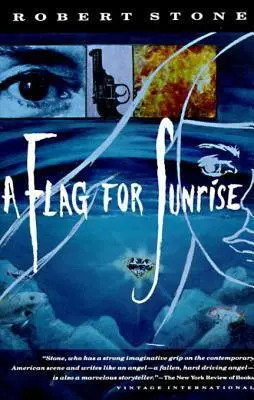
- Название:A Flag for Sunrise
- Автор:
- Издательство:Vintage
- Жанр:
- Год:2012
- ISBN:нет данных
- Рейтинг книги:4 / 5. Голосов: 1
-
Избранное:Добавить в избранное
- Отзывы:
-
Ваша оценка:
A Flag for Sunrise: краткое содержание, описание и аннотация
Предлагаем к чтению аннотацию, описание, краткое содержание или предисловие (зависит от того, что написал сам автор книги «A Flag for Sunrise»). Если вы не нашли необходимую информацию о книге — напишите в комментариях, мы постараемся отыскать её.
A Flag for Sunrise — читать онлайн бесплатно полную книгу (весь текст) целиком
Ниже представлен текст книги, разбитый по страницам. Система сохранения места последней прочитанной страницы, позволяет с удобством читать онлайн бесплатно книгу «A Flag for Sunrise», без необходимости каждый раз заново искать на чём Вы остановились. Поставьте закладку, и сможете в любой момент перейти на страницу, на которой закончили чтение.
Интервал:
Закладка:
Negus flushed.
“There is such a creature, Jack, I hate to tell you.”
“Snowflake,” Tino told them. “Copo. Das his name.”
“Tecan is a mixture of the old and the new,” Deedee said.
“Look,” Negus said, “there are times when the two of you act stark crazy. Now we gonna keep this damn boat right end up and do our business or what?”
“I’ll come through for you, Fred. You do the same for me. Are you guys with us or not?”
Tino nodded silently.
“Of course I’m with you,” Negus said. “Always have been. Just I get the feeling sometimes you’re flirting with disaster.”
Callahan grinned with adolescent mischief and winked at his wife.
“If it be now, ’tis not to come,” he declared. “If it be not to come, it will be now. If it be not now, yet it will come. The readiness is all.”
“Ripeness,” Deedee Callahan said.
“It’s readiness, Dee.”
“I mean taking a risk is one thing,” Negus told them. “Fucking around for kicks is another.”
“I like ripeness better,” Deedee said.
“You like it,” Callahan said, “because it’s sexier.”
With the air tank tucked into the gunwales under the bench on which he sat, Holliwell smoked and watched the green coastline — palm groves, banana plants strayed from the plantations, beach heliotrope of outsized luxuriance. Sandy, the dive master, ran his thirty-six-footer at full throttle, slapping the hull over the placid water; the bow took spray over the windward side that soaked the STP jacket Holliwell had worn against the sun.
Sandy was a long, spare man with a freckled English countryman’s face darkened by the suns of Tecan and West Africa. He lounged in the stern, one loose hand over the stick, one elbow on the rail, leaning out to see the water ahead. His long black hair was bleached at the crown, parted at the middle of his skull like a nineteenth-century Russian peasant’s, and this with his sharp black eyes deep-set under thick low brows brought a kind of dervish flair, a Rasputin intensity, to his appearance.
In the boat with Holliwell was a family of five Cuban-Americans from Miami. The father was stocky and muscular, his hair worn in a brush cut, his jaw jowled and pitted from relentless shaving. His wife was buxom and fleshy-faced yet with a long-legged trim frame, a Floridian body honed by dieting and Gloria Stevens. There were three boys between twelve and seventeen — the oldest vulpine with a nearly complete moustache and muscular like his father, the two younger quite like their mother; over the waist of each of their bathing suits sagged a tube of buttery fat. The parents spoke to each other in Spanish, the boys in American Adolescent. All of them ignored Holliwell.
“Could be seein’ turtle over this reef,” Sandy told the boys. “Good place to see dem.”
“Aw-right,” said the middle boy with enthusiasm.
“Would they bite you?” asked the smallest boy.
Sandy laughed. “Turtle bite you? Turtle don’t bite you. Maybe take you for a ride.”
“Hey,” the seventeen-year-old said, “I could go for that.”
When the children’s parents spoke to Sandy it was in a formal and imperious way, as though they were used to service. Sandy answered them with deference.
Three hundred yards offshore, Sandy killed his engine and hopped forward to put the anchor line down. Everyone looked over the side. The sky’s light sparkled back at them, reflected and refracted from the reef tops below — a long line of peaks curving out toward open ocean.
Sandy gave them the dive plan. The current was southerly. They would dive straight out from the stern, up-current. Then they could follow a semicircle of reef tops, cross a sandy bottom and follow the edge of a drop back to the boat with the current behind them. There was black coral there, Sandy told them. The site was called Twixt by the people of the coast.
Holliwell stared down at the liquid light of the white reefs. They were, after all, what he had come to see. He took a deep breath and put on his buoyancy compensator, his backpack tank, and bent to wrestle on his weight belt. Sandy put his own tank on with the ease of a man donning a sweater. The Cuban-American bustled about, trying stays and buckles — the head of the house overseeing procedure. The woman and the youngest boy were not going down. While Holliwell put his boots and fins on, Sandy checked out the gear of the younger of the two boys who were diving.
“Ever see any sharks around here?” the younger boy asked, as casually as he could. Holliwell admired his sangfroid. Testing his own regulator, he turned to watch Sandy answer.
“No sharks here,” Sandy said simply.
It turned out that the younger boy was diving with Sandy, the oldest with his father. It had been so ordered.
“Want to come with us?” the dive master asked Holliwell.
“I’ll just follow along,” Holliwell said. “I’ll be all right.” He was not in fact a very experienced diver but the dive seemed easy enough.
Holliwell went over last, carrying two five-pound weights, wearing trunks and a tee shirt to ease the shoulder straps on his sunburned back. On the jump-off, his mask filled almost to eye level; he let the water rise in it, pinching his nostrils to equalize pressure. When he saw the reef tips rising around him, he cleared his mask and checked the depth gauge on his wrist. He was forty-five feet below the surface. He settled over a punch-bowl depression on the bottom; his fin tips stirred the milk-white sand there. The visibility at this depth was marvelous — over a hundred feet, perhaps two hundred. Black and golden angelfish swarmed around him as though they expected to be fed. There were parrot fish and convict tangs in uncountable numbers. The reef descended in terraces from its highest peaks, from each terrace elkhorn coral stretched in tortured fantastical shapes between the domes of brain coral. Below him wrasse and groupers glided by, a boxfish watched him shyly from behind two prongs of elkhorn. When he paddled out from the plateau on which he had rested, two trumpet fish came along with him like scouts. He swam clear of the next terrace and let the weights take him deeper; on the edge of vision he saw a barracuda — fairly small, certainly under three feet — prowling the edge of the swarm to pick off stragglers. When he leveled off, he was at sixty feet and the ocean floor still sloped downward under his fins. Far off and about forty feet above him he saw Sandy and the Cuban boy outlined against the shimmering curtain of the surface, swimming away from him.
On the next terrace he saw the black coral. There seemed to be acres of it, dappled with encrusting yellow infant sponges, and circling down he felt as though he were flying over a lava field grown with daisies. When he was closer, he could see the coral’s root and branch patterns. It was sublime, he thought. He could feel his heart beating faster; his blood coursed through him like a drug. The icy, fragile beauty was beyond the competency of any man’s hand, even beyond man’s imagining. Yet it seemed to him its perfection provoked a recognition. The recognition of what? he wondered. A thing lost or forgotten. He followed the slope of the coral field. Down.
It had been years since he had taken so much pleasure in the living world.
At about ninety feet, he confronted the drop. The last coral terrace fell away and beyond it there was nothing, an immensity of shadowy blue, an abyss. He was losing color now. The coral on the canyon wall read blue-gray as he descended; the wrasse, the butterflies, the parrot fish looked as dun as mackerel. A gray lobster scurried along the cliff. Enormous gray groupers approached to have a look at him. In a coral crevice, a spotted moray drew back at his approach, then put its head out to watch his bubble trail with flat venomous eyes. The surface became a mirage, a distant notion.
Читать дальшеИнтервал:
Закладка:
Похожие книги на «A Flag for Sunrise»
Представляем Вашему вниманию похожие книги на «A Flag for Sunrise» списком для выбора. Мы отобрали схожую по названию и смыслу литературу в надежде предоставить читателям больше вариантов отыскать новые, интересные, ещё непрочитанные произведения.










Обсуждение, отзывы о книге «A Flag for Sunrise» и просто собственные мнения читателей. Оставьте ваши комментарии, напишите, что Вы думаете о произведении, его смысле или главных героях. Укажите что конкретно понравилось, а что нет, и почему Вы так считаете.