Evan Hunter - Streets of Gold
Здесь есть возможность читать онлайн «Evan Hunter - Streets of Gold» весь текст электронной книги совершенно бесплатно (целиком полную версию без сокращений). В некоторых случаях можно слушать аудио, скачать через торрент в формате fb2 и присутствует краткое содержание. Город: New York, Год выпуска: 1975, ISBN: 1975, Издательство: Ballantine Books, Жанр: Современная проза, на английском языке. Описание произведения, (предисловие) а так же отзывы посетителей доступны на портале библиотеки ЛибКат.
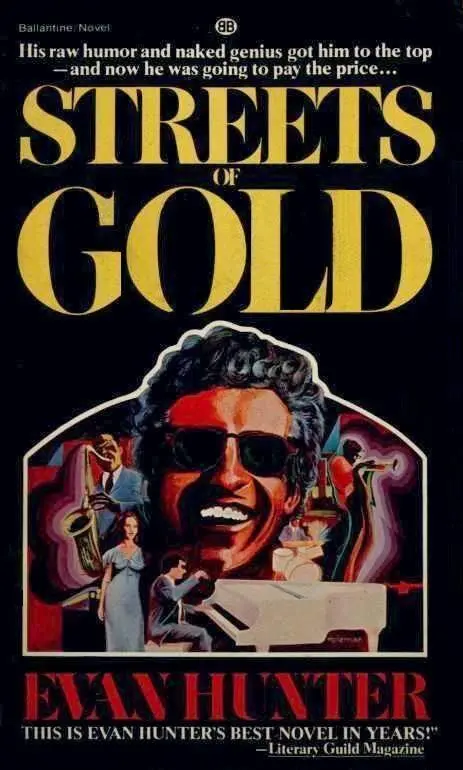
- Название:Streets of Gold
- Автор:
- Издательство:Ballantine Books
- Жанр:
- Год:1975
- Город:New York
- ISBN:978-0-345-24631-8
- Рейтинг книги:4 / 5. Голосов: 1
-
Избранное:Добавить в избранное
- Отзывы:
-
Ваша оценка:
Streets of Gold: краткое содержание, описание и аннотация
Предлагаем к чтению аннотацию, описание, краткое содержание или предисловие (зависит от того, что написал сам автор книги «Streets of Gold»). Если вы не нашли необходимую информацию о книге — напишите в комментариях, мы постараемся отыскать её.
Streets of Gold — читать онлайн бесплатно полную книгу (весь текст) целиком
Ниже представлен текст книги, разбитый по страницам. Система сохранения места последней прочитанной страницы, позволяет с удобством читать онлайн бесплатно книгу «Streets of Gold», без необходимости каждый раз заново искать на чём Вы остановились. Поставьте закладку, и сможете в любой момент перейти на страницу, на которой закончили чтение.
Интервал:
Закладка:
My Aunt Bianca’s corset shop on a Saturday afternoon in September, shortly before my eighth birthday. I am curled up in a floppy armchair draped with brassieres. My aunt is working at one of her dress dummies, fashioning a corset for a lady of gigantic proportions. There are pins sticking in her mouth, and when she answers my questions, she mumbles around the pins. A soft, slow, gentle autumn rain nuzzles the plate-glass window of the shop. Somewhere far in the distance, there is the lingering intermittent rumble of thunder.
“Are brassieres sexy?” I ask.
“What?” she says.
“Tony says they are.”
“Well...”
“Are they?”
“Not to me,” Aunt Bianca says.
“What does that mean , anyway?”
“What does what mean?”
“Sexy.”
“Go ask Tony.”
“Do you think he knows?”
“Maybe,” Aunt Bianca says. “He’s advanced for his age.”
“Yeah.” Silence. Distant thunder. “Aunt Bianca?”
“Mmmm?”
“Why do ladies wear them, anyway?”
“You ask too many questions,” she says.
My grandfather first took me to meet Federico Passaro on a bitterly cold day in January of 1935. Showing the proper deference to an educated man (and especially a man educated in music! ), he alternately addressed Passaro as either Dottore or Professore , telling him how long I’d been studying, and how beautifully I could play, and then explaining that I had perfect pitch, which phenomenon he demonstrated by striking three random notes simultaneously on the keyboard, and asking me to identify them — which of course I did. Passaro seemed singularly unimpressed by my feat. At least, he made no comment about it. I later learned that he, too, had perfect pitch, so what was the big deal? All he wanted was to hear me play, but I was shivering (literally and figuratively) at the electric heater in the corner of the room, and beginning to think my hands would never get warm.
I liked his voice. His English was tinged with a faint accent, and when he spoke to my grandfather in the Neapolitan dialect, even this sounded less harsh than it did in the streets of Harlem. He was described to me later by my grandfather as a short, squat man in his early sixties, with a wild thatch of black hair, a hooked nose (“like a Jew’s, Ignazio”) and lips perpetually pursed as though in displeasure. When I finally sat down to play a piece I knew cold — C. P. E. Bact’s “Solfegietto” - he stood by my side at the piano and listened attentively, his even breathing interrupted only once, when I fluffed a passage I’d played without error perhaps a hundred times before.
I wish I could say that something startling happened the first time I played for Passaro. I couldn’t see his reactions, of course, but I can guarantee there was no dramatic B-movie-type revelation, with Passaro shouting “ Madonna mia!” in discovery of a remarkable child prodigy in his living room. I simply played the piece through, cursing myself for the fluff (but blaming it on my cold chops), and when I’d struck the final chords, I sat at the piano in silence, my hands in my lap, and waited.
“Well,” my grandfather said in Italian, “what do you think?”
“Who has been teaching you?” Passaro asked.
“Miss Goodbody. At school.”
“And you’ve been playing for how long?”
“I started when I was six.”
“How old are you now?”
“I was eight in October.”
“So that’s more than two years.”
“Yes.”
“Has your teacher given you any Chopin?”
“Just the A-Major Prelude.”
“Bach, of course.”
“Yes.”
“Mendelssohn?”
“The ‘Six Pieces for Children.’ ”
“No Brahms, eh?”
“No.”
“How does she teach you? Does she play the piece for you, or what? I’ve never taught a blind person.”
“The pieces are in Braille,” I said. “She usually plays them through first, and then I read the notes. In Braille.”
“Ah,” Passaro said.
“So what do you think?” my grandfather asked in Italian.
“I’ve never taught a blind person,” Passaro answered in Italian.
“How long do you practice every day?” he asked me.
“Two hours.”
“If I teach you, I want you to practice not only during the hours you’ve set aside for practice, but also when you simply feel like playing. That is important to me.”
“Okay,” I said.
“How will I know what compositions are available in Braille?” Passaro asked.
“I can get a list from Miss Goodbody,” I said.
“Why do you want to leave her?” Passaro asked.
I hesitated. Then, looking up from the keyboard for the first time, I turned in the direction of Passaro’s voice, and said, “I can play better than she can.”
“I see,” Passaro said. “Will you expect to play better than I can?”
“Yes,” I said.
“I’ve played at Carnegie Hall,” Passaro said. “I gave a recital at Carnegie Hall fourteen years ago.”
“Okay,” I said, and nodded.
“Okay? What does that mean, okay?”
“If you want me to play at... whatever you said, I’ll do it.”
“What do you want?”
“I just want to learn how to play better.”
“For what? To amuse your friends?”
“Just to be real good,” I said.
“Do you think you’re good now?”
“Yes.”
“You’re very sloppy,” Passaro said. “If a student of mine had been studying with me for two and a half years...”
“It’s not that long,” I said.
“Then what? Two years and two months? Even so. I would stop giving lessons to someone who was still so sloppy after all that time.”
“Well,” I said, “I don’t think I’m so sloppy. Just because I made a dumb mistake...”
“I’m not talking about the mistake. I’ve heard giants make mistakes, though rarely. I am talking about your fingering. I am talking about this ,” he said, and his right hand must have darted out because the next thing I heard was a descending arpeggio, “instead of this ,” he said, and the identical arpeggio sprang clean and crisp and true from the instrument. “Do you hear a difference?”
“Yes.”
“Can you play what I just played?”
“Maybe.”
“Try it.”
“Was that an F sharp?” I asked. “The first note?”
“Was it?”
“Yes.” I found F sharp above high C, positioned my right hand over the keys, and played the arpeggio slowly and carefully, F sharp, C sharp, A, and then to F sharp again, repeating the notes until I reached the center of the keyboard. I took my hand off the keys.
“That was sloppy,” Passaro said.
“Well, it was the first time I played it.”
“I’ve never taught a blind person,” Passaro said. “I don’t like students who whine or complain or who don’t do the work. If I have to worry about hurting your feelings because you’re blind, then I don’t want to teach you.”
“Well, how would you hurt my feelings?” I asked.
“Doesn’t it hurt your feelings to know you’re sloppy?”
“No.”
“It should,” Passaro said.
“Miss Goodbody doesn’t think I’m sloppy.”
“If you can play better than she can, how would she know if you’re sloppy?”
I burst out laughing.
“You think that’s funny?” Passaro said
“Yeah,” I said, still laughing.
“Don’t laugh when the professore is talking,” my grandfather said.
“When can you get me this Braille list?” Passaro asked.
“Will you teach him?”
“First I want to see the list. If there are enough compositions on it, compositions I want to teach...”
Читать дальшеИнтервал:
Закладка:
Похожие книги на «Streets of Gold»
Представляем Вашему вниманию похожие книги на «Streets of Gold» списком для выбора. Мы отобрали схожую по названию и смыслу литературу в надежде предоставить читателям больше вариантов отыскать новые, интересные, ещё непрочитанные произведения.

Обсуждение, отзывы о книге «Streets of Gold» и просто собственные мнения читателей. Оставьте ваши комментарии, напишите, что Вы думаете о произведении, его смысле или главных героях. Укажите что конкретно понравилось, а что нет, и почему Вы так считаете.