Mathias Énard - Street of Thieves
Здесь есть возможность читать онлайн «Mathias Énard - Street of Thieves» весь текст электронной книги совершенно бесплатно (целиком полную версию без сокращений). В некоторых случаях можно слушать аудио, скачать через торрент в формате fb2 и присутствует краткое содержание. Год выпуска: 2014, Издательство: Open Letter, Жанр: Современная проза, на английском языке. Описание произведения, (предисловие) а так же отзывы посетителей доступны на портале библиотеки ЛибКат.
- Название:Street of Thieves
- Автор:
- Издательство:Open Letter
- Жанр:
- Год:2014
- ISBN:нет данных
- Рейтинг книги:4 / 5. Голосов: 1
-
Избранное:Добавить в избранное
- Отзывы:
-
Ваша оценка:
Street of Thieves: краткое содержание, описание и аннотация
Предлагаем к чтению аннотацию, описание, краткое содержание или предисловие (зависит от того, что написал сам автор книги «Street of Thieves»). Если вы не нашли необходимую информацию о книге — напишите в комментариях, мы постараемся отыскать её.
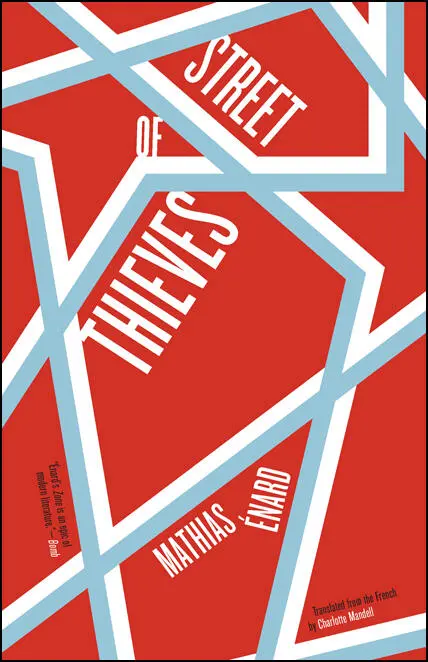
is a timely novel about a young Moroccan boy caught up in the turbulent events of the Middle East, and a possible murder.
Exiled from his family for religious transgressions related to his feelings for his cousin, Lekhdar finds himself on the streets of Barcelona hiding from both the police and the Muslim Group for the Propagation of Koranic Thoughts, a group he worked for in Tangiers not long after being thrown out on the streets by his father.
Lekhdar's transformations — from a boy into a man, from a devout Muslim into a sinner — take place against the backdrop of some of the most important events of the past few years: the violence and exciting eruption of the Arab Spring and the devastating collapse of Europe's economy.
If all that isn't enough, Lekhdar reunites with a childhood friend — one who is planning an assassination, a murder Lekhdar opposes.
A finalist for the prestigious Prix Goncourt,
solidifies Énard's place as one of France's most ambitious and keyed-in novelists of this century. This novel may even take
's place in Christophe Claro's bold pronouncement that Énard's earlier work is "the novel of the decade, if not of the century."
Mathias Énard
Zone Charlotte Mandell
Street of Thieves — читать онлайн бесплатно полную книгу (весь текст) целиком
Ниже представлен текст книги, разбитый по страницам. Система сохранения места последней прочитанной страницы, позволяет с удобством читать онлайн бесплатно книгу «Street of Thieves», без необходимости каждый раз заново искать на чём Вы остановились. Поставьте закладку, и сможете в любой момент перейти на страницу, на которой закончили чтение.
Интервал:
Закладка:
I spent the night in a bar called El Estrecho, which was well-named, narrow as the Strait itself; it had a TV, Real Madrid had played to a 1–1 draw in Moscow, it took up my entire evening.
On my way back I returned to glance at my emails and Facebook, still no news from Judit. I decided to call her on her cell, it was 11:30; there was a line of phone booths in the locutorio. I dialed her number and she answered almost immediately.
“ Hola, it’s Lakhdar,” I said. “I’m in Algeciras.”
I tried to control my voice, to seem cheerful, so she wouldn’t guess my anxiety.
“Lakhdar, ¿ qué tal? Kayfa-l hal? ”
“Everything’s fine,” I said. “I have a visa, did you get my email?”
I could sense she was embarrassed, that something wasn’t right.
“No. . Or yes, I saw your email. .” She hesitated for an instant. “But I haven’t had time to answer.”
I knew right away she was lying.
The conversation was full of silences, she made an effort to ask me what was new, suddenly I didn’t really know what to say.
“Do you. . do you want me to come to Barcelona?”
I already knew the answer, but I waited, like a deserter facing the execution squad.
“Um, yes, of course. .”
We were in the process of humiliating each other; she was humiliating me by lying and I was humiliating her by forcing her to lie.
I tried to smile as I spoke: that’s okay, don’t worry, I’ll call back in a few days, in the meantime, we can write; and then whereas usually it took us many minutes to bring ourselves to end the conversation, I sensed her relief when she said see you soon then, and hung up.
I didn’t leave the tiny phone booth right away; I looked at the dial for a while, my head empty. Then I thought that the Moroccans outside were making fun of me, calling me little cuckolded prick, tittering; I was ashamed that my eyes were burning. I left the cabin to pay.
I returned to my luxury hotel after stopping on the way in a grocery store that was still open to buy a couple of beers, which I drank, lying on the bed, thinking I really was all alone now. I tore out the pages from an old tourist magazine to try to write a long poem or a letter to Judit, but I was incapable of doing either.
She was with someone else, you feel these things; little by little my rage grew with the alcohol, a desperate rage, in the emptiness and bustle of a continent that had just lost all its meaning, all I had left was this pathetic room, my whole life was summarized in this shitty craphole, I was locked up again, there was nothing for it, nothing, you’re never free, you always collide with things, with walls. I thought about this world on fire, about a Europe that would burn again someday like Libya, like Syria, a world of dogs, of abandoned beggars — it’s hard to resist mediocrity, in the constant humiliation life holds us in, and I was angry at Judit, I was angry at Judit for the pain of abandonment, the blackness of solitude and the betrayal I imagined behind her embarrassed words, the future was a stormy sky, a sky of steel, leaden in the north; Fate plays in little spurts, little movements, the sum of minute mistakes in a direction that hurls you onto the rocks instead of reaching the paradisiacal island so desired, the Leeward Islands or the catlike Celebes. I thought of Saadi, of Ibn Battuta, of Casanova, of happy travelers — I alone was stuck with a lukewarm beer and a heart of sadness, in the Western darkness, and there was no beacon in the night of Algeciras, none, the lights of Barcelona, of Paris, were all out, I had nothing left but to go back to Tangier, Tangier and kilometrically typing the names of dead soldiers, conquered by too many shipwrecks.
THISwhole series of coincidences, chances, I don’t know how to interpret them; call them God, Allah, Fate, predestination, karma, life, good luck, bad luck, whatever you like — I didn’t go to Barcelona right away, I didn’t run to find Judit, because I was convinced she was with another guy, true, but also because I was afraid, afraid of falling back into wandering, poverty, because I was a little cowardly too; who knows. I was tired. No revolution, no books, no future. I couldn’t go back to Tangier because I knew it would be impossible for me to leave it again, not northward, at least, or illegally; on board the Ibn Battuta I had heard a lot of stories, terrible stories of exile, of men drowned in the Strait or the Atlantic coast, between Morocco and the Canaries — Africans preferred the Canaries because the archipelago was harder to monitor. Since all those blacks and North Africans wandering around the streets with nothing to do were bad for tourism, the Canary government sent them packing somewhere else by plane, to the continent, at its own expense, and the sub-Saharans, Moors, Nigerians, and Ugandans wound up in Madrid or Barcelona, trying their chances in a country with the highest unemployment rate in Europe — the girls became whores, the men ended up in illegal, squalid camps out in the country, in Aragon or La Mancha, stuck between a couple of trees, living out in the open in the middle of garbage dumps, discarded trash, and the cold, and they developed magnificent diseases of the skin, abscesses, parasites, chilblains, waiting for a farmer to give them a little menial work in exchange for stale bread and potato peelings for their soup, they cleared stones out of fields in the winter, picked cherries and peaches in the summer — not for me, thanks. You always find people worse off than you, compared to these galley slaves I was well-off, I had a little education, a little money, and a country where, in the worst case, you could scrape together a living — I was a city boy, I had read books, I spoke foreign languages, I knew how to use a computer, I’d end up finding something, and in fact I did very quickly find a job near Algeciras, thanks to Saadi of course, it would never have occurred to me to explore that branch, supposing such a branch actually exists: when I was moping around in my stinking hovel a few hundred meters away from the Ibn Battuta, picturing Judit with her new guy, he sent me a text asking me to call, which I did right away. At the port he had spoken to an “entrepreneur” from the region who needed a Moroccan for a small job, and that’s how I entered the service of Marcelo Cruz, funeral services: my Fortune was playing tricks on me, it hadn’t had its fill, it always wanted more. Señor Cruz scheduled a meeting with me in a café in the center of Algeciras, he had a black SUV which he unhesitatingly double-parked, he recognized me because of the green parka, said is that you Lakhdar? Yes, I answered and smiled, that’s me, I’m a friend of Saadi’s. Of who? he asked. I said of the sailor on the Ibn Battuta, oh yes, good, he said, would you like to work for me, I answered, of course, of course, what exactly is involved? Well it’s a very simple job, he said, you have to look after dead people.
Mr. Cruz had a mournful, sweaty face, a shirt open to the middle of his chest, and a black leather jacket.
I didn’t quite see what that meant, looking after dead people, aside from my experience with the poilus, but I accepted, obviously.
Marcelo Cruz’s business had been flourishing; for years, he was the one who gathered, stored, and repatriated all the bodies of illegal immigrants in the Strait — drowned men, men who died from fear or hypothermia, bodies the Guardia Civil gathered on the beaches, from Cadiz to Almeria. After the judge and the pathologist, when they were assured the poor guy or guys had indeed croaked, their faces turned gray by the sea, their bodies swollen, they would call Marcelo Cruz; he would then put the remains in his cold-storage room and would try to guess the stiff’s origins, which wasn’t a piece of cake, as he said. There aren’t any easy jobs, Señor Cruz repeated to me during the trip in his SUV, which brought me to the funeral enterprise, a few kilometers away from Algeciras toward Tarifa. If there weren’t any material leads and no surviving witnesses, if it was impossible to put a name to the corpse, they’d end up burying the body at the expense of the State in an anonymous grave in one of the cemeteries along the coast; when they guessed its origins, either because it had a passport on it, or a handwritten note, or a telephone number, they’d keep it cold until its possible repatriation in a fine lead-lined, zinc coffin: Mr. Cruz would then climb into his hearse, take the ferry in Algeciras and bring the deceased to his final resting place. He knew Morocco like the back of his hand, most of his “clients” were Moroccan; entire villages would start mourning when they saw his wagon of death arriving. According to him, Marcelo Cruz was sadly famous there.
Читать дальшеИнтервал:
Закладка:
Похожие книги на «Street of Thieves»
Представляем Вашему вниманию похожие книги на «Street of Thieves» списком для выбора. Мы отобрали схожую по названию и смыслу литературу в надежде предоставить читателям больше вариантов отыскать новые, интересные, ещё непрочитанные произведения.







Обсуждение, отзывы о книге «Street of Thieves» и просто собственные мнения читателей. Оставьте ваши комментарии, напишите, что Вы думаете о произведении, его смысле или главных героях. Укажите что конкретно понравилось, а что нет, и почему Вы так считаете.