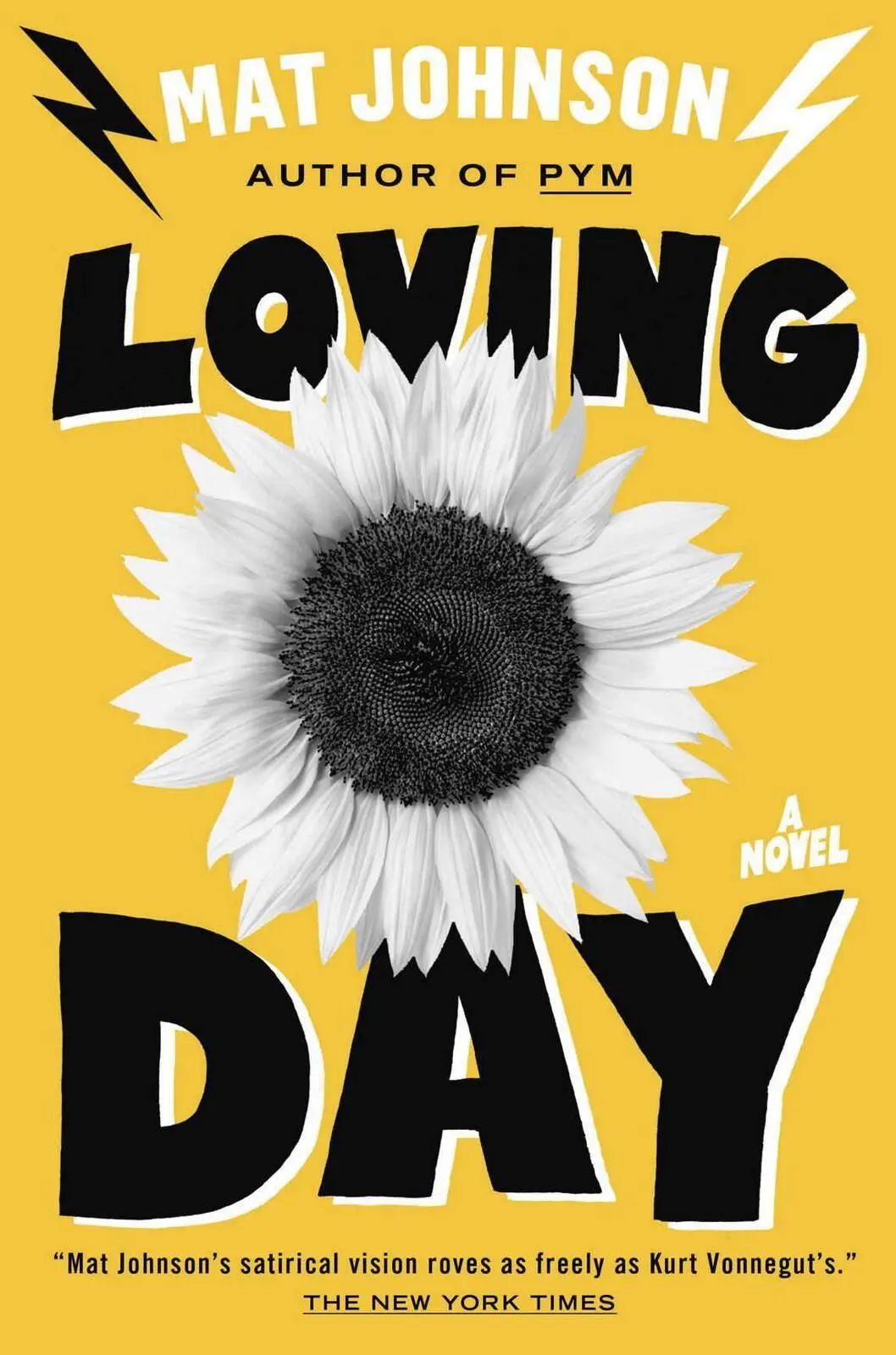
Mat Johnson - Loving Day
Здесь есть возможность читать онлайн «Mat Johnson - Loving Day» весь текст электронной книги совершенно бесплатно (целиком полную версию без сокращений). В некоторых случаях можно слушать аудио, скачать через торрент в формате fb2 и присутствует краткое содержание. Год выпуска: 2015, Издательство: Spiegel & Grau, Жанр: Современная проза, на английском языке. Описание произведения, (предисловие) а так же отзывы посетителей доступны на портале библиотеки ЛибКат.
- Название:Loving Day
- Автор:
- Издательство:Spiegel & Grau
- Жанр:
- Год:2015
- ISBN:нет данных
- Рейтинг книги:3 / 5. Голосов: 1
-
Избранное:Добавить в избранное
- Отзывы:
-
Ваша оценка:
Loving Day: краткое содержание, описание и аннотация
Предлагаем к чтению аннотацию, описание, краткое содержание или предисловие (зависит от того, что написал сам автор книги «Loving Day»). Если вы не нашли необходимую информацию о книге — напишите в комментариях, мы постараемся отыскать её.
comes a ruthlessly comic and moving tale of a man discovering a lost daughter, confronting an elusive ghost, and stumbling onto the possibility of utopia.
"In the ghetto there is a mansion, and it is my father's house." Warren Duffy has returned to America for all the worst reasons: His marriage to a beautiful Welsh woman has come apart; his comics shop in Cardiff has failed; and his Irish American father has died, bequeathing to Warren his last possession, a roofless, half-renovated mansion in the heart of black Philadelphia. On his first night in his new home, Warren spies two figures outside in the grass. When he screws up the nerve to confront them, they disappear. The next day he encounters ghosts of a different kind: In the face of a teenage girl he meets at a comics convention he sees the mingled features of his white father and his black mother, both now dead. The girl, Tal, is his daughter, and she’s been raised to think she’s white.
Spinning from these revelations, Warren sets off to remake his life with a reluctant daughter he’s never known, in a haunted house with a history he knows too well. In their search for a new life, he and Tal struggle with ghosts, fall in with a utopian mixed-race cult, and ignite a riot on Loving Day, the unsung holiday for interracial lovers.
A frequently hilarious, surprisingly moving story about blacks and whites, fathers and daughters, the living and the dead,
celebrates the wonders of opposites bound in love.
Loving Day — читать онлайн бесплатно полную книгу (весь текст) целиком
Ниже представлен текст книги, разбитый по страницам. Система сохранения места последней прочитанной страницы, позволяет с удобством читать онлайн бесплатно книгу «Loving Day», без необходимости каждый раз заново искать на чём Вы остановились. Поставьте закладку, и сможете в любой момент перейти на страницу, на которой закончили чтение.
Интервал:
Закладка:
“Warren Duffy!” My name interrupts him. But I don’t say it. It comes from a woman. She’s tall, her sable mane tied up behind her head, the large glasses resting on her nose, her face’s most prominent feature. I watch as she walks off one of the trailer’s little porches, carrying rolls of rubber mats under one arm and a gaggle of hula hoops in the other. Look at that, her sandals, they still clap for her.
I smile, wave, yell out, “Hi, so good to see you again,” but she just looks annoyed in my direction.
When she gets to the gate she says, “Look at that. The world’s biggest sunflower has come to bloom.”
6
RUSTY OLD TRAILERS, decomposing in the woods. There are different kinds of trailers — travel trailers with monotonous white ruffled siding, drab gray business ones the size of shipping containers, shiny aluminum ones shaped like suppositories. There’s even a row of mobile homes that look like Victorian houses for oversized dolls, lined up side by side on the grass in imitation of a town house block. But that’s it. Some moldy circus tents, but they just add to the feeling of bohemian impermanence. A good breeze and it’s all gone.
“I assure you, we are very well funded, and have already begun building an endowment,” the center’s director tells me. As soon as we’re introduced, she asks me to call her Roslyn, or Director Roslyn, but she doesn’t give me her last name. “A literal building is the next step.”
“But this is a public park, right?” It’s totally a public park. It’s owned by the City of Philadelphia.
“There’s an ongoing litigation.” She smiles calmly, the patience of a mother enjoying childlike naïveté.
It’s hard to tell Roslyn’s age because she’s clearly fit and wrinkle-free, and conventionally attractive, but from the full white of her hair I know she’s almost a generation older than me. She shows me her world and I look around this place thinking, Is it free? If not, can I afford it? But all I ask her is, “What’s a ‘sunflower’?”
“A ‘sunflower’? Where did you hear that? That’s a horrible word.”
“It’s a beautiful flower. You can eat it too.”
“Yellow on the outside, brown on the inside. A slang term for a biracial person who denies their mixed nature, only recognizing their black identity.” Roslyn turns her head to look over at me as we slowly walk down the wooded path, as if I’m the source of the etymology. “I don’t allow use of that word here. The Mélange Center is about inclusion of all perspectives of the black and white, mixed-race experience. Our goal is to overcome the conflict of binary. To find the sacred balance.”
“The sacred balance,” I say back to her, to prove I’m listening.
“The sacred balance. An equilibrium that allows you to live a life that expresses all of who you are and hide none of it,” she says, and she keeps talking. I look at her and offer an occasional “Yes” and smile, but mostly I watch my daughter across the lawn with that first biracial militant I encountered. She’s taller than Tal. Much thicker. How can any grown straight man become infatuated with teens when there are women walking this earth? With cellulite and stretch marks because they’re actually living?
“Oh. Sunita.” The director follows my eyes. “Sun is a miracle, really, my little soul sister. But when you get called names your whole life, it’s easy to revert to doing the same.”
Sun . She’s at the younger end of my generation, with a name like that. Creative, but predating the celebrity insane-name movement, which means her parents were also hippies and most likely young and idealistic when she was born. The Brits, they can tell your social station from asking you the weather, but in African America first names offer not only class and region, but year.
“That’s fine. I’m sure Sun’s just used to the word from being called it.”
“Oh no, Sunita Habersham?” Roslyn asks, laughing. “Sun used to be the biggest Oreo on the compound.”
There’s a lecture. A spiel. I’m certainly not the first to hear it and by the time I do it’s fairly glossy and filled with sentences like “We aim to help mixed children deal with the unique challenge of negotiating African and European hybridity.” It’s a beautiful sentence. I don’t know what it actually means, or how you would do it, or what the end product would be either. “Now we’re actively moving to the next stage. A cultural center, an artist retreat. And a school. For your daughter’s age, it would be a GED diploma, by exam, but we offer teachers from the most competitive colleges and universities to give recommendations. We’re building something that will last. A permanent oasis. When you consider that this whole enterprise started as an annual weekend event just three years ago, you get a sense of the trajectory.”
“How’d you do it?”
“Nobody went home. On the last day of the retreat, nobody went home. And then more came. And here you are.” Roslyn smiles again. The grin doesn’t reach her eyes and it reminds me of the mask-like grins of the principals I submitted to from elementary through high school. Instinctively, I want to know if I’m going to be suspended.
We’re by the Victorian cottages now, with their gabled roofs. There’s more than a dozen in the row, with another row behind it. Beautiful little shotgun homes with intricate woodwork and little concrete block porches. But when you look under those porches, you can see the wheels. Roslyn notices me bend a little to look and says, “All of our teachers are well credentialed, and specifically trained in our method of multiracial balance. If you decide to enroll your daughter, I assure you, nobody will be absconding in the night with your tuition.”
When I hear the word tuition , the rest barely registers. Whatever it is, I’m fairly certain it’s beyond what I can afford. I have $532 in the bank, after buying back the bike and picking up some more furniture from Whosoever Gospel Mission. I will get funds from my father’s cash accounts, but who knows when and how much will be left over. Even to live in the damn shell of a house he left me I’ve had to arrange for some roofers and get an electrician who doesn’t care about codes. I’ll be chilling when the house burns down, but even that payout could take another year. Knowing this, that this is beyond my reach, I blink and the school becomes suddenly desirable. It’s an education out in the trees. It’s small classes with teachers still fresh and not worn down by the friction of reality against their good intentions. It’s probably the least threatening majority black place I could take Tal, and the only one where I wouldn’t have to worry about her destroying everything by saying something offensive. They seem a little wacky, but all teachers are a little wacky. At least the ones I’ve dated. Crazy hippie school out in the woods. Naïvely earnest mulattoes starting a comfy commune. It’s Mulattopia. Tal in tie-dye. It would be so adorable.
“How much is it, can you tell me? Monthly?”
She says a yearly number out loud that’s so insanely high that I laugh because I think she’s messing with me. She smiles again, her perfect teeth on display, and I know she’s not. What kind of halfros have that kind of money? But she keeps going on, saying, “Fellowships and some financial aid are available. Although the forms are still being designed.”
We continue our tour, but only because I’m too embarrassed to say, Sorry, I’m one of those broke-ass Negroes you may have read about . I get Tal as soon as I can break away politely. My teenage daughter’s talking to Sunita Habersham, who after a half-hour to think about it still clearly doesn’t care for me. But she does seem to have a real appreciation for what my X chromosome can create though, because she’s holding Tal’s hand like she’s her aunt.
Читать дальшеИнтервал:
Закладка:
Похожие книги на «Loving Day»
Представляем Вашему вниманию похожие книги на «Loving Day» списком для выбора. Мы отобрали схожую по названию и смыслу литературу в надежде предоставить читателям больше вариантов отыскать новые, интересные, ещё непрочитанные произведения.





Обсуждение, отзывы о книге «Loving Day» и просто собственные мнения читателей. Оставьте ваши комментарии, напишите, что Вы думаете о произведении, его смысле или главных героях. Укажите что конкретно понравилось, а что нет, и почему Вы так считаете.