Ma Jian - Beijing Coma
Здесь есть возможность читать онлайн «Ma Jian - Beijing Coma» весь текст электронной книги совершенно бесплатно (целиком полную версию без сокращений). В некоторых случаях можно слушать аудио, скачать через торрент в формате fb2 и присутствует краткое содержание. Год выпуска: 2009, Издательство: Vintage, Жанр: Современная проза, на английском языке. Описание произведения, (предисловие) а так же отзывы посетителей доступны на портале библиотеки ЛибКат.
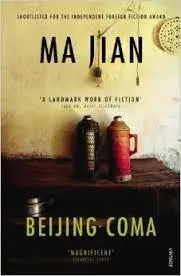
- Название:Beijing Coma
- Автор:
- Издательство:Vintage
- Жанр:
- Год:2009
- ISBN:нет данных
- Рейтинг книги:3.5 / 5. Голосов: 2
-
Избранное:Добавить в избранное
- Отзывы:
-
Ваша оценка:
Beijing Coma: краткое содержание, описание и аннотация
Предлагаем к чтению аннотацию, описание, краткое содержание или предисловие (зависит от того, что написал сам автор книги «Beijing Coma»). Если вы не нашли необходимую информацию о книге — напишите в комментариях, мы постараемся отыскать её.
As the minute-by-minute chronicling of the lead-up to his shooting becomes ever more intense, the reader is caught in a gripping, emotional journey where the boundaries between life and death are increasingly blurred.
Beijing Coma — читать онлайн бесплатно полную книгу (весь текст) целиком
Ниже представлен текст книги, разбитый по страницам. Система сохранения места последней прочитанной страницы, позволяет с удобством читать онлайн бесплатно книгу «Beijing Coma», без необходимости каждый раз заново искать на чём Вы остановились. Поставьте закладку, и сможете в любой момент перейти на страницу, на которой закончили чтение.
Интервал:
Закладка:
Dongsheng removes his padded coat and the air fills with the smell of stale leftovers and oily pans.
‘The government keeps urging everyone to go into business,’ my mother says. ‘My only talent is singing. I can’t do anything else. So when I retired from the opera company, I decided to give private singing lessons at my home. But the police come round so often, checking up on Dai Wei, most of my pupils have been scared away. I’ve only got one left now.’
‘Dr Ma, you’ve come!’ Dai Dongsheng shouts into the corridor in a Shandong dialect.
My mother gets up from her stool.
I hear the doctor approach, treading over the pumpkin-seed shells scattered across the floor. I can sense there’s a group of people behind him, standing in the doorway, blocking the small amount of the light that reaches this room.
‘You’ve left it too late, I’m afraid,’ Dr Ma says. ‘If you’d brought him to me two years ago, he’d be walking about by now.’
‘He’s been having terrible green diarrhoea, and he’s got a temperature of thirty-nine degrees,’ my mother says, a beseeching tone creeping into her voice.
‘He needs stronger medicine. I’ll take him to the graveyard tonight, and ask the fox spirit to offer assistance.’ Dr Ma pinches my earlobes then inspects my tongue. ‘Help me pull him up, Dongsheng. I want to move him about a little.’ He and Dongsheng pull me up into a sitting position, then push me back down. ‘And up again, down again, up again, down again… One can’t rely on medicine alone. He must do these exercises. The joints and ligaments need to be supple if the herbs are to have an effect.’ They fold me up and stretch me out one last time, then leave me to rest on my back. A confusion of red and black blotches dances before my eyes. I feel as though I’m suffocating.
You remember sticking your head out of the window of the covered balcony one cold winter morning, and gazing at the few golden leaves still clinging to the branches of the locust tree.
The nights are very black in the countryside. They’ve laid me down in the graveyard and draped a blanket over me. My limbs are freezing. We’ve been here a long time, and still no spirit has appeared, although for a moment I thought I sensed the ghost of my grandfather, who was buried alive here by Dongsheng’s father during the Cultural Revolution. Perhaps I have already consumed traces of his spirit in the graveyard herbs I’ve been fed. A few hours ago, Dr Ma placed a pile of paper money by my side and burned it, muttering, ‘Come and help this man, fox spirit, and let him walk again. Show him your mercy…’
When my mother had to leave me for a while, she asked Taotao to stay by my side and make sure no dogs or pigs came and bit me. After we were left alone, Taotao whispered to me, ‘Stop pretending to be dead!’ then picked up a stick and hit my face, hands and stomach with it. Thanks to that beating, I am now able to feel cold and anxious. Perhaps tomorrow I’ll be able to move my fingers.
After an uncertain lapse of time, I feel a bright light shining on my eyes and hear someone say, ‘Dr Ma, the secretary of the county Party committee has ordered us to take this patient to the county Armed Forces department.’
‘You’d better take him, then. What’s the problem?’
‘A patient receiving treatment for physical injuries must have their crackdown certificate stamped by the public security bureau. The clinic’s stamp isn’t sufficient any longer. The provincial authorities telephoned this morning to inform us about this new regulation.’
The torchlight flashes over my face again. A dizzying prism of black and white blotches floats before my eyes.
Your thoughts return to those glimmering locust-tree leaves, and to the beautiful moment of dawn when darkness merges into light.
I used to long for Tian Yi’s visits, but now I dread them. I know that my cousin Kenneth has sent her a letter confirming he’ll act as her financial sponsor in America. All she needs to do now is hand in her residence permit to the talent-exchange centre, then apply for a visa.
She walks into my room. She hasn’t seen me for six months. My appearance must disgust her. My body is shrivelled and dry. There’s a feeding tube in my mouth. A stream of saliva leaking from the corner of my parted lips is trickling down my neck onto the pillow. My mother has opened the windows and doused the floor with eau de cologne, but the room still smells of sickness. The odour seeps from my pores onto the mattress and is released into the air by the spreading mould.
She sits down next to me. ‘You’ve lost more weight, Dai Wei,’ she says. ‘It makes me so sad.’
I breathe in and smell the scent of her freshly washed hair mingled with the strange smells wafting from under the bed. Somewhere beneath me is a bag containing her journals and photograph albums. Inside one album is the photo of Tian Yi and me in the rainforest of Yunnan — the one where she’s leaning against me, exhausted after our walk, her mouth half open.
‘I’ve come today because it’s the third anniversary of 4 June. The streets are filled with police cars and the Square has been cordoned off.’
After she leaves, her image lingers inside my head for a while, then slowly breaks up and disappears.
‘I was never able to develop my talents in the opera company,’ my mother says. ‘The other singers would laugh at me when I went off to do voice exercises. They spent all their time playing Mahjong, or sucking up to the leaders, trying to wangle a trip abroad or a new flat. Everyone was so corrupt. I had to leave…’ She’s talking to An Qi in the sitting room. Fan Jing is also with them. Last time she came, she said that after her son was killed in the crackdown, her cat died of heartbreak.
Your skin is as dry as a wheat husk. Your heart lies trapped inside damp walls, invisible and untouchable.
On the afternoon of 12 May, Han Dan and Ke Xi posted a notice in the Triangle calling for students to sign up for a hunger strike due to start in Tiananmen Square at 2 p.m. the following day.
In Old Fu’s Democracy Forum show that evening, Bai Ling and Han Dan gave impassioned speeches, urging everyone to join the strike. Ke Xi, who’d gone into hiding for three days after hearing rumours of an imminent police clampdown, turned up again in the Triangle to welcome a delegation of Shanghai students who’d travelled to Beijing to submit a petition to the government.
Sensing the new mood of excitement in the campus, the Organising Committee realised it would be futile to oppose the strike. Hai Feng suggested we set up a support group and a first-aid team to assist the hunger strikers during their occupation of the Square. By now, nearly forty students had signed up.
Shu Tong climbed onto the windowsill, gazed down at the crowd in the Triangle and said morosely, ‘They stir the masses into a frenzy, then say, “Listen to the voice of the people!” Everyone from Hitler to Mao has done it. The movement we’ve worked so hard to build up is being destroyed by these bloody upstarts.’
‘You’ve had many chances to seize the leadership,’ I said, ‘but you’ve always let them slip. You prevaricate.’
‘No, my belief has always been that if we push things too far, we’ll be crushed. The Communist Party was catapulted to power through student uprisings, so it understands the threat we pose to the status quo.’
Only when the Shanghai students were taken off to the dorms at two in the morning did the Triangle finally quieten down. I told Mou Sen he could sleep on my bunk, then went to find an empty bed in Tian Yi’s dorm.
Mou Sen had been appointed the new chairman of the Beijing Students’ Federation. His university was tightly guarded, so he’d based his headquarters at our campus. Sister Gao was his secretary general. They’d organised a meeting the night before, but no one had turned up. A few members sent messages saying they’d returned to classes or were being monitored by the authorities. The Federation seemed to exist in name only.
Читать дальшеИнтервал:
Закладка:
Похожие книги на «Beijing Coma»
Представляем Вашему вниманию похожие книги на «Beijing Coma» списком для выбора. Мы отобрали схожую по названию и смыслу литературу в надежде предоставить читателям больше вариантов отыскать новые, интересные, ещё непрочитанные произведения.







Обсуждение, отзывы о книге «Beijing Coma» и просто собственные мнения читателей. Оставьте ваши комментарии, напишите, что Вы думаете о произведении, его смысле или главных героях. Укажите что конкретно понравилось, а что нет, и почему Вы так считаете.