Calvin Baker - Grace
Здесь есть возможность читать онлайн «Calvin Baker - Grace» весь текст электронной книги совершенно бесплатно (целиком полную версию без сокращений). В некоторых случаях можно слушать аудио, скачать через торрент в формате fb2 и присутствует краткое содержание. Год выпуска: 2015, Издательство: Tyrus Books, Жанр: Современная проза, на английском языке. Описание произведения, (предисловие) а так же отзывы посетителей доступны на портале библиотеки ЛибКат.
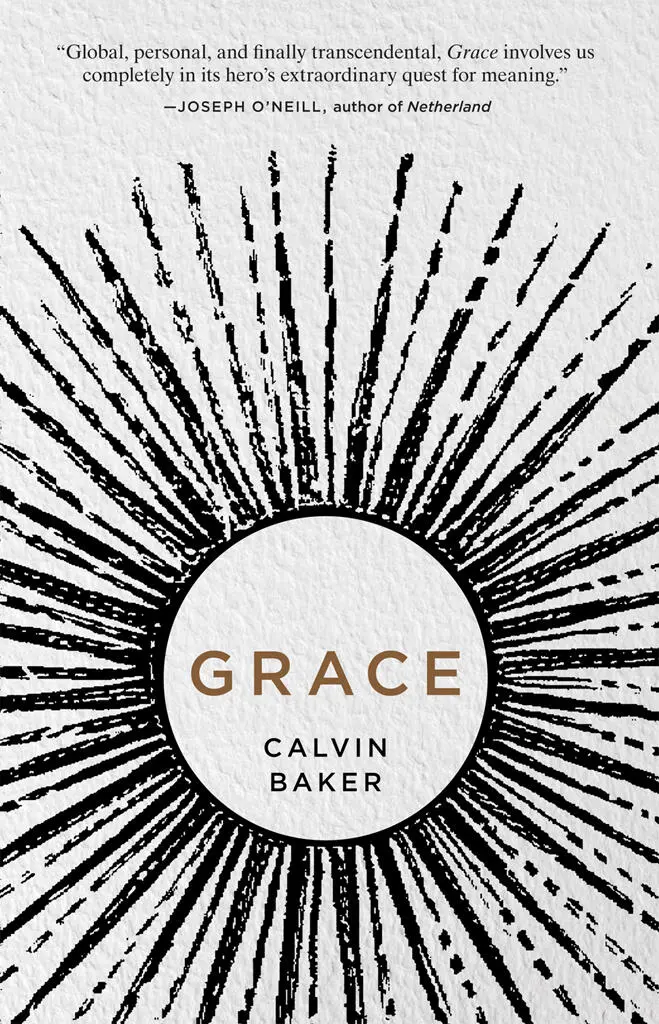
- Название:Grace
- Автор:
- Издательство:Tyrus Books
- Жанр:
- Год:2015
- ISBN:нет данных
- Рейтинг книги:4 / 5. Голосов: 1
-
Избранное:Добавить в избранное
- Отзывы:
-
Ваша оценка:
Grace: краткое содержание, описание и аннотация
Предлагаем к чтению аннотацию, описание, краткое содержание или предисловие (зависит от того, что написал сам автор книги «Grace»). Если вы не нашли необходимую информацию о книге — напишите в комментариях, мы постараемся отыскать её.
Along the way, he meets an intellectually gifted but emotionally absent doctor, a beautiful Parisian artist who burns too hot to the touch, and a human rights lawyer who has left New York in search of a more centered life.
The novel's sweeping tale encompasses four continents-where prior assumptions are constantly tested, and men who cling too passionately to certainty unleash destruction-and ultimately leads Harper back to the chaos he was trying to escape. The result is a startlingly fresh view of the contemporary world, in which place and history are mere starting points for the deeper journey into the geography of the human heart.
Calvin Baker is the author of the brilliantly-acclaimed novels Naming the New World, Once Two Heroes and Dominion, which was a finalist for the Hurston-Wright Award, a New York Magazine Critics’ Pick and New York Daily News Best Book of the Year. He has taught at Columbia University, in the Graduate School of the Arts, and at the University of Leipzig, Germany as Picador Professor of American Studies. He grew up in Chicago and currently lives in New York.
Grace — читать онлайн бесплатно полную книгу (весь текст) целиком
Ниже представлен текст книги, разбитый по страницам. Система сохранения места последней прочитанной страницы, позволяет с удобством читать онлайн бесплатно книгу «Grace», без необходимости каждый раз заново искать на чём Вы остановились. Поставьте закладку, и сможете в любой момент перейти на страницу, на которой закончили чтение.
Интервал:
Закладка:
Beyond that I was expected to wear the mask of my social self as everyone did, understanding these were merely masks, and only those who took them too seriously, with no space between self and mask, were harmed. Everyone else knew there was an interior beneath the surface of everything. The outside mattered, but only just so. I observed the sense of release I felt as an invisible burden lifted. Then I noticed the heat, and soon after that my own foul temper.
We had emerged into the humid arrivals hall, where the air was oppressive as a truncheon, and I retrieved my mental list of everything that drove me crazy about Africa, all of which boiled down to the fact that generations after decolonization, the electricity still did not work. Maybe that’s blaming the victim, or maybe it was a reasonable minimum standard for an international airport; in whichever case the air-conditioning and lights in the hall were out, and we were lost in the sea of people.
Sylvie’s mood was undampened and I tried to keep mine to myself when I saw how invigorated she was by the new landscape beyond the glass doors. “It’s so beautiful,” she said. “It’s like an Eden.”
“It’s like hell,” I returned, as we searched for the driver from our tour company amid the bustle of the hall.
“Relax, we’re in paradise. Besides, you must know by now how sad it makes me feel when you criticize everything.”
I was uncertain how to respond as I realized she was serious. “I did not know.”
“You don’t know everything. Maybe sometimes, not even yourself and what you are feeling. How much sadness and anger — outrage and indignation at the world, but also just pure leaden rage — you carry. Or how much that weighs and space it takes up.”
There are seemingly insignificant things people say in close quarters, whose substance takes a while to come clear. Maybe it’s something they’ve said before, maybe you disagree, but you stop and hear it fully for once, because you realize it is bound up with, if not everything mean in the world, but a radius you can affect. She was not angry or skeptical or annoyed. She was hurt, a thought I could not bear. “What do you want me to do?” I asked. “Tell me how you would have me be instead.”
“Like I said, just relax. Stop weighing and comparing and ranking and judging everything you see. Only take it in and experience it every once in a while, the way they did in Eden.”
She gave my hand a quick squeeze, and released it when she spied our names on a neat, hand-stenciled sign across the hall. We began toward it.
Our driver was a jauntily dressed man in his mid-twenties, named Ali, of mixed African and Indian extraction, boundless energy, and morbid good cheer, as he helped us with the luggage and led us to a waiting Range Rover.
“I see you survived the flight,” he remarked as we exited the heat of the terminal. “You know they crash sometimes.”
We loaded into the truck, where he had been listening to bangra at full volume, which he quickly cranked down. “Sorry, boss,” he said, not fully apologetic. “It’s my theme song.”
I eyed him warily, still undecided how reliable he was, as I realized I had forgotten to exchange currency, and announced I was going back to the hall to buy some of the local money.
“Don’t bother with the touts here in the airport,” Ali advised. “The bank machine will be broken, and the brokers will only offer you ninety percent of the bank rate.”
“What is the right rate?”
“I can get you forty percent over the listed one any day of the week. Fifty on Sundays.”
I told him I was going to go to the restroom before the long drive, and ventured back inside, unconvinced of his claims. When I checked around the hall, though, it was as he said: the powerless ATM had a cardboard out-of-service sign affixed to it, and the currency kiosk took too large a markup. I exchanged two hundred dollars to be safe, and returned to the car.
“Did you check?” Ali asked.
“Yes, Ali,” I said.
“I would have checked, too,” he replied. “It is no offense to me, boss. But I can get you the best rate. Anything else you require, just let me know. I am the man for the job.”
“Thank you, Ali.”
“Air conditioning or window, boss?” he asked, as we pulled away from the curb.
“Ali. Don’t call me boss.”
“Whatever you want, sahib. Hakuna matata ,” he turned and winked to me. “Means, don’t worry.”
“The window, please,” Sylvie laughed gaily.
He powered the windows down with the push of a button on his console, and hot air suffocated the interior of the car, until we cleared the parking lot and sped out onto the dense, new black road, which he navigated expertly through airport traffic, skirting the edge of the city to point us up toward the cool, green hills.
“How is lady boss?” he asked. “Is the air too much?”
“I’m fine, Ali. Thank you for asking.” I caught Sylvie’s reflection in the side mirror as she smiled, and I began to relax at last.
An hour later we were in the bush, with nothing around except an occasional zebra or giraffe herd by the side of the road, which by then had turned into a pretty improvisational affair. We continued climbing up over a range of hills, where the sweet air cooled enough to begin to hush our jangled nerves.
The vegetation thinned once we reached the other side of the hills, near our base camp on the plains, a set of low mud-colored buildings, with a brick-lined walkway and sparse garden, which, like the rest of the vegetation on the plains, was in the midst of a drought, though not so parched as the wilderness.
Our rooms were airy and simple. There was a sitting area with a sofa, a large bed draped with mosquito netting, and two nightstands. Out back we discovered an open-air shower, where we bathed in the cool waters and dying sun, before heading to the dining room. The beer at the bar was stored unrefrigerated in a dark pantry, but was cool to the touch, and refreshing when we drank it.
As we sat, the chef could be seen in the outdoor kitchen, and when he noticed us he came to let us know there would be eland for dinner, and offered something to tide us over if we were hungry.
We were, and he provided bread and fruit, along with some roasted peanuts, all fresh and good. Out in the field beyond the kitchen there was a commotion from the camp askaris , who could be heard chanting energetically, arranged in a circle, moving in turns in the distance.
“What are they doing?” Sylvie asked, trying to get a better glimpse. The barman demurred to answer, but Ali, who had come into the dining room, told her.
“Drinking the blood from the eland.”
“Why?” she asked. “Don’t they get meat too?”
“In their tribe they drink the blood first, because it is life, and it is a sin to them to waste it.”
He offered to arrange for us to try some, but we stuck with our bread and fruit.
That evening we had a supper of the just-butchered eland, with garden vegetables, then sat around a fire on the broad lawn, where we were joined by a group just in from Tanzania. They had all been traveling awhile, but had met each other in a bar near Kilimanjaro. They were already sick of each other, though, and after not too long we were sick of them, too.
There were three couples: one Australian; one British — she was Scottish, he was an Englishman; and an American couple from New Jersey with squeaky voices, who worked for an NGO. We called them the Coalition. The Americans we named Higher and Higher, because of their voices, which were like brittle glass. I did not like their politics either — their beliefs were State Department boilerplate and not their own. But mostly I hated them because of those voices. The Aussies I disliked because they were Australian. I had nothing special against the Brits yet, besides the ostentatious understatement the English specialize in, and Edward’s red pants — the leisure uniform that year of men who did not work for a living and their acolytes — and the fact that they were riding with the others.
Читать дальшеИнтервал:
Закладка:
Похожие книги на «Grace»
Представляем Вашему вниманию похожие книги на «Grace» списком для выбора. Мы отобрали схожую по названию и смыслу литературу в надежде предоставить читателям больше вариантов отыскать новые, интересные, ещё непрочитанные произведения.









Обсуждение, отзывы о книге «Grace» и просто собственные мнения читателей. Оставьте ваши комментарии, напишите, что Вы думаете о произведении, его смысле или главных героях. Укажите что конкретно понравилось, а что нет, и почему Вы так считаете.