Laila Lalami - Hope and Other Dangerous Pursuits
Здесь есть возможность читать онлайн «Laila Lalami - Hope and Other Dangerous Pursuits» весь текст электронной книги совершенно бесплатно (целиком полную версию без сокращений). В некоторых случаях можно слушать аудио, скачать через торрент в формате fb2 и присутствует краткое содержание. Год выпуска: 2005, Издательство: Algonquin Books, Жанр: Современная проза, на английском языке. Описание произведения, (предисловие) а так же отзывы посетителей доступны на портале библиотеки ЛибКат.
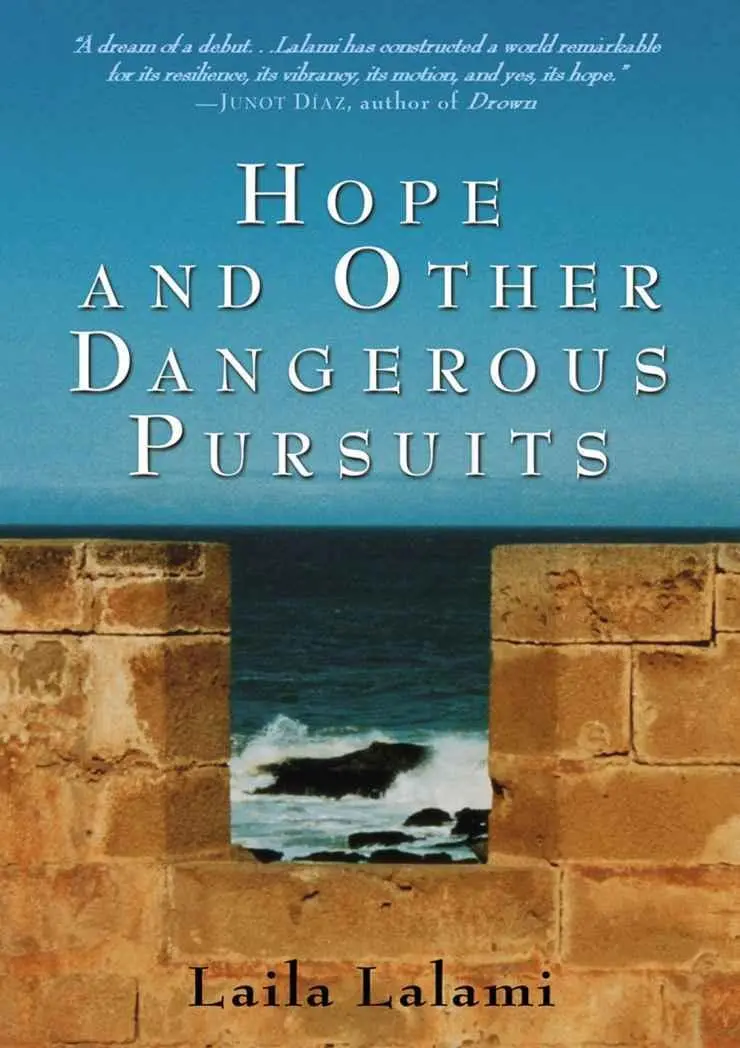
- Название:Hope and Other Dangerous Pursuits
- Автор:
- Издательство:Algonquin Books
- Жанр:
- Год:2005
- ISBN:нет данных
- Рейтинг книги:4 / 5. Голосов: 1
-
Избранное:Добавить в избранное
- Отзывы:
-
Ваша оценка:
Hope and Other Dangerous Pursuits: краткое содержание, описание и аннотация
Предлагаем к чтению аннотацию, описание, краткое содержание или предисловие (зависит от того, что написал сам автор книги «Hope and Other Dangerous Pursuits»). Если вы не нашли необходимую информацию о книге — напишите в комментариях, мы постараемся отыскать её.
Sensitively written with beauty and boldness, this is a gripping book about what propels people to risk their lives in search of a better future.
Hope and Other Dangerous Pursuits — читать онлайн бесплатно полную книгу (весь текст) целиком
Ниже представлен текст книги, разбитый по страницам. Система сохранения места последней прочитанной страницы, позволяет с удобством читать онлайн бесплатно книгу «Hope and Other Dangerous Pursuits», без необходимости каждый раз заново искать на чём Вы остановились. Поставьте закладку, и сможете в любой момент перейти на страницу, на которой закончили чтение.
Интервал:
Закладка:
When he arrived at the marketplace entrance, the vendors were still opening their shops, preparing their displays of fruits, vegetables, and spices. A butcher was busy hanging skinned lambs and cow’s feet. Aziz felt nauseous at the sight of the meat. Carts creaked behind him as the drivers rushed to make their deliveries. Shouts of “Balak!” warned him to stand aside, and twice he had to flatten himself against a wall to avoid being run over. He felt beads of sweat collecting on his forehead, and the unbearable weight of his sweater on his chest. He wished he could take it off, but both his hands were busy and he was too nervous to stop before getting home.
Aziz turned onto a narrow alley and continued walking until finally he found himself at the entrance of the building, a rambling, turn-of-the-century riad that had been converted into small apartments. Aziz crossed the inner courtyard and knocked on the door of the apartment. The only response he received was from his own stomach, which growled as it tied a knot. He looked over toward the window and saw that the shutters were open. He knocked again. This time, he heard footsteps rushing and there she was, his wife.
“Ala salamtek!” Zohra cried.
“Llah i-selmek,” he replied. She put her arms around him and they hugged. Their embrace was loose at first but grew tighter. Aziz’s mother shuffled slowly to the door, and she wrapped one arm around him, the other one holding her cane. She started crying. Aziz let go of both women, grabbed his suitcase and handbag, and stepped inside.
The apartment was darker than he remembered. The paint on the walls was flaking. One of the panes on the French windows was missing, and in its place was a piece of carton; but the divan covers were a shiny blue, and there was a new table in the center of the room.
Aziz’s mother broke into a long ululation, her tongue wagging from side to side in her toothless mouth. She wanted all the neighbors to know of the good news. Zohra joined her, her voice at a higher pitch. Aziz closed the door behind him, and now they all stood in the living room, laughing and crying and talking.
Zohra looked thin and small, and she had defined lines on her forehead. Her hair was tied in a ponytail. Her eyes — he saw now that they were gray-brown — were lined with kohl. Her lips had an orange tint to them. She must have rubbed her mouth with roots of swak to make her teeth whiter.
“Are you hungry?” Zohra asked.
“No,” Aziz said, his hand on his stomach. “I couldn’t eat.”
“At least let me make you some tea.” Aziz knew he couldn’t turn it down, and besides, he longed to taste mint tea again. Zohra disappeared into the kitchen and he sat next to his mother. Her eyes scrutinized him.
“You look thinner,” his mother said. She herself seemed to have shrunk, and her shoulders stooped. Of course, he told himself, it’s been a few years, it’s normal. “And your skin is lighter,” she added. Aziz didn’t know what to say to this, so he just kept smiling as he held her wrinkled hand in his.
Zohra came back with the tea tray. Aziz sat up. She was still very beautiful, he thought. When she gave him his glass of hot tea, he noticed that her hands seemed to have aged a lot faster than the rest of her, the skin rough and dry. Her knuckles were swollen and red. He felt a twinge of guilt. Perhaps the money he had sent hadn’t been enough and she’d had to work harder than he thought to make ends meet. But it hadn’t been easy for him, either. He took a sip.
“Let me show you what I brought for you,” he said. He put down his glass and went to open the suitcase. He took out the fabric he brought his mother, the dresses for Zohra, the creams, the perfumes. The two women oohed and aahed over everything.
When he took out the portable sewing machine, Zohra looked at it with surprise. “I bought one last year,” she said. She pointed to the old Singer that lay in a corner of the room.
“This one is electric,” he said proudly. “I’ll install it for you. You’ll see how much faster it is.”
WITHIN AN HOUR of his arrival, a stream of visitors poured in to see Aziz. The tiny apartment was filled with people, and Zohra kept shuttling between the kitchen and the living room to refill the teapot and the plate of halwa.
“Tell us,” someone said, “what’s Spain like?”
“Who cooks for you?” asked another.
“Do you have a car?” asked a third.
Aziz talked about Madrid and how it could get cold in the winter, the rain licking your windows for days on end. He also talked about the Plaza Neptuno, near the Prado, where he liked to wander on summer days, watching the tourists, the vendors, and the pigeons. He spoke of his job at the restaurant and how his manager liked him enough to move him from dishwashing to busing tables. He described the apartment in Lavapiés, where he lived with two other immigrants. They took turns cooking.
“Did you make friends?” someone asked.
“Some,” Aziz said. He mentioned his neighbor, who had always been kind to him, and his boss at the restaurant. But he didn’t talk about the time when he was in El Corte Ingles shopping for a jacket and the guard followed him around as if he were a criminal. He didn’t describe how, at the grocery store, cashiers greeted customers with hellos and thank yous, but their eyes always gazed past him as though he were invisible, nor did he mention the constant identity checks that the police had performed these last two years.
Zohra’s mother, who lived down the street, had also dropped by, and she sat quietly through all the conversations. Finally she asked, “Why would you work there while your wife is here?” She clicked her tongue disapprovingly. Aziz looked at Zohra. He wanted to talk to her about this, but they hadn’t had any time to themselves yet. He cleared his throat and refilled his mother-in-law’s glass.
“Where is Lahcen?” Aziz asked. “I thought he’d be here by now.” He and Lahcen had exchanged letters in the beginning, but as time went by, they had lost touch. Aziz had received the last postcard from Lahcen two years earlier.
“He’s moved to Marrakesh,” Zohra said. “Everyone has mobile phones now, so he couldn’t sell phone cards anymore.”
AFTER THE GUESTS left, Aziz’s mother went to spend the night with the neighbors next door so that he and Zohra could have the apartment to themselves. Aziz stepped into the bedroom to change into a T-shirt and sweats. He sat at the edge of the bed and looked around. There was a faded picture of him tucked in a corner of the mirror on the old armoire and a framed one, of the two of them on their wedding day, hanging on the wall by the door. Under him, the mattress felt hard. He bobbed on it and the springs responded with a loud creaking.
Zohra busied herself for a while in the kitchen before finally turning off the lights and coming into the bedroom. She had been talkative and excited during the day, but now she seemed quiet, shy, even. Aziz sat back against the pillow and crossed his legs.
“You must be tired,” Zohra said, her eyes shifting.
“I’m not sleepy yet,” Aziz said.
Zohra looked ahead of her, at the street lights outside.
“I have something to tell you,” he said. He swallowed hard. Zohra looked at him intently. “I have some savings. But …” He swallowed again. “I don’t think it’s enough.”
Zohra sat on the edge of the bed. “How much?” she asked, a look of apprehension on her face.
“Fifty thousand dirhams,” he said. “It could have been more, but the first year was tough.”
Zohra reached over and took his hand in hers. “I know it was.”
“There was the rent. And the lawyer’s fees to get the papers. And the money I had to send every month.”
Читать дальшеИнтервал:
Закладка:
Похожие книги на «Hope and Other Dangerous Pursuits»
Представляем Вашему вниманию похожие книги на «Hope and Other Dangerous Pursuits» списком для выбора. Мы отобрали схожую по названию и смыслу литературу в надежде предоставить читателям больше вариантов отыскать новые, интересные, ещё непрочитанные произведения.











Обсуждение, отзывы о книге «Hope and Other Dangerous Pursuits» и просто собственные мнения читателей. Оставьте ваши комментарии, напишите, что Вы думаете о произведении, его смысле или главных героях. Укажите что конкретно понравилось, а что нет, и почему Вы так считаете.