Laila Lalami - Hope and Other Dangerous Pursuits
Здесь есть возможность читать онлайн «Laila Lalami - Hope and Other Dangerous Pursuits» весь текст электронной книги совершенно бесплатно (целиком полную версию без сокращений). В некоторых случаях можно слушать аудио, скачать через торрент в формате fb2 и присутствует краткое содержание. Год выпуска: 2005, Издательство: Algonquin Books, Жанр: Современная проза, на английском языке. Описание произведения, (предисловие) а так же отзывы посетителей доступны на портале библиотеки ЛибКат.
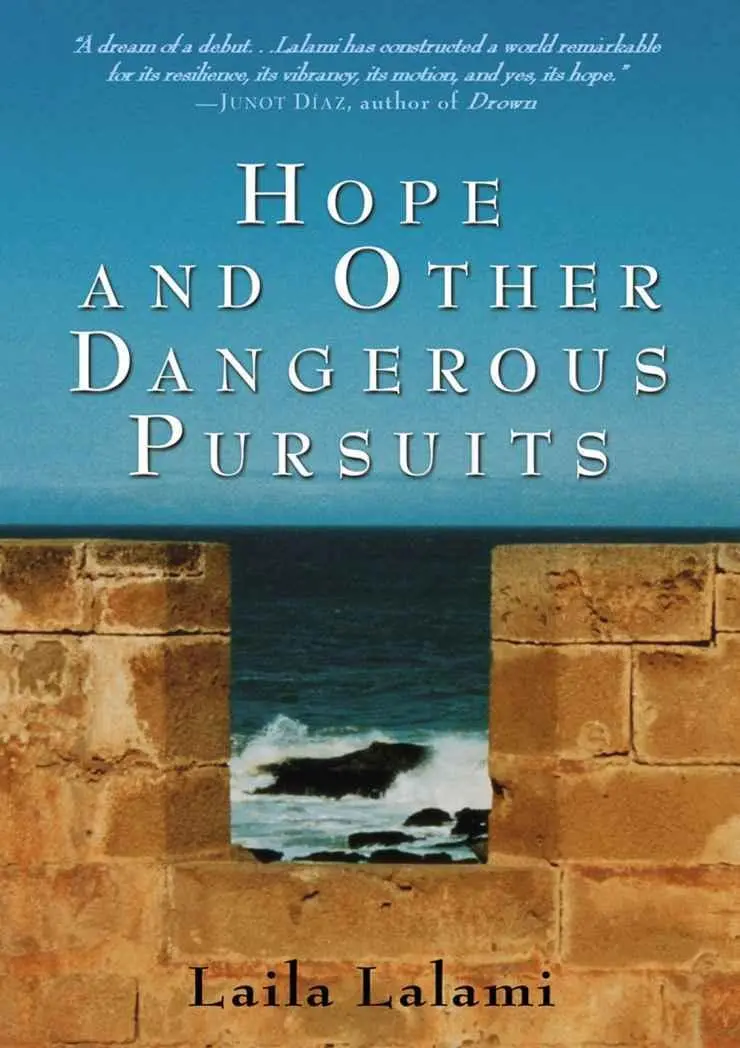
- Название:Hope and Other Dangerous Pursuits
- Автор:
- Издательство:Algonquin Books
- Жанр:
- Год:2005
- ISBN:нет данных
- Рейтинг книги:4 / 5. Голосов: 1
-
Избранное:Добавить в избранное
- Отзывы:
-
Ваша оценка:
Hope and Other Dangerous Pursuits: краткое содержание, описание и аннотация
Предлагаем к чтению аннотацию, описание, краткое содержание или предисловие (зависит от того, что написал сам автор книги «Hope and Other Dangerous Pursuits»). Если вы не нашли необходимую информацию о книге — напишите в комментариях, мы постараемся отыскать её.
Sensitively written with beauty and boldness, this is a gripping book about what propels people to risk their lives in search of a better future.
Hope and Other Dangerous Pursuits — читать онлайн бесплатно полную книгу (весь текст) целиком
Ниже представлен текст книги, разбитый по страницам. Система сохранения места последней прочитанной страницы, позволяет с удобством читать онлайн бесплатно книгу «Hope and Other Dangerous Pursuits», без необходимости каждый раз заново искать на чём Вы остановились. Поставьте закладку, и сможете в любой момент перейти на страницу, на которой закончили чтение.
Интервал:
Закладка:
Rahal ordered mint tea and then poured it, slowly raising the teapot until foam formed in the glass, then he leaned against the blue-tiled wall. “Have you thought about our conversation last week?” Rahal had been hustling Murad, trying to get him to go on one of those boats to Spain, and Murad had already told him twice that he wasn’t interested. The man didn’t give up easily.
Murad shook his head. “I don’t think it’s a good idea.”
Rahal played with the sugar cube on his saucer. He turned it around and around between his fingers. “Let me ask you something. How much money did you make this month?”
“It’s low season right now. Things will pick up in the summer.”
Rahal smiled. “You can’t be a guide forever. You’ll never make a living on it.”
Murad took a sip of his coffee and continued watching the match. “Great kick,” he said, pointing at the screen. “Barcelona will win.”
Rahal didn’t look up at the TV. “In Spain,” he said “someone like you would get a job in no time.”
“I don’t know,” Murad said.
“Look, I don’t usually talk about this, but I can tell. I can tell right away whether someone’s going to make it or not. And you will. You’re not like the others.”
Murad grinned. Did Rahal think he was going to believe that one?
“Suit yourself,” Rahal said. “Go play guide. Maybe in ten years you’ll have saved enough to move out of your mother’s house.”
Murad looked down. In his cup, yellowish foam slowly dissolved in the black coffee. “How much?” he asked.
“Twenty thousand dirhams.”
Murad shot to his feet. Rahal grabbed his wrist and motioned to him to sit back down. “If I get caught, I go to jail,” Rahal whispered.
Murad huffed at him. How could jail scare Rahal? He’d dealt drugs in the past, and now he smuggled people to Spain because it was more profitable. Fifteen years ago Rahal’s boss had been a simple fisherman, but now he owned a fleet of these small boats and he’d hired smugglers like Rahal to work for him.
“What about me?” Murad asked, his thumb pointed at his chest.
“You wouldn’t go to jail.”
“I don’t have twenty thousand.”
“What about your family?”
“My father is deceased, may God have mercy on him. My mother doesn’t have any money. If it weren’t for my uncle and my sister, we’d be out on the street.”
“Can’t they lend you money?”
“Not that kind of money.”
“It’s a very good price,” Rahal said, “We’ve never had any problems.”
“All I can get is eight thousand,” Murad said, even as he wondered how he was going to convince his uncle and his sister to let him borrow the sum.
Rahal chuckled. “This isn’t some game. We’re taking a lot of risk here.” He refilled his glass of tea. “We have Zodiac lifeboats, not like the pateras the others use.”
Murad called to mind the sunken fishing boats the Guardia Civil stacked on the Spanish coast, plainly visible from the Moroccan side. They thought it would scare people. It didn’t.
“Ten thousand,” Murad said.
“La wah, la wah. I can’t do it for that little.”
“You think ten thousand is little?”
“I don’t get all of it. I have to pay for the fuel, don’t forget. And then there’s the police. I have to grease them.” Rahal turned the extra sugar between his fingers. With a swift movement he put it in his pocket. “Let me tell you something. You know Rashid the baker? His brother went on one of our boats about eight months ago. Now he’s in Barcelona and he sends his family money every month.”
Murad never tired of hearing stories like that. He’d heard the horror stories, too — about the drownings, the arrests, the deportations — but the only ones that were told over and over in the neighborhood were the good stories, about the people who’d made it. Last year Rashid’s brother had been just another unemployed youth, a kid who liked to smoke hashish and build weird-looking sculptures with discarded matchboxes, which he then tried to sell off as art. Look at him now. Murad took a deep breath. “Twelve thousand. And that’s it,” he said at last. “By God, I won’t be able to get any more out of them.” Even though Murad talked about “them,” he knew Lamya wouldn’t give him a single rial. For one thing, she now had a wedding coming up; for another, he couldn’t imagine asking his little sister for help. But it would be different with his uncle. He would talk to him, man to man, and ask for a loan. Surely the old man wouldn’t say no, not after having slighted Murad on the wedding of his sister.
“If you make it twenty thousand, I’ll get you a job. Guaranteed. Like Rashid’s brother.”
Murad sighed. “Fine,” he said.
“But listen here. People back out. I don’t want to waste my time.”
“I’m not the type to back out.”
Rahal took a sip. “Good. When the time comes, we’ll call you. We’ll meet on the beach at Bab al Oued.”
“When do we leave?”
“When can you get me the money?”
Murad looked away. “Soon,” he said.
AFTER LEAVING THE Café La Liberté, Murad headed back toward the beach. He found a spot near the Casbah where he could get a view of the Mediterranean. It was getting dark. In the distance, car lights from the Spanish side looked like so many tiny lighthouses, beacons that warned visitors to keep out. He thought about the work visas he’d asked for. For the last several years, the quotas had filled quickly and he’d been turned down. He knew, in his heart, that if only he could get a job, he would make it, he would be successful, like his sister was today, like his younger brothers would be someday. His mother wouldn’t dream of discounting his opinion the way she did. And Spain was so close, just across the Straits.
He started walking through the Socco. He saw a few tourists wandering down the market. He couldn’t understand these foreigners. They could go to a nice hotel, have a clean bed, go to the beach or the pool, and here they were in the worst part of town, looking around for something exotic. He thought of talking to one or two, asking them if they needed a guide, but his heart wasn’t in it anymore.
The smell of grilled meat tempted him, and he stopped at a stall that made kefta and brochettes. While he waited for his order he heard a woman speak in English and he turned around to look. It was the one from earlier in the day. What was her name? Eileen. She held a guidebook open in one hand and pointed ahead of her with the other. “I think it’s that way,” she said. When she looked up and met his gaze, Murad wondered if she recognized him without his jellaba. She smiled. He saw the ease with which she carried herself, the nonchalance in her demeanor, free from the burden of survival, and he envied her for it.
“Do you know where the Café Central is?” she asked. So he had been right about them after all — they’d come to Tangier looking for the Beats. How easy it would be for him to insert himself into their trip now — he could show them the café where Burroughs smoked kif, or the hotel where he wrote Naked Lunch. But he was past all that now; he was already thinking about his new beginning, in a new land. He pointed down the street. “This way,” he said. “Across from the Pension Fuentes.” Then he turned back to wait for his order.
PART II: After
The Saint
FARID HAD SAVED HER. Some people said it was impossible. They said the boy was only ten years old, that he could barely have saved himself, let alone his mother. They didn’t believe Halima when she told them that he’d held out a stick and used it to pull her through the water all the way to the shore. They asked her how he got the stick and she said she didn’t know. Crazy woman, they said, fingers tapping temples. You have to forgive her, they said, she’s been through so much.
Читать дальшеИнтервал:
Закладка:
Похожие книги на «Hope and Other Dangerous Pursuits»
Представляем Вашему вниманию похожие книги на «Hope and Other Dangerous Pursuits» списком для выбора. Мы отобрали схожую по названию и смыслу литературу в надежде предоставить читателям больше вариантов отыскать новые, интересные, ещё непрочитанные произведения.










Обсуждение, отзывы о книге «Hope and Other Dangerous Pursuits» и просто собственные мнения читателей. Оставьте ваши комментарии, напишите, что Вы думаете о произведении, его смысле или главных героях. Укажите что конкретно понравилось, а что нет, и почему Вы так считаете.