Philipp Meyer - The Son
Здесь есть возможность читать онлайн «Philipp Meyer - The Son» весь текст электронной книги совершенно бесплатно (целиком полную версию без сокращений). В некоторых случаях можно слушать аудио, скачать через торрент в формате fb2 и присутствует краткое содержание. Год выпуска: 2013, Издательство: Ecco, Жанр: Современная проза, на английском языке. Описание произведения, (предисловие) а так же отзывы посетителей доступны на портале библиотеки ЛибКат.
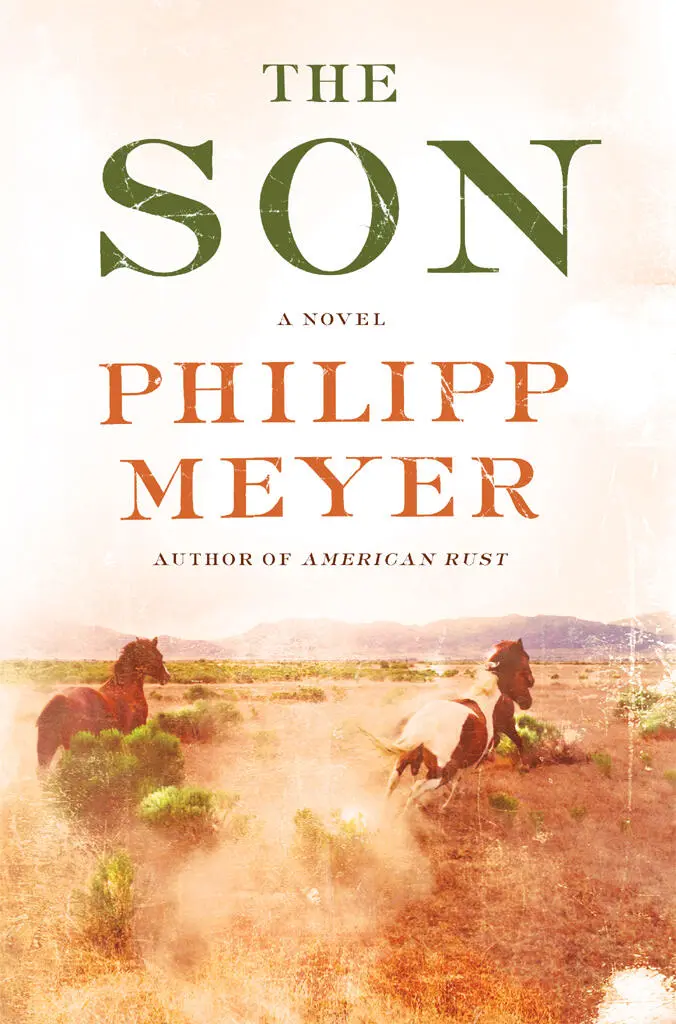
- Название:The Son
- Автор:
- Издательство:Ecco
- Жанр:
- Год:2013
- ISBN:нет данных
- Рейтинг книги:3 / 5. Голосов: 1
-
Избранное:Добавить в избранное
- Отзывы:
-
Ваша оценка:
The Son: краткое содержание, описание и аннотация
Предлагаем к чтению аннотацию, описание, краткое содержание или предисловие (зависит от того, что написал сам автор книги «The Son»). Если вы не нашли необходимую информацию о книге — напишите в комментариях, мы постараемся отыскать её.
Part epic of Texas, part classic coming-of-age story, part unflinching portrait of the bloody price of power, The Son is an utterly transporting novel that maps the legacy of violence in the American West through the lives of the McCulloughs, an ambitious family as resilient and dangerous as the land they claim.
Spring, 1849. The first male child born in the newly established Republic of Texas, Eli McCullough is thirteen years old when a marauding band of Comanche storm his homestead and brutally murder his mother and sister, taking him captive. Brave and clever, Eli quickly adapts to Comanche life, learning their ways and language, answering to a new name, carving a place as the chief's adopted son, and waging war against their enemies, including white men-complicating his sense of loyalty and understanding of who he is. But when disease, starvation, and overwhelming numbers of armed Americans decimate the tribe, Eli finds himself alone. Neither white nor Indian, civilized or fully wild, he must carve a place for himself in a world in which he does not fully belong-a journey of adventure, tragedy, hardship, grit, and luck that reverberates in the lives of his progeny.
Intertwined with Eli's story are those of his son, Peter, a man who bears the emotional cost of his father's drive for power, and JA, Eli's great-granddaughter, a woman who must fight hardened rivals to succeed in a man's world.
Phillipp Meyer deftly explores how Eli's ruthlessness and steely pragmatism transform subsequent generations of McCulloughs. Love, honor, children are sacrificed in the name of ambition, as the family becomes one of the richest powers in Texas, a ranching-and-oil dynasty of unsurpassed wealth and privilege. Yet, like all empires, the McCoulloughs must eventually face the consequences of their choices.
Harrowing, panoramic, and vividly drawn, The Son is a masterful achievement from a sublime young talent.
The Son — читать онлайн бесплатно полную книгу (весь текст) целиком
Ниже представлен текст книги, разбитый по страницам. Система сохранения места последней прочитанной страницы, позволяет с удобством читать онлайн бесплатно книгу «The Son», без необходимости каждый раз заново искать на чём Вы остановились. Поставьте закладку, и сможете в любой момент перейти на страницу, на которой закончили чтение.
Интервал:
Закладка:
“Then you walked me through the house. I saw into my parents’ room, my mother and father dead, my sister lying with them, then in the sala were Cesár and Romaldo and Gregorio, Martin and my nephew, and their families. I could see the front door was open, and the sun was coming through it and I began to hope I might live, but when we reached the portico I saw the entire town had gathered. Then I wished I hadn’t hidden in the closet. I nearly took your gun.
“After that I was at the Reynoldses’ house. They thought they were rescuing me, they thought they were doing me a favor. They fed me, allowed me to bathe, gave me clothes, a room with clean sheets. Meanwhile, my own house, with my own bed and my own clothes, was just a few miles away. But it was already not mine.”
“No one wanted it to happen.”
“These lies come out of your mouth so easily,” she said. “You yourself, I believe you had reservations, perhaps a few others… the Reynoldses, obviously… but not anyone else.”
She looked at the plate in front of her. “And still I am hungry. That is what I cannot believe.”
It was quiet and finally she said, “Can we go outside? I get spells of hot and cold, and now I am very hot.”
We went onto the porch and looked over the land. It was an unusually cool day, a pleasant evening, with the sun just going down. I considered remarking as much, then decided against it. I could hear the drilling going on from the other side of the hill.
After we’d sat awhile, she said: “I’ve spent a long time thinking about what happened. And the longer I thought about it, the more I began to think that things had just gone very badly wrong, of course the shooting of your son — it was Glenn?”
“Yes.”
“And how is he?”
“He is alive.”
“I am glad.”
I felt my face get hot. For some reason this — Glenn still being alive — embarrassed me.
“One of yours hurt, eleven of mine dead…” She put up her hands, as if balancing scales. “We have all suffered, the past is the past, it is time to move on.”
I didn’t answer.
“That is what you think, isn’t it? Your child injured, my family exterminated, we are even. And of course you are the best of them; the others think okay, a white man was scratched, there is no amount of Mexican blood that can wash out that sin. Five, ten, one hundred… it’s all the same to them. In the newspapers, a dead Mexican is called a carcass”—she held up her fingers—“like an animal.”
“Not all newspapers.”
“Just the ones that matter. But of course I’m no better; for a long time, I had fantasies about nearly every white person in town, burning them, cutting them. I remember very clearly Terrell Snyder staring at me with a grin on his face and the Slaughter brothers as well…”
“I don’t think the Slaughters were there,” I said.
“They were, I saw them clearly, but that is irrelevant. I decided I would stop being angry and perhaps accept that the entire situation, everything that had happened, was bad luck. In fact I became certain of it. We had known your family for decades, it didn’t make sense. You in particular we knew very well; I could not imagine you plotting against us. I began to think that perhaps I overreacted by fleeing from the Reynoldses’ house.
“And so when my cousin was killed, I decided I would come back. I crossed the river and reached our pastures and felt more alive than I had been in months. I decided to walk all night. I had a story prepared if I met one of your fence riders, though I hoped I would not, as I knew that, depending on their mood, my story would not matter. But… there was no one. This I also took as a sign.
“I knew what condition the house would be in. The stuffing would be pulled out of chairs, bird droppings, dirt everywhere, our papers shredded by mice, and of course the old pools of the blood of my family would not have been cleaned and the bullets would still be in every wall. It would look exactly as I had left it, except that it would have aged two years.
“When I reached our lower pasture, by the old church, the sun was coming up and I could see the house had been burned. But still I thought no, empty homes are often vandalized, lovers go to them, the poor occupy them, the dry climate — even a cigarette might have started a fire. I went through one of the doors, made my way through the rubble to my father’s office, where I knew all our papers were kept, in metal cabinets that would have resisted any fire. The cabinets were buried under debris, like everything else, but after some time I uncovered them. My birth certificate, perhaps some money, stock certificates, things like that. But do you know what I found?”
I looked away.
“Nothing. They were empty. The papers were gone. Every single document and letter, every record had been removed. And then I knew it had been intentional. It was not enough to exterminate my family; it was also necessary to remove every record of our existence.”
“No one wanted that,” I told her.
“Another lie. You of all people, you have already forgotten that you are lying. Your lies have become the truth.”
I decided to study a green lizard scuttling across the porch. Sometime later I heard a sound; her breath was rattling like a dying man’s. I had a terrible feeling but I watched her and she continued to breathe; she was asleep. I watched her for a long time after that and when I was sure she was not going to perish, I went inside and got a blanket and put it over her.
Chapter Thirty-one. Eli/Tiehteti, Late Fall/Early Winter 1851
After we buried the last of the dead, the fifty of us still alive had gathered the few remaining horses and were making our way southwest, mostly on foot, hoping to find the buffalo, or to at least cut their trail. There was no fresh sign. It was clear the n um ukutsu had not been in the area for over a year.
No one knew where the good grass was or where the buffalo might be headed. Later we found out they had stayed north, with the Cheyennes and Arapahoes. Meanwhile, the snow was beginning to fall and there was not much to eat.
With the exception of Yellow Hair, myself, and a few old Comanches who’d been exposed in previous epidemics, there was no logic to who had survived. The tasía had killed the weak and the strong, the smart and the stupid, the cowardly and the brave, and if the survivors had anything in common, it was that they had been too lazy or fatalistic to run away. The best of us had either fled or died in the plague.
No one spoke. There was nothing but the wind, creaking of packs, the travois poles scraping over rocks. If we did not see enough deer or antelope, we would kill a horse, further slowing our progress. There was no plan except to find the buffalo; we did not know what we would do if we ran into the T uhano or the army; there were less than ten of us who could still fight; many of the children had gone blind.
One day, as we watched another norther blow in, the sky behind us the color of a bruise, a cold I knew would cut through my robe, it occurred to me that I had missed seeing many of the children at breakfast. I could not recall seeing them the previous night, either. I looked behind me and made a count of our long slow column and it was true. Half the children were missing. Their mothers had taken all the blind ones out onto the prairie and killed them, so that the rest of us would have enough to eat.
That night we ran into a group of Comanchero traders who saw our fire in the storm. They were loaded down with cornmeal and squash, powder and lead, knives and steel arrowheads, woolen blankets. We had nothing to give them. Apparently all the other bands were decimated because they decided to keep us company a few days. They gave us a few sacks of cornmeal but we had no hides and our few remaining horses could not be traded.
Читать дальшеИнтервал:
Закладка:
Похожие книги на «The Son»
Представляем Вашему вниманию похожие книги на «The Son» списком для выбора. Мы отобрали схожую по названию и смыслу литературу в надежде предоставить читателям больше вариантов отыскать новые, интересные, ещё непрочитанные произведения.



Обсуждение, отзывы о книге «The Son» и просто собственные мнения читателей. Оставьте ваши комментарии, напишите, что Вы думаете о произведении, его смысле или главных героях. Укажите что конкретно понравилось, а что нет, и почему Вы так считаете.