Eva Ibbotson - The Morning Gift
Здесь есть возможность читать онлайн «Eva Ibbotson - The Morning Gift» весь текст электронной книги совершенно бесплатно (целиком полную версию без сокращений). В некоторых случаях можно слушать аудио, скачать через торрент в формате fb2 и присутствует краткое содержание. Год выпуска: 0101, ISBN: 0101, Издательство: Pan Macmillan, Жанр: Современная проза, Исторические любовные романы, Детская проза, на английском языке. Описание произведения, (предисловие) а так же отзывы посетителей доступны на портале библиотеки ЛибКат.
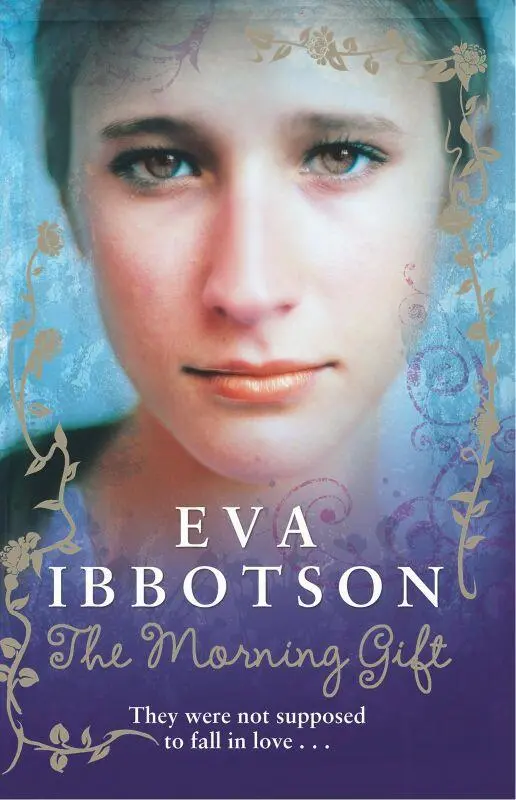
- Название:The Morning Gift
- Автор:
- Издательство:Pan Macmillan
- Жанр:
- Год:0101
- ISBN:9780330477345
- Рейтинг книги:4 / 5. Голосов: 1
-
Избранное:Добавить в избранное
- Отзывы:
-
Ваша оценка:
The Morning Gift: краткое содержание, описание и аннотация
Предлагаем к чтению аннотацию, описание, краткое содержание или предисловие (зависит от того, что написал сам автор книги «The Morning Gift»). Если вы не нашли необходимую информацию о книге — напишите в комментариях, мы постараемся отыскать её.
The Morning Gift — читать онлайн бесплатно полную книгу (весь текст) целиком
Ниже представлен текст книги, разбитый по страницам. Система сохранения места последней прочитанной страницы, позволяет с удобством читать онлайн бесплатно книгу «The Morning Gift», без необходимости каждый раз заново искать на чём Вы остановились. Поставьте закладку, и сможете в любой момент перейти на страницу, на которой закончили чтение.
Интервал:
Закладка:
‘How extraordinary,’ she said, fixing her eyes on two people standing together by the edge of the sea. One was Professor Somerville, looking unfamiliar in a navy sweater and rubber boots. The other was a girl, barefooted, with wind-blown, tossing hair. And to her mother: ‘Unless I’m mistaken, Miss Berger has managed to get herself up here after all. I wonder what strings she pulled to achieve that?’
Lady Plackett took the binoculars. Her sight was less keen than her daughter’s but she too agreed that the girl was Ruth. She turned to Miss Somerville. ‘This is unfortunate,’ she said. ‘And quite irregular. The girl is a Jewish refugee who seems to think that she is entitled to every sort of privilege.’
‘One must not belittle her, of course,’ said Verena, anxious to be fair. ‘She works extremely hard. She is a waitress in a café in the north of London.’
‘They say she brings in all sorts of trade,’ said Lady Plackett meaningfully.
Miss Somerville sighed. She took back her binoculars, but she did not put them to her eyes. If there was one thing she did not wish to examine so early in the morning, it was a Jewish waitress on Bowmont beach.
Chapter 18
The first day of the field course was, by tradition, spent close to Bowmont’s shores. Though everyone worked hard, learning the sampling techniques they would need to make proper observations, there was a festive air among the students — for if this was science it was also a marvellous seaside holiday and the experienced staff made no attempt to curb their pleasure. Indeed Dr Felton himself, his hornrims turning to russet or amber to match the creatures he fished from the pools, looked like a boy let out of school — and Dr Elke, pacing the littoral in shorts and a straining, reindeer-covered sweater was a sight to make the gods themselves rejoice. Which was as well, for the coast of North Northumberland was continuing to drive Ruth a little mad. She knew it was not really British to feel like this, but her state of ecstasy, though she tried to control it, continued to get the better of her. It got her by the throat when she saw a wave lift itself against the light so as to make a window for the sky; it came at her with the dazzle of a gull’s wing; it was transmitted through her bare feet as she followed the wave ripples in the sand. She filled her pockets with shells and when her pockets were full, she fetched her sponge bag and filled that. She bit into the bladders of seaweed, choked on the salty liquid, and did it again.
And she beachcombed…
‘Look, oh look !’ cried Ruth every ten minutes — and then whoever was closest had to go and examine what was undoubtedly a plank from the treasure chest of a Spanish galleon, or a coconut from the distant Indies. Dr Felton might point out, gently, the words ‘Bentham and Son, Sanitary Engineers’ on the back of the plank, making the galleon theory unlikely; Janet might turn the coconut round so as to reveal the stamp of a Newcastle grocer — but it made no difference to Ruth whose next find was as mysterious and magical as the one before.
Verena’s approach to the delights of the seashore was different. She had appeared after breakfast in a white cable-knit sweater as pristine as her lab coat and now, followed by Kenneth Easton who received the contents of her net as once he had received the contents of her stomach, she moved unerringly over banks of seaweed and through rocky pools.
‘Not, I think, a bearded horse mussel?’ said Verena, addressing Dr Felton, but throwing a sidelong glance at the Professor who was showing Huw and Sam how to sink a box quadrant into a patch of sand. ‘A horse mussel, but not, I would hazard, bearded?’
Dr Felton, examining the creature she had prised from the rock, agreed with her, and Kenneth, moved to spontaneous admiration, said: ‘Really, Verena, you are quite brilliant with bivalves!’
But it was not only bivalves with which Verena was brilliant. The other students might be glad to recognize a limpet, but Verena could tell a slit limpet from a keyhole limpet; she knew of a whole armoury of limpets; tortoiseshell limpets and slipper limpets and blue-rayed limpets, and was aware that the brave periwinkle, fighting dessication on the higher rocks, might be smooth or edible or rough.
But Ruth, here in this world which washed one free of pettiness, did not, as she would have done in London, go to the reference books in the laboratory to search for mussels that were yet more bearded, or a bristlier bristle worm than the one turned up by Verena’s spade. She did not want to read about mussels, she wanted to hold one and marvel at the blue and black striations of its shell. She was free of the urge to excel and succeed; she even gave up her complicated manoeuvres to keep out of the Professor’s way — and when she found her most valuable treasure of the morning, it was to him she came.
‘Look!’ said Ruth for the hundredth time. ‘Oh, look! Emeralds !’ He held out his hands and she tipped the smooth green stones into his palms.
‘Could they be?’ she said. ‘My great aunt had a bracelet and the stones looked just like that!’
He didn’t laugh at her. There were gem stones on this coast: carnelians and agates and amethysts — and leading her gently away from her dream, he said: ‘Only the sea does that — makes stones so perfect and so smooth. You could hire the best jeweller in the world and set him to work for a year and a day and he wouldn’t get anywhere near.’
He took one and held it to the light and as she came closer to look, he thought how wonderfully emeralds would have become her with her dark eyes and lion-coloured hair.
But Verena, never far from the Professor, now appeared by their side. ‘Good heavens, girl,’ she said, peering at the stones. ‘They’re just bits of bottle glass — surely you knew that? Even in Vienna they must have bottles.’
She looked at Quin, ready to share the joke of Ruth’s idiocy — but he had turned away and was putting the stones back into Ruth’s cupped hands as carefully as if they really were precious jewels.
‘Bottles can be extremely important,’ he said, holding her eyes. ‘It isn’t necessary for me to tell you that.’
And she flushed and smiled and moved away, feeling a glow of warmth, for whether they were emeralds or not mattered very little, but that he remembered what she had told him, there by the Danube — that mattered a lot!
At lunchtime Verena, approaching the Professor, said: ‘Isn’t it time we went to the house? Luncheon is at one o’clock, I understand?’
But here she suffered a reverse.
‘Yes, you go; my aunt’s a stickler for punctuality. I’ll stay down here — I don’t usually bother much with lunch.’
This remark caused considerable amusement to Dr Elke who had past experience of Quin’s conviction that he did not eat in the middle of the day, and gathering two of the girls to help, she made her way to the boat-house where she unwound an extra coil of sausages which Pilly proceeded to fry with an expertise which amazed her friends.
‘Why aren’t you afraid of sausages?’ asked Janet, as Pilly deftly turned the sizzling, ferociously spitting objects. ‘They’re much more dangerous than the experiments we do.’
‘I don’t have to learn sausages,’ said Pilly.
But in the afternoon Verena came into her own again, for the Professor took boatloads of students out into the bay to show them how to sweep for plankton and Verena, who had sailed in India and crewed for her cousin at Cowes, was in her element. She had only to twitch once at its toggle, and the outboard motor roared into life; she knew exactly what to do with sails, she rowed like an Amazon, so that it was natural that as the students changed places, Verena should remain by the Professor and help.
Читать дальшеИнтервал:
Закладка:
Похожие книги на «The Morning Gift»
Представляем Вашему вниманию похожие книги на «The Morning Gift» списком для выбора. Мы отобрали схожую по названию и смыслу литературу в надежде предоставить читателям больше вариантов отыскать новые, интересные, ещё непрочитанные произведения.







Обсуждение, отзывы о книге «The Morning Gift» и просто собственные мнения читателей. Оставьте ваши комментарии, напишите, что Вы думаете о произведении, его смысле или главных героях. Укажите что конкретно понравилось, а что нет, и почему Вы так считаете.