Jack O'Connell - The Skin Palace
Здесь есть возможность читать онлайн «Jack O'Connell - The Skin Palace» весь текст электронной книги совершенно бесплатно (целиком полную версию без сокращений). В некоторых случаях можно слушать аудио, скачать через торрент в формате fb2 и присутствует краткое содержание. Год выпуска: 2011, Издательство: MysteriousPress.com/Open Road, Жанр: Современная проза, Триллер, на английском языке. Описание произведения, (предисловие) а так же отзывы посетителей доступны на портале библиотеки ЛибКат.
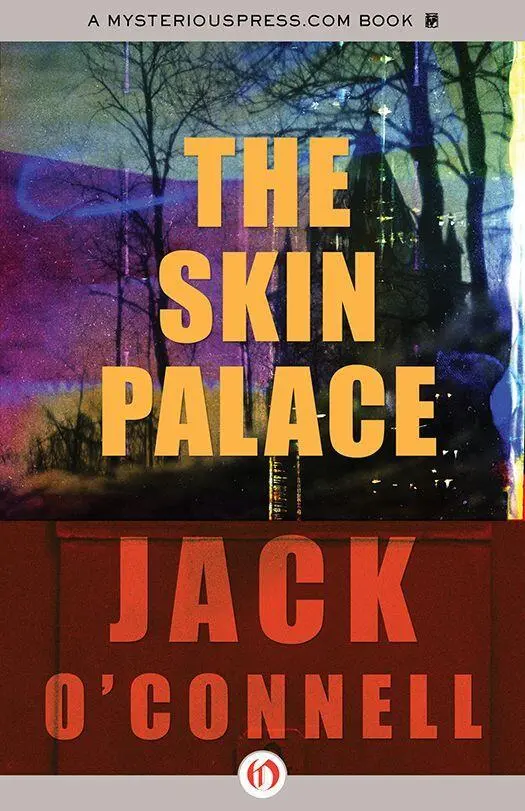
- Название:The Skin Palace
- Автор:
- Издательство:MysteriousPress.com/Open Road
- Жанр:
- Год:2011
- ISBN:нет данных
- Рейтинг книги:3 / 5. Голосов: 1
-
Избранное:Добавить в избранное
- Отзывы:
-
Ваша оценка:
The Skin Palace: краткое содержание, описание и аннотация
Предлагаем к чтению аннотацию, описание, краткое содержание или предисловие (зависит от того, что написал сам автор книги «The Skin Palace»). Если вы не нашли необходимую информацию о книге — напишите в комментариях, мы постараемся отыскать её.
The Skin Palace — читать онлайн бесплатно полную книгу (весь текст) целиком
Ниже представлен текст книги, разбитый по страницам. Система сохранения места последней прочитанной страницы, позволяет с удобством читать онлайн бесплатно книгу «The Skin Palace», без необходимости каждый раз заново искать на чём Вы остановились. Поставьте закладку, и сможете в любой момент перейти на страницу, на которой закончили чтение.
Интервал:
Закладка:
“I must get back to the store,” he says, gives a little bow, turns on his heel and starts to walk away across the lot. Sylvia doesn’t try to stop him. She doesn’t say a word. When he gets to the edge of the plaza, the rain begins to fall and she watches him turn up the collar of his suitcoat before he disappears around the corner.
She turns on the radio. She searches the drawers for an eraser so she can rub out all of Cora’s crossword answers. She picks up one of the romance novels that someone’s always leaving behind in the booth, opens it randomly and reads a page.
… Yes,” Simone said as she turned away from the sight of Pierre disappearing down the beach, “if I can’t have you, my love, I can still paint you!” She picked up her palette and straightened the canvas on the easel. She began to mix the colors once again, swirling shades together the way she had been taught so long ago in Paris, but now her eyes began to fill with the sting of tears and the dabs of bright paint spread out before her began to blur and …
She throws the book in the trash bucket. The courier truck pulls up to the window and she slides the bubble open. She’s never seen this driver before. He doesn’t say hello. He’s writing furiously on a clipboard which he suddenly heaves at her, almost hitting her in the face. She signs for the delivery and hands him back the board and the courier passes her a fat packet of film envelopes held together with thick rubber bands. Then he drives off, leaving the Shack engulfed in a cloud of carbon monoxide. Sylvia closes the window completely, which she hates doing even when it rains. She unbands the envelopes and sits them in her lap and starts to alphabetize them.
The phone rings and she jumps and the envelopes fall onto the floor. She starts to scoop them back with one hand and answers the phone with the other.
“Snapshot Shack, this is Sylvia. Can I help you?”
“A heart and lung machine and total forgiveness would be a start.”
It’s Perry. She knew the call would come but she’s still dreading the next three minutes.
“You survived,” she says.
“Barely. You just can’t do this after you turn thirty. I’m going to be hurting for a week.”
“Well, you couldn’t let the district attorney think you were a lightweight.”
“Eddie’s out of my league. Never again. I’m just not a Scotch drinker,” a pause, then, “How are you feeling, Syl?”
“Much better,” she says. “I just needed some sleep.”
“You were gone when I got in this morning.”
“I got to work early. I wanted to beat the rain.”
“I’m really sorry, Syl. That was really juvenile last night. I’m an idiot.”
“It’s okay. I understand. The new law partner doesn’t say no when the D.A. is buying the drinks.”
There’s a second of silence and she wonders if he thinks she’s being sarcastic, but he comes back with a new tone to his voice, all low and serious. “We’ve really been strangers all week. It’s worrying me, Sylvia. I don’t—”
She cuts him off. She doesn’t want to do this. “It’s been a bad week, Perry,” she says. “It’s been bad for both of us. It’s the moon or something.”
“We need to do some major talking, honey. You know. We need to just sit down and clear the air. Start fresh. We’ve got to get things straight again—”
“Oh, God, wouldn’t you know it,” she says.
“What?”
“I’ve got a customer at the window. I’m going to have to run.”
“Call me back, Sylvia.”
“Okay, I’ll call. I’ve gotta go now.”
“Call me.”
She hangs up the phone. She doesn’t know why she lied to him. She doesn’t know why she couldn’t talk to him. She reaches down to pick up the last of the dropped pictures and the phone rings again. She stares at it, thinking about letting it ring, thinks that it might be Cora checking on her and picks up the receiver.
“Snapshot Shack, Sylvia speaking. Can I help you?”
“In more ways than you can imagine.”
It’s Hugo Schick.
“Actually,” he continues, “I think we can very likely help each other.”
“If you’re calling about the job, Hugo—” she begins, but he cuts her off.
“Did this morning’s delivery come yet, Sylvia?”
This throws her and she looks down at the black plastic envelopes in her lap. “Yeah. About five minutes ago.”
“I’m hosting a working party tonight, Sylvia. I need for you to be there. It’s going to be a major event. I’ll be filming all evening and into the morning. I’ll be completing my meisterstück. Tonight, we finish years of work on Don Juan Triumphant. I need you to document it all, Sylvia. I need your eyes.”
“I’m not coming to the party, Hugo.”
“We’ll be taking down a wall and using both studios. Bring your equipment, Sylvia.”
“I won’t be there, Hugo.”
“You’ll want to talk to me. And if you come, I promise I’ll make time. We’ll steal away at some point.”
“I’m sorry, Hugo—”
“In this morning’s delivery. A package for a Mr. and Mrs. Jones. Not much technique, but you have to credit their imaginations. You take a long look at their pictures, Sylvia. And then you decide about tonight.”
“Look Hugo,” but he’s already hung up.
She replaces the receiver. She shuffles the envelopes and looks at each name sticker until she comes to one that reads Jones. She puts all the other envelopes to the side and holds the Jones’s in her hands. She breaks the seal and pulls out the prints. They’re 4 × 6 color shots. Of Perry. And of Candice Haskell. And they’re having dinner in a restaurant that could be Fiorello’s. And they’re walking in what looks like a public park, holding hands. And then they’re seen from a distance, through the window of some nondescript room, kissing each other. They’re touching each other. They’re on top of each other. Perry on top. Candice on top. There are shots of them on some leather couch, necking. Shots of them half-clothed, bent over Perry’s desk at Walpole & Lewis.
Shots of them in Sylvia’s bed, completely naked, sitting up, in motion, chest to chest, both sets of eyes closed as if they were straining against the force of some imminent explosion.
28
Mr. Quevedo moves down Waldstein Avenue striking the sidewalk with his cane, tapping out the beat of a song from his childhood, “La Tablada,” a tango by Vincente Greco. He’s pleased with his recollection, though the song holds no sense of nostalgia for him, no longing for an unretrievable past time. Quevedo is simply happy and surprised that his memory is not only intact at this advanced age, but seems to be somehow improving. Images he hasn’t pulled up in decades are now being screened daily behind his ever worsening eyes. The candy store on Tucuman Street where the guapos bought their mermaid playing cards. The garden in Palermo where grandfather practiced his topiary. The old-book smell in the basement of the library at Montevideo.
We go back to the past, replay the familiar in slightly different ways, with new shadings and colors that give what was once mundane a new aura of excitement, and sometimes, of meaning. There’s no harm in this reconstruction. Like everything else, its a way to occupy the hours until the true darkness falls. Certainly it’s a more pleasant diversion than trying to determine where a schizophrenic camera salesman might be hiding.
There was a time in Quevedo’s life when the more complicated transactions were the most worthwhile and when a modicum of precariousness gave an exquisite seasoning to the deal. Those were the days of long afternoons in Turkish cafés, drinking raki and not having any idea whether the briefcase being opened by a fat man in a linen suit contained a stolen Egyptian fertility totem or a 9 mm Beretta automatic. Fortunes impenetrable to the tax man were made in Istanbul’s spring and squandered by Stockholm’s autumn. Contracts were sealed with a passing of the jewel-encrusted hashish pipe and ruptured with a bundle of dynamite underneath the antique Rolls-Royce.
Читать дальшеИнтервал:
Закладка:
Похожие книги на «The Skin Palace»
Представляем Вашему вниманию похожие книги на «The Skin Palace» списком для выбора. Мы отобрали схожую по названию и смыслу литературу в надежде предоставить читателям больше вариантов отыскать новые, интересные, ещё непрочитанные произведения.






Обсуждение, отзывы о книге «The Skin Palace» и просто собственные мнения читателей. Оставьте ваши комментарии, напишите, что Вы думаете о произведении, его смысле или главных героях. Укажите что конкретно понравилось, а что нет, и почему Вы так считаете.