Frederick Busch - Girls
Здесь есть возможность читать онлайн «Frederick Busch - Girls» весь текст электронной книги совершенно бесплатно (целиком полную версию без сокращений). В некоторых случаях можно слушать аудио, скачать через торрент в формате fb2 и присутствует краткое содержание. Год выпуска: 2011, Издательство: Ballantine Books, Жанр: Современная проза, на английском языке. Описание произведения, (предисловие) а так же отзывы посетителей доступны на портале библиотеки ЛибКат.
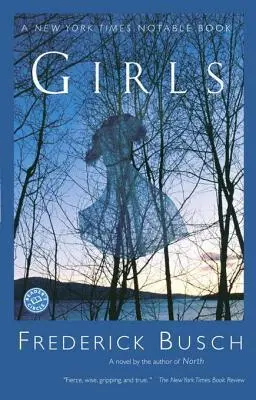
- Название:Girls
- Автор:
- Издательство:Ballantine Books
- Жанр:
- Год:2011
- ISBN:нет данных
- Рейтинг книги:4 / 5. Голосов: 1
-
Избранное:Добавить в избранное
- Отзывы:
-
Ваша оценка:
Girls: краткое содержание, описание и аннотация
Предлагаем к чтению аннотацию, описание, краткое содержание или предисловие (зависит от того, что написал сам автор книги «Girls»). Если вы не нашли необходимую информацию о книге — напишите в комментариях, мы постараемся отыскать её.
Notable Book.
In the unrelenting cold and bitter winter of upstate New York, Jack and his wife, Fanny, are trying to cope with the desperate sorrow they feel over the death of their young daughter. The loss forms a chasm in their relationship as Jack, a sardonic Vietnam vet, looks for a way to heal them both.
Then, in a nearby town, a fourteen-year-old girl disappears somewhere between her home and church. Though she is just one of the hundreds of children who vanish every year in America, Jack turns all his attention to this little girl. For finding what has become of this child could be Jack's salvation-if he can just get to her in time. .
Girls — читать онлайн бесплатно полную книгу (весь текст) целиком
Ниже представлен текст книги, разбитый по страницам. Система сохранения места последней прочитанной страницы, позволяет с удобством читать онлайн бесплатно книгу «Girls», без необходимости каждый раз заново искать на чём Вы остановились. Поставьте закладку, и сможете в любой момент перейти на страницу, на которой закончили чтение.
Интервал:
Закладка:
I heard what I thought might be the car, but I couldn’t see it. I ran back from the rear entrance of what was apparently a dorm to the walkway. Now I didn’t hear it. I swiveled, turning my ears so they wouldn’t catch the wind roaring in them. Several students leaving the dorm walked wide detours. I didn’t blame them. But I did hear the throaty, harsh rumble of his engine. I ran back to the lot and found my car, which was about as well disguised as a hippo in a frog pond.
I started up and aimed at what I thought was the direction. I stopped at the driveway from the lot and turned the engine off. Someone behind me revved his motor, then honked. But I heard the kid’s motor above the horn, and I took off. At the corner, I saw him. He was heading to the western edge of Masonville. I went with him, not hanging back, but not forcing the issue. The streets were plowed and they’d been salted, and, though the nose of his Trans Am swung out when he made his turns, the Jeep held tight. We were leaving the business district, and then the streets of small wooden houses and tarted-up double-wide mobile homes. The farther west you went, I thought, the less was there. We climbed gradually and were on a plateau that, as I remembered, had farms on it, and county roads, and empty fields.
I was right. He was jittering now, because the roads up here were not salted and the surface was slick. You could see for miles ahead and around us. We were on one of the lines of a grid of small roads that connected farms. In the late spring and in summer, these vast fields of snow bounded by gray-black road would be creamy with soy and wheat. The rest of the crop would be feed corn for cattle on the dairy farms. Now, though, everything was white, with the dirty clouds above, and a weak sun suggesting itself, but not with much force. We passed a few farms. I knew he was going a back way toward the Thruway as he now headed north.
Was this how children were rescued? By men baring their teeth in illegally used vehicles, chasing alleged students who, if they wore suits and sold tobacco, would be called businessmen? By men who waited in ignorance and pursued in reflex? By hook, crook, luck, and mostly mistake? Was this how children were saved? Could we find no surer way to protect them?
I was going too fast for the surface conditions, but I was worried about getting back to work and worried about Janice Tanner. I mean this: I knew she was dead, and I wanted this apprentice merchant to prove me wrong.
Prayer, Mrs. Tanner would call it.
We were on a long, empty stretch with no houses in sight. I thought to get to the end of it all instead of waiting. I put my brights on, hit the blue light on top, sounded my horn in long, even blasts, and went in behind him. I couldn’t see his eyes in his rearview mirror because my car was higher than his. His legs must have been nearly parallel to the ground, I thought.
I decided to touch him a little, so I went in until we kissed fenders. It was enough to send him off the road, almost. I did it again. He pounded his horn. I hit the accelerator and did a little damage, I thought, to both cars. He skidded, he recovered, and then he lost it again. The snowbanks were high enough to keep him on the road, so what he did was slide at an acute angle, nose of the car in the ice, until he hit a soft patch and laid out on the angle. The Trans Am went over the bank and got stuck partway through it, rear wheels racing, but in the air.
I parked behind him and waited until he decided to take his foot off the gas. He tried to push the door out, but apparently he couldn’t because of the snow wedged against it. He must have leaned back along the seat and kicked the door. It opened partway, and he edged out, falling into deep snow up to his elbows. His lip was bleeding. He might have bitten it through in the impact, or in anger. Because he recognized me, of course, and he was preparing to deal out some punishment.
“You ain’t no police, you civilian motherfucker.” He got himself up by pulling on the frame of his door. He was coming for me. “You got less rights here than fucking cows , you cow college rent-boy.”
By the time he was out of the snowbank, stumbling on the road, I had the roll of dimes out of my pocket and in my right hand.
I held up my left, saying, “Sorry you had that skid, William. I was running an errand and I saw you lose it. I stopped to see if you needed any help. How’s that bloody lip?”
He walked through my outstretched left hand and threw a long, clumsy punch at my head. I moved aside and slammed through his unzipped leather jacket and into his gut. The dimes would have broken his jaw. For the solar plexus, they were almost too much. He lost all color, he went double, tried to recover, couldn’t, knew enough to make his legs take him sideways a few paces so I couldn’t reach him again, and then he worked his lips like a fish as he tried to breathe.
I went after him. “Are you all right ?” I put the dimes back in my pocket. I wouldn’t need them anymore, and I didn’t want to cut him a lot. I smacked his face with my gloved hand. In that cold, it must have stung the skin as well as rocked his brain. Before he could talk, I smacked him again, harder. He sat down.
“Let me help you,” I said.
A big orange county work truck passed, slowed, stopped, then backed up, its warning buzzer hooting. The driver, a man with a light brown beard smeared with tobacco juice, said, “You folks all right?”
“Kid skidded off. I’ll see he gets his wind back — he was scared, you know — and then I’ll tow him out. No problem.”
After a pause, the driver said, “Yup per. ”
“Thanks a lot.” I kept my hand on Franklin’s shoulder and leaned so he couldn’t clamber up, and when I’d waved with my other hand to the driver of the truck, I bent as though to give help. With the hand that had waved, I smacked him, hard, on the side of the jaw. There’s a nerve there, vulnerable to pressure, above the muscle in the back quadrant, and you don’t want the edge of an angry man’s hand coming down on it.
He lay in the road.
“Let me give you a hand,” I said. I dug my thumb into the nerve bundle under the point of his jaw. He almost leapt to his feet. “Now,” I said, “I want to ask you a question.”
In spite of my anger, in spite of my urgency about finding Janice, I knew, and I think I knew from the beginning, that he was a dead end. He knew nothing. He sold drugs. He was in the hands of larger dealers, just as college kids horny for weed or maybe pills were in his. He knew nothing, he was nothing, and I knew it. But I didn’t know what to tug on. There was nothing that led anywhere. There was this narrow county two-lane road going to no place and all I could do was ask him. “A little town near the college called Chenango Flats. You were seen there. Your car was seen in it on the day a little girl went missing. You know who I mean, because her posters are all over everyplace you go.
“Nod your head and tell me you know the girl.”
“From the poster,” he said, after drawing in a deep breath.
“You ever see her?”
“No.”
“You ever drive through her town?”
“I don’t know what town she lives in, man. And I don’t need to steal no pussy.”
I raised my hand and he flinched.
“No,” he said. “I never seen her except the picture.”
“You feel all right now?”
“Why?”
“Are you recovered from your accident? You were a little breathless when I came down the road and found you.”
“Motherfuck,” he said.
I raised my hand, then dropped it. I hadn’t been this bad in a while. And he knew nothing. Then I thought, Who are you to say what he knows? So I did hit him. I slammed him in the sternum with the heel of my hand. He went gray at once. His eyes bulged. I thought for a second I’d killed him. He went over sideways and lay in the road, his legs moving very slowly. He looked like a kid making angels in the snow.
Читать дальшеИнтервал:
Закладка:
Похожие книги на «Girls»
Представляем Вашему вниманию похожие книги на «Girls» списком для выбора. Мы отобрали схожую по названию и смыслу литературу в надежде предоставить читателям больше вариантов отыскать новые, интересные, ещё непрочитанные произведения.


Обсуждение, отзывы о книге «Girls» и просто собственные мнения читателей. Оставьте ваши комментарии, напишите, что Вы думаете о произведении, его смысле или главных героях. Укажите что конкретно понравилось, а что нет, и почему Вы так считаете.