Tash Aw - Five Star Billionaire
Здесь есть возможность читать онлайн «Tash Aw - Five Star Billionaire» — ознакомительный отрывок электронной книги совершенно бесплатно, а после прочтения отрывка купить полную версию. В некоторых случаях можно слушать аудио, скачать через торрент в формате fb2 и присутствует краткое содержание. Год выпуска: 2013, Издательство: Spiegel & Grau, Жанр: Современная проза, на английском языке. Описание произведения, (предисловие) а так же отзывы посетителей доступны на портале библиотеки ЛибКат.
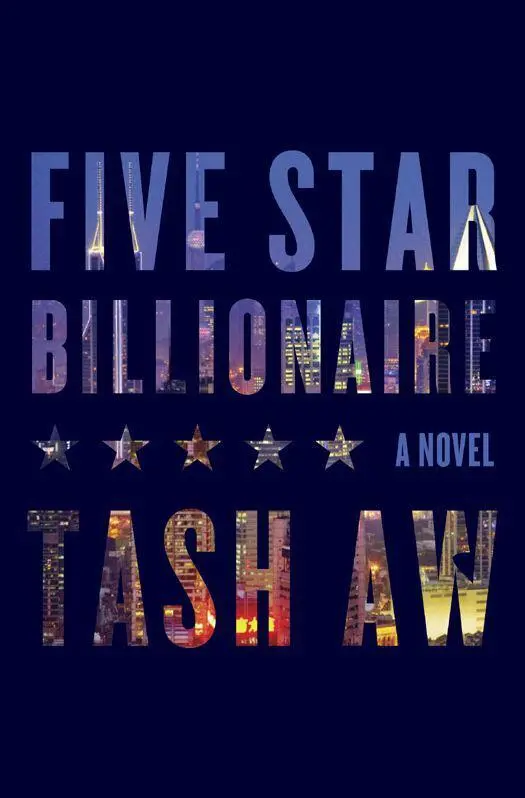
- Название:Five Star Billionaire
- Автор:
- Издательство:Spiegel & Grau
- Жанр:
- Год:2013
- ISBN:нет данных
- Рейтинг книги:3 / 5. Голосов: 1
-
Избранное:Добавить в избранное
- Отзывы:
-
Ваша оценка:
Five Star Billionaire: краткое содержание, описание и аннотация
Предлагаем к чтению аннотацию, описание, краткое содержание или предисловие (зависит от того, что написал сам автор книги «Five Star Billionaire»). Если вы не нашли необходимую информацию о книге — напишите в комментариях, мы постараемся отыскать её.
the dazzling kaleidoscopic new novel by the award-winning writer Tash Aw, offers rare insight into China today, with its constant transformations and its promise of possibility.
Five Star Billionaire — читать онлайн ознакомительный отрывок
Ниже представлен текст книги, разбитый по страницам. Система сохранения места последней прочитанной страницы, позволяет с удобством читать онлайн бесплатно книгу «Five Star Billionaire», без необходимости каждый раз заново искать на чём Вы остановились. Поставьте закладку, и сможете в любой момент перейти на страницу, на которой закончили чтение.
Интервал:
Закладка:
We got the news about the housing development while I was still up in Kota Bharu with my father. I had decided not to return to Johor yet, because I was worried about my father and wanted to be with him. He had just spent a whole week making rubber replicas of bird nests — little boat-shaped cups — which he intended to glue to the ceilings of the hotel in order to encourage nesting birds to enter the house once again. I, meanwhile, had been trying to find a job in town, which was not easy.
Nik K. stopped by one afternoon. “Good news for you, boss,” he said. He was holding a couple of bags of kacang putih , which he held out to us in an almost ceremonial fashion, as if they were a peace offering. “Someone is going to buy your house, make all your troubles go away.”
“What troubles?” my father said.
Nik K. looked up at the hotel, squinting into the sunlight. “Everything is still top secret, okay? But it’s going to be in the papers soon. This whole area is going to be transformed — a big company from KL is going to buy up all the land and build a new housing estate.”
We listened patiently as he told us of plans to redevelop two thousand acres of countryside stretching south of town, including some of the run-down outskirts, which included the old workshops and small warehouses that formed the warren of streets around our property. Where the Tokyo Hotel now stood, there would soon be gardens and newly paved roads lined with ornamental bushes leading to long streets of single-story link houses arranged in grids, hundreds and hundreds of them, each one identical, with a front garden separated by chain-link fences. There would be clusters of shophouses dotted around the estate, where the residents would find sundry shops and laundries and hairdressers — all the modern conveniences people needed in this day and age.
“But,” my father started to question, interrupting Nik K.’s lengthy explanation. “That means they are going to tear down my house also, ah ?”
Nik K. stared at him for a while, trying to figure out if he had understood anything at all. In the end, Nik K. did not have to reply. My father turned away; he had indeed taken in everything Nik K. had said. His question had not really been a question but a distillation of Nik K.’s news. Our house was going to be torn down: Everything else — the development, the shops, the modern amenities — did not matter to my father.
“What about compensation?” I asked. “How much are we going to be paid?”
Nik K. shrugged. “The land is being bought by the government — compulsory-purchase scheme. You know what that means?”
I nodded.
“You will get fair money,” Nik K. explained anyway, as if we were children. “But the government wants this land, so it requires every single property owner to sell, no argument.”
“What is ‘fair’? What does that mean?” my father said.
“It means enough- lah ,” Nik K. said, before getting into his Datsun and driving off.
Secretly, I was not displeased. One could say that I was even excited by this unexpected development. Someone was going to pay us for a building that was a wreck, a no-hope project that would surely ruin my father. I would no longer have to persuade my father to sell the building, for now we had no choice but to do so. The government wanted the land, and it would have it; there was no argument to be made.
We got the letter a few weeks later, stating the date by which we had to vacate the property and the amount of money we were to receive. I stood with the piece of paper in my hand, counting out the number of zeros in the compensation sum by placing the tip of a pencil under each one, just to make sure I was not making a mistake. The price of our building was to be less than it had been when my father bought it more than a year previously. We were being paid only a third of its original value, nowhere near enough to cover the debt my father had taken on to buy the hotel in the first place.
Still, I said to my father, we had no choice. The government had ordered the purchase of the land; there was nothing we could do to fight against it. It was true, we were being offered very little money, but at least it was something — we couldn’t ask for any more. I knew it was not a good situation, but it enabled us to escape the Tokyo Hotel for a fresh start somewhere: a modest life that suited us. We were not people who were primed for a life of wealth; we would never know how to be millionaires. We could cut our losses and run. To our debtors, we could plead bad luck: The government wanted the land; what could we do? Now that a return to a simple life had suddenly become a real possibility, I could not think of anything else. I urged my father to sign the papers as soon as possible: Take the money, start anew, be content.
“But it’s not fair,” my father repeated, over and over again, as if it were all the reasoning he needed. Even as my desire to abandon the hotel grew, his obsession with completing his fledgling business became stronger, and I knew his will would prevail. For this is what I have always known about my father: His ambitions have a persuasive, almost transformative quality; he makes you believe in him, he absorbs you into his fantasies, even when all logic tells you that he will fail. I guess it is because we all want to live in hope rather than in despair, even when despair is all that we have — all that we are entitled to.
He began to bombard me with calculations of profits we could make in less than a year, persuading me that we would be comfortable in no time at all, and then all that I wanted — a nice modern house, a small car, enough money to go on trips to Penang or Singapore — would be easily attainable. As long as we could keep the hotel, we would be fine. It was ours; we would make it work. He would go and speak to Nik K. again, try to find a way of saving our home. If all else failed, we would organize a protest, show the world how unfair the whole business was. But Nik K. seemed never to be around all of a sudden. His colleagues said he’d gone down to KL, that he had a lot of business there, that maybe he was getting a promotion — they didn’t know.
Every week, we would get a new letter, reminding us of the time limit. We had to sign the documents soon and then vacate the property, otherwise we would get nothing. Every day, my father cycled into town to find Nik K., but he was never there. Eventually he got hold of Nik K. by phone; he was in Terengganu on holiday with his kids. There was nothing he could do, he told my father: He was just a clerk. But, sure, this was a free country — if he wanted to complain or protest, he could do so.
“Who do I speak to?”
“I don’t know,” Nik K. replied. “But the developer is a company called L.K.H. Holdings — there, you know, that Chinese company. Old man Cecil Lim Kee Huat and his sons and grandsons, rich towkays down in KL. The fat youngest son comes up here often. He’s the big boss in charge. Anything else, don’t ask me.”
21. ADOPT OTHERS’ THOUGHTS AS THOUGH THEY WERE YOUR OWN
THEY HAD JUST FINISHED DINNER ONE EVENING AND WERE SUPPOSED to go look for a jazz bar somewhere in Luwan that Phoebe had read about. It was already quite late, about ten-thirty on a Saturday evening. They got in the car and Walter said, “Oh, sorry, would you mind if we stopped by my apartment quickly? I’ve left my Hong Kong mobile at home, and I need to check it for messages. I’m in the middle of a business deal, you see.”
Phoebe thought at once, Aha, this is a seduction technique.
Читать дальшеИнтервал:
Закладка:
Похожие книги на «Five Star Billionaire»
Представляем Вашему вниманию похожие книги на «Five Star Billionaire» списком для выбора. Мы отобрали схожую по названию и смыслу литературу в надежде предоставить читателям больше вариантов отыскать новые, интересные, ещё непрочитанные произведения.

![Scott O’Hara - Five-Star Fugitive [= Border Town Girl]](/books/432138/scott-o-hara-five-thumb.webp)






Обсуждение, отзывы о книге «Five Star Billionaire» и просто собственные мнения читателей. Оставьте ваши комментарии, напишите, что Вы думаете о произведении, его смысле или главных героях. Укажите что конкретно понравилось, а что нет, и почему Вы так считаете.