Tash Aw - Five Star Billionaire
Здесь есть возможность читать онлайн «Tash Aw - Five Star Billionaire» — ознакомительный отрывок электронной книги совершенно бесплатно, а после прочтения отрывка купить полную версию. В некоторых случаях можно слушать аудио, скачать через торрент в формате fb2 и присутствует краткое содержание. Год выпуска: 2013, Издательство: Spiegel & Grau, Жанр: Современная проза, на английском языке. Описание произведения, (предисловие) а так же отзывы посетителей доступны на портале библиотеки ЛибКат.
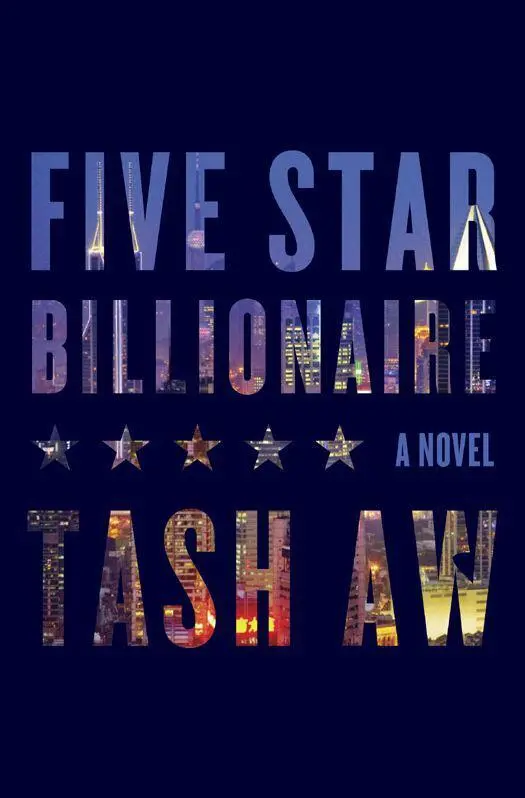
- Название:Five Star Billionaire
- Автор:
- Издательство:Spiegel & Grau
- Жанр:
- Год:2013
- ISBN:нет данных
- Рейтинг книги:3 / 5. Голосов: 1
-
Избранное:Добавить в избранное
- Отзывы:
-
Ваша оценка:
Five Star Billionaire: краткое содержание, описание и аннотация
Предлагаем к чтению аннотацию, описание, краткое содержание или предисловие (зависит от того, что написал сам автор книги «Five Star Billionaire»). Если вы не нашли необходимую информацию о книге — напишите в комментариях, мы постараемся отыскать её.
the dazzling kaleidoscopic new novel by the award-winning writer Tash Aw, offers rare insight into China today, with its constant transformations and its promise of possibility.
Five Star Billionaire — читать онлайн ознакомительный отрывок
Ниже представлен текст книги, разбитый по страницам. Система сохранения места последней прочитанной страницы, позволяет с удобством читать онлайн бесплатно книгу «Five Star Billionaire», без необходимости каждый раз заново искать на чём Вы остановились. Поставьте закладку, и сможете в любой момент перейти на страницу, на которой закончили чтение.
Интервал:
Закладка:
He found a brochure on a table and pretended to read it, so that his isolation would appear less noticeable. It was about foreign companies in Shanghai and was full of phrases such as “deepening ties” and “bridgebuilding.” He walked around the room as he read, looking at the nominees for the evening’s awards — young women with battle-hardened faces, their eyes already bearing the scars of disillusionment and disappointment. They were only in their thirties, some of them even younger, but already they had a world-weariness that he recognized only too well, a hardened edge that announced that life could no longer surprise them, that the only route to happiness lay in the accumulation of more — of more and more and more.
A face gazed up at him from the pages of the brochure; he stopped and allowed his brain the time to process the image, affixing it to his consciousness: the close-set eyes that seemed to focus intensely on whatever they were looking at, the small mouth that could appear either delicate or ready for an argument, depending on her mood. At first he assumed he had made a mistake — the small studio portrait was overlit, making the woman’s features look blander than he remembered. Her hair was different — longer, but strangely more severe than the short gamine style that had once been her trademark (if it was indeed her). The cheekbones seemed more angular now, her eyes expressionless. He really wasn’t feeling well, he thought; maybe he was genuinely going mad — she had always dismissed business as an immature game played by boys who refused to grow up. But here she was, nominated for an award, her name printed in capital letters under the photo, the distinctly non-Mainland spelling announcing her foreignness: LEONG YINGHUI. He looked back at the shape of her face. It was definitely her. He looked around the room but could not see her; surely she would be here. Suddenly he became aware of his every movement — the way he placed one foot in front of the other, the way he smiled at passersby, the way he breathed. And then, when he turned around, she was there, as if waiting for him.
“Hello, Yinghui,” he said.
“Justin Lim Chee Keong. What a surprise,” she said. Her tightly held mouth relaxed into a smile, but she seemed neither surprised nor happy at this chance meeting; she seemed annoyed, as if he were an unexpected inconvenience.
They chatted for a few moments, with all the awkwardness of friends who have not seen each other for many years, each hoping (he thought) to recapture past intimacy; but then he remembered that they had never really been friends, despite his longing to be so. He answered her polite questions monosyllabically, which frustrated him, because he had always wanted to be witty and expressive with her but was never able to be. He had once thought that it was a question of youthful shyness on his part, that when he was older and successful he would chat with her with greater ease, but things had not changed.
Zhou X. suddenly appeared at his side again, clutching his arm as if it were a pole. More cameras, more smiles; people crowding in on him. Amid the bank of camera flashes, he looked for Yinghui and feared that she had disappeared. But no, she was reaching toward him, holding out her business card, and then, as he took it, still blinking from the glare of the lights, she escaped. He posed for a few more photographs, but all at once he began to feel exhausted, his limbs weighing heavily, his joints aching. His head felt cloudy and his mouth dry. Music was playing through the loudspeakers, signaling the arrival of a local dignitary, but he made his way to the door, crossed the hotel lobby, and headed straight to the cabstand to hail a taxi home.
Now he sat before the Rolodex with her card staring at him — a link to all that he had once wanted but now feared. Too much stood between them, and the passage of time had not made things better. He hesitated for a while before flipping the cardholder all the way to the end, where he began working through the Mainland surnames beginning with Z. He had left the windows open all day and the apartment smelled of cooking fat, which had drifted in from the kitchen above.
He simply couldn’t call Yinghui; she would have nothing but contempt for him.
15. A STRONG FIGHTING SPIRIT SWALLOWS MOUNTAINS AND RIVERS

AS GARY STEPS ONTO THE STAGE, HE IS STRUCK, FIRST OF ALL, BY how small it is. It has been years since he performed on a stage this small. In a second, the backup dancers are going to appear, and he has no idea how they are all going to fit on a platform measuring eight by five meters, covered in a green Astroturf-like material with pots of plastic flowers at each of the front corners — the only decoration there is. The stage feels flimsy under his feet, little more than a big hollow box made of plywood, ready to collapse at any moment. The papers are always full of stories of freak accidents in public places, roofs falling down on cinemas, whole ice rinks being swallowed up into the ground. Maybe this will be one of those sad, bizarre stories.
The music is already playing loudly in the atrium of the shopping mall, a bright, breezy tune with uplifting guitars over a simple melody and a heavy drumbeat — the kind of music that makes teenagers want to get to their feet and sing along while bouncing up and down on their heels. He hasn’t sung this tune in years — it is from an earlier time in his career, when he was so young and malleable that he would sing anything he was told to sing. The shopping mall is decorated with huge plastic banana trees in plastic pots, and there are banners streaming down from the upper floors, announcing, OPENING CELEBRATION, BIG DISCOUNT. Now he understands why his agent had said, “It’s the perfect song for the setting.”
A cry goes up from the small crowd — about a hundred people — as he walks to the middle of the stage. It feels strange to be up here again, in front of an audience. Even though he still cannot fully understand why he has bothered to come all the way out here and has not rehearsed at all for this gig, he begins to sway in time with the music as soon as he steps onto the stage. He is a professional — his body knows what to do, even if his spirit is absent. In a few moments he will lift the microphone to his mouth and his voice will emerge, bright and clear, without him even commanding it to do so. Just like driving a car, he thinks, even though he doesn’t know how to drive.
It has now been more than four months since news of Gary’s various misdemeanors were splashed over the cheap newspapers and glossy magazines and Internet gossip pages. In the intervening time, Gary has spent long periods at home in a rented apartment in Zhabei, which has two bedrooms, a modest sitting room, and a small kitchen that looks out onto the five other tower blocks that make up the condominium complex. In the middle of these thirty-story towers, there is a swimming pool, bright blue in color and shaped like a gourd, two circles joined together, one plumper than the other. From the twenty-eighth floor, where Gary lives, the pool looks fake, like a detail in an architectural model, fringed with palm trees; and because it is shielded from the sun by the high buildings around it, the water is cold and there is never anyone in it, even now that spring is slowly turning to summer. But it is the only view there is, apart from the one into the other apartments in the adjacent tower blocks.
During his first few days there, Gary hated it and felt homesick for his apartment in Taipei, but then he realized that it was the first time in years that he had been able to spend a whole day and night without closing his curtains. There were no paparazzi trying to take photos of him with a lens the size of a rocket launcher, no one rummaging through his rubbish bins, no one dressing up as a gas inspector pretending to read the meter. With the curtains wide open, he was the one doing the looking. He could see right into other people’s apartments and watch them eating dinner under harsh fluorescent lights. Later, the children would settle down to do their homework while their parents sat in front of the TV — dozens and dozens of families doing exactly the same thing at exactly the same time. He could see what TV programs they were watching and even the colored circles of the PowerPoint presentations they were preparing on their computers, and sometimes he would sing along to their karaoke sets. It made him smile when they sang one of his own hits that had become karaoke classics, such as “Sunshine After Rain,” or “Y-O-U,” or his rendition of Leslie Cheung’s “Bygone Love,” distinguished by his own arrangement for strings and piano.
Читать дальшеИнтервал:
Закладка:
Похожие книги на «Five Star Billionaire»
Представляем Вашему вниманию похожие книги на «Five Star Billionaire» списком для выбора. Мы отобрали схожую по названию и смыслу литературу в надежде предоставить читателям больше вариантов отыскать новые, интересные, ещё непрочитанные произведения.

![Scott O’Hara - Five-Star Fugitive [= Border Town Girl]](/books/432138/scott-o-hara-five-thumb.webp)










Обсуждение, отзывы о книге «Five Star Billionaire» и просто собственные мнения читателей. Оставьте ваши комментарии, напишите, что Вы думаете о произведении, его смысле или главных героях. Укажите что конкретно понравилось, а что нет, и почему Вы так считаете.