Tash Aw - Five Star Billionaire
Здесь есть возможность читать онлайн «Tash Aw - Five Star Billionaire» — ознакомительный отрывок электронной книги совершенно бесплатно, а после прочтения отрывка купить полную версию. В некоторых случаях можно слушать аудио, скачать через торрент в формате fb2 и присутствует краткое содержание. Год выпуска: 2013, Издательство: Spiegel & Grau, Жанр: Современная проза, на английском языке. Описание произведения, (предисловие) а так же отзывы посетителей доступны на портале библиотеки ЛибКат.
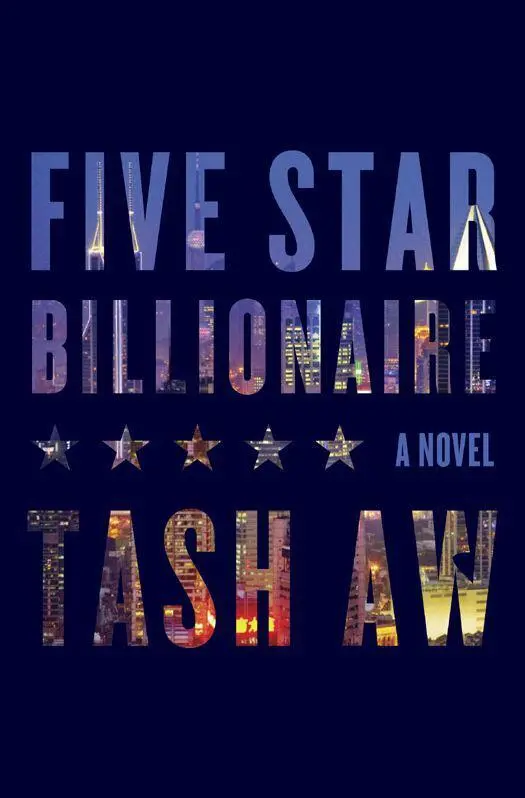
- Название:Five Star Billionaire
- Автор:
- Издательство:Spiegel & Grau
- Жанр:
- Год:2013
- ISBN:нет данных
- Рейтинг книги:3 / 5. Голосов: 1
-
Избранное:Добавить в избранное
- Отзывы:
-
Ваша оценка:
Five Star Billionaire: краткое содержание, описание и аннотация
Предлагаем к чтению аннотацию, описание, краткое содержание или предисловие (зависит от того, что написал сам автор книги «Five Star Billionaire»). Если вы не нашли необходимую информацию о книге — напишите в комментариях, мы постараемся отыскать её.
the dazzling kaleidoscopic new novel by the award-winning writer Tash Aw, offers rare insight into China today, with its constant transformations and its promise of possibility.
Five Star Billionaire — читать онлайн ознакомительный отрывок
Ниже представлен текст книги, разбитый по страницам. Система сохранения места последней прочитанной страницы, позволяет с удобством читать онлайн бесплатно книгу «Five Star Billionaire», без необходимости каждый раз заново искать на чём Вы остановились. Поставьте закладку, и сможете в любой момент перейти на страницу, на которой закончили чтение.
Интервал:
Закладка:
For the next few days, he attempted to re-create the existence he had had until just recently: the long dank days in bed, windows shut and curtains drawn against the noise of the city; quiet evenings gazing at the skyline, his mind perfectly empty, his body inert. But it did not work. Sunlight eased its way into his bedroom, and even through the thick velvet curtains he could sense the gathering intensity of spring. Then there was the noise, which would not go away now. The outside world had forced itself into his existence; the safety of his winter retreat was over. He would have to find somewhere else to live.
He began to search on the Internet for apartments to rent, but there were thousands of pages full of boxy places that looked identical. In the past he would have asked his secretary to do it for him, but he no longer had one; he no longer had an office or a car or a network of friends whom he might have rung, people who knew people who knew people. Three months was all it had taken for these friends to disappear from his life. As he scrolled through the pages of bare, featureless apartments, he felt a shallow wave of nostalgia for his former life, the ease and commodity with which small tasks such as this would have been accomplished. But remembering the interiors of the offices — a world of veneered wood and padded black leather and hearty men in suits — he felt stricken, too, by a sense of panic. He remembered his father’s voice, solemn, unyielding, remembered the sickening weight of responsibilities, and he was glad because all that had vanished. Convenience and obligation. That was all his life had been.
He clicked on his in-box to look at his emails — the first time in weeks that he had done so. He calmly waited while the emails loaded, not panicking as he had done before, feeling strong enough to deal with whatever appeared. Even when he saw the number of unread emails—3,281—highlighted in bold font, as if to emphasize his negligence, he felt unruffled. He scanned the pages swiftly; he could sense three or four calling out to him, like ailing antelope in a herd of thousands whose weak bleating drew the attention of the predators. They were from his brother, imploring him to come home. Justin went back to them and read them slowly, appreciating C.S.’s facility with the written word: One message was curt, hurt, accusing; the next was generous, understanding, forgiving; the next was matter-of-fact, newslike; the last one was cajoling, vulnerable. They were exercises in style for his brother, who had wanted to be a writer but now — in Justin’s absence — was forced to run the family business. Every email was designed to carry one message: Their family was ruined; his brother was hapless, did not know how to run a business; Justin had abdicated in the hour of greatest need and had to return to save them. One email ended poetically with a single line: I am drowning .
He stared at this line and remembered his brother once saying, “The thing about you is that you have no fantasy . You can’t imagine being anything other than yourself.” It was true: He had not been able to conceive of life in any other way.
In a few deft clicks of the keyboard, he had selected all 3,281 emails in his in-box and, without hesitating, deleted every one of them.
He had been working on the sofa, the laptop balanced on his knees. He leaned back and sank into the plush velvet, feeling heavy and immobile. He did not have to try very hard to imagine what the atmosphere in his family home might be at the moment — it came to him at once, clear and true as daylight: silent corridors, the whisper of accusation hanging in the air; the wary tread of the servants’ feet on marble floors; wordless dinners, the array of dishes smaller now because of Father’s diabetes and Mother’s growing worry about maintaining a pleasing shape. Or maybe they would be at the old house by the seaside at Port Dickson, where the breeze and darkness would make the silence more tolerable and the foamy hush of the waves would calm Mother’s nerves. The bamboo blinds on the veranda would be frayed and brittle, awaiting a replacement that was long overdue; the sea would wash plastic bags and beer bottles and other debris up onto the beach, leaving a dark snaky trail along the sand; and on the hills overlooking the bay and behind the house, there would be yet another of those newly constructed condominium blocks that had been springing up over the decades, white and featureless. Father would grumble about all these things, and Mother would say, It wasn’t like this when the boys were small.
Contained in their small gestures — Mother’s failure to prepare afternoon tea; Father’s firm refusal to go for his usual evening swim, which he used to perform proudly in front of his wife and young children, splashing powerfully through the low waves — was an intricate dance of blame, in which each would take a turn to play victim and accuser. In her unwillingness to take part in the rituals of domesticity, Mother was blaming Father for the position they were in now — they could no longer afford the staff, no longer had the power or influence to buy the adjacent land to save their precious view — and in remaining housebound and static, he blamed her for the loss of his vigor and pride. They had always found ways to avoid the inescapable fact that they had ground each other down over the years, but now they would be forced together, in a house that was falling quickly into disrepair, with a view that was ruined, with children who were ruined. They had had to sell the penthouse apartment in Hong Kong, the giant pied-à-terre on the Upper East Side, and the bolt-hole in Regent’s Park. There was nowhere for them to escape each other now. He wondered for a moment where Sixth Uncle was right now, whether he had escaped to a farm in Tasmania as he was always threatening to do — or whether he was where he had always been, at his family’s beck and call.
Justin closed his eyes, glad that his parents did not know where he was, glad that there was a huge distance between them.
He reached for his laptop again and typed the name of the building he had wanted to buy several months earlier, on which they had pinned all their hopes. The first news item confirmed what he had assumed:
969 Weihai Lu Sold to Anonymous Property Magnate. In a deal estimated to be worth RMB 900 million, the historic building located in the prestigious Nanjing Xi Lu area of downtown Shanghai will be transformed into a civic center, with a concert hall, open-access library facilities, and restaurants. Officials from the Shanghai municipal department today confirmed that the preferred bidder had been selected only because of the exemplary nature of his charitable proposals, which would not only preserve one of the gems of Shanghai’s architectural heritage but also contribute to the community. The reputed size of the deal had nothing to do with it, Wang C. from the municipal department said. “There had been a fierce bidding war, and in fact we received a higher bid from another overseas developer for this important site. We were not swayed by money.”
His eyes began to tire from the screen of his laptop. After months of not looking at a computer, they had lost the habit of staring at bright light, and he decided to go out for a walk along the river. As he approached the foot of the stairs at the entrance to the building, he saw someone sitting on the front steps, a girl in her twenties playing with what appeared to be a stray kitten. Dressed in candy-pink pajamas, her hair tied in a ponytail by a single elastic band, she looked entirely ordinary, and Justin would have walked straight past her if not for the song she was humming—“Little Moonlight Song,” out of tune, just like the voice that had ruined his afternoons. No longer filtered through layers of concrete, it sounded purer and gentler than that persecutory voice, and he wondered if he was making a mistake — but, no, it was definitely the same voice.
Читать дальшеИнтервал:
Закладка:
Похожие книги на «Five Star Billionaire»
Представляем Вашему вниманию похожие книги на «Five Star Billionaire» списком для выбора. Мы отобрали схожую по названию и смыслу литературу в надежде предоставить читателям больше вариантов отыскать новые, интересные, ещё непрочитанные произведения.
![Scott O’Hara - Five-Star Fugitive [= Border Town Girl]](/books/432138/scott-o-hara-five-thumb.webp)





Обсуждение, отзывы о книге «Five Star Billionaire» и просто собственные мнения читателей. Оставьте ваши комментарии, напишите, что Вы думаете о произведении, его смысле или главных героях. Укажите что конкретно понравилось, а что нет, и почему Вы так считаете.