David Wallace - Infinite jest
Здесь есть возможность читать онлайн «David Wallace - Infinite jest» весь текст электронной книги совершенно бесплатно (целиком полную версию без сокращений). В некоторых случаях можно слушать аудио, скачать через торрент в формате fb2 и присутствует краткое содержание. Год выпуска: 2006, Издательство: Back Bay Books, Жанр: Современная проза, на русском языке. Описание произведения, (предисловие) а так же отзывы посетителей доступны на портале библиотеки ЛибКат.
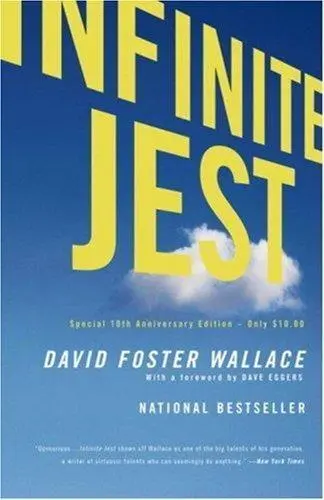
- Название:Infinite jest
- Автор:
- Издательство:Back Bay Books
- Жанр:
- Год:2006
- ISBN:нет данных
- Рейтинг книги:3 / 5. Голосов: 1
-
Избранное:Добавить в избранное
- Отзывы:
-
Ваша оценка:
Infinite jest: краткое содержание, описание и аннотация
Предлагаем к чтению аннотацию, описание, краткое содержание или предисловие (зависит от того, что написал сам автор книги «Infinite jest»). Если вы не нашли необходимую информацию о книге — напишите в комментариях, мы постараемся отыскать её.
Infinite Jest
On this outrageous frame hangs an exploration of essential questions about what entertainment is, and why it has come to so dominate our lives; about how our desire for entertainment interacts with our need to connect with other humans; and about what the pleasures we choose say about who we are. Equal parts philosophical quest and screwball comedy, Infinite Jest bends every rule of fiction without sacrificing for a moment its own entertainment value. The huge cast and multilevel narrative serve a story that accelerates to a breathtaking, heartbreaking, unfogettable conclusion. It is an exuberant, uniquely American exploration of the passions that make us human and one of those rare books that renew the very idea of what a novel can do.
Infinite jest — читать онлайн бесплатно полную книгу (весь текст) целиком
Ниже представлен текст книги, разбитый по страницам. Система сохранения места последней прочитанной страницы, позволяет с удобством читать онлайн бесплатно книгу «Infinite jest», без необходимости каждый раз заново искать на чём Вы остановились. Поставьте закладку, и сможете в любой момент перейти на страницу, на которой закончили чтение.
Интервал:
Закладка:
The first birth of the Incandenzas’ second son was a surprise. The tall and eye-poppingly curvaceous Avril Incandenza did not show, bled like clockwork; no hemorrhoids or gland-static; no pica; affect and appetite normal; she threw up some mornings but who didn’t in those days?
It was on a metal-lit November evening in the seventh month of a hidden pregnancy that she stopped, Avril, on her husband’s long arm as they ascended the maple staircase of the Back Bay brownstone they were soon to leave, stopped, turned partly toward him, ashen, and opened her mouth in a mute way that was itself eloquent.
Her husband looked down at her, paling: ‘What is it?’
‘It’s pain.’
It was pain. Broken water had made several steps below them gleam. She seemed to James Incandenza to sort of turn in toward herself, hold herself low, curl and sink to a stairstep she barely made the edge of, hunched, her forehead against her shapely knees. Incandenza saw the whole slow thing in a light like he was Vermeer: she sank steadily from his side and he bent to hers and she then tried to rise.
‘Wait wait wait wait. Wait.’
‘It’s pain.’
A bit ragged from an afternoon of Wild Turkey and low-temperature holography, James had thought Avril was dying right before his eyes. His own father had dropped dead on a set of stairs. Luckily Avril’s half-brother Charles Tavis was upstairs, using the portable StairMaster he’d brought with him for an extended and emotional-battery-recharging visit the preceding spring, after the horrible snafu with the video-scoreboard at Toronto’s Skydome; and he heard the commotion and scuttled out and down and promptly took charge.
He had to be more or less scraped out, Mario, like the meat of an oyster from a womb to whose sides he’d been found spiderishly clinging, tiny and unobtrusive, attached by cords of sinew at both feet and a hand, the other fist stuck to his face by the same material. [113]He was a complete surprise and terribly premature, and withered, and he spent the next many weeks waggling his withered and contractured arms up at the Pyrex ceilings of incubators, being fed by tubes and monitored by wires and cupped in sterile palms, his head cradled by a thumb. Mario had been given the name of Dr. James Incandenza’s father’s father, a dour and golf-addicted Green Valley AZ oculist who made a small fortune, just after Jim grew up and fled east, by inventing those quote X-Ray Specs! that don’t work but whose allure for mid-’6os pubescent comic-book readers almost compelled mail-order, then selling the copyrights to New England novelty-industry titan AcméCo, then promptly in mid-putt died, Mario Sr. did, allowing James Incandenza Sr. to retire from a sad third career as the Man From Glad [114]in sandwich-bag commercials during the B.S. 1960s and move back to the saguaro-studded desert he loathed and efficiently drink himself to a cerebral hemorrhage on a Tucson stairway.
Anyway, Mario II’s incomplete gestation and arachnoidal birth left the kid with some lifelong character-building physical challenges. Size was one, he being in sixth grade about the size of a toddler and at 18+ in a range somewhere between elf and jockey. There was the matter of the withered-looking and bradyauxetic arms, which just as in a hair-raising case of Volk-mann’s contracture [115]curled out in front of his thorax in magiscule S’s and were usable for rudimentary knifeless eating and slapping at doorknobs until they sort of turned just enough and doors could be kicked open and forming a pretend lens-frame to scout scenes through, plus maybe tossing tennis balls very short distances to players who wanted them, but not for much else, though the arms were impressively — almost familial-dysautonomically — pain-resistant, and could be pinched, punctured, singed, and even compressed in a basement optical-device-securing viselike thing by Mario’s older brother Orin without effect or complaint.
Bradypedestríanism-wise, Mario had not so much club feet as more like block feet: not only flat but perfectly square, good for kicking knob-fumbled doors open with but too short to be conventionally employed as feet: together with the lordosis in his lower spine, they force Mario to move in the sort of lurchy half-stumble of a vaudeville inebriate, body tilted way forward as if into a wind, right on the edge of pitching face-first onto the ground, which as a child he did fairly often, whether given a bit of a shove from behind by his older brother Orin or no. The frequent forward falls help explain why Mario’s nose was squished severely in and so flared out to either side of his face but did not rise from it, with the consequence that his nostrils tended to flap just a bit, particularly during sleep. One eyelid hung lower than the other over his open eyes — good and gently brown eyes, if a bit large and protrusive to qualify as conventionally human eyes — the one lid hung like an ill-tempered windowshade, and his older brother Orin had sometimes tried to give the recalcitrant lid that smart type of downward snap that can unstick a dicky shade, but had succeeded only in gradually loosening the lid from its sutures, so that it eventually had to be refashioned and reattached in yet another blepharoplasty-procedure, because it was in fact not Mario’s real eyelid — that had been sacrificed when the fist stuck to his face like a tongue to cold metal had been peeled away, at nativity — but an extremely advanced blepharoprosthesis of dermal fibropolymer studded with horsehair lashes that curved out into space well beyond the reach of his other lid’s lashes and together with the lazy lid-action itself gave even Mario’s most neutral expression the character of an oddly friendly pirate’s squint. Together with the involuntarily constant smile.
This is probably also the place to mention Hal’s older brother Mario’s khaki-colored skin, an odd dead gray-green that in its corticate texture and together with his atrophic in-curled arms and arachnodactylism gave him, particularly from a middle-distance, an almost uncannily reptilian/ dinosaurian look. The fingers being not only mucronate and talonesque but nonprehensile, which is what made Mario’s knifework untenable at table. Plus the thin lank slack hair, at once tattered and somehow too smooth, that looked at 18+ like the hair of a short plump 48-year-old stress engineer and athletic director and Academy Headmaster who grows one side to girlish length and carefully combs it so it rides thinly up and over the gleaming yarmulke of bare gray-green-complected scalp on top and down over the other side where it hangs lank and fools no one and tends to flap back up over in any wind Charles Tavis forgets to carefully keep his left side to. Or that he’s slow, Hal’s brother is, technically, Stanford-Binet-wise, slow, the Brandeis C.D.C. found — but not, verifiably not, retarded or cognitively damaged or bradyphrenic, more like refracted, almost, ever so slightly epis-temically bent, a pole poked into mental water and just a little off and just taking a little bit longer, in the manner of all refracted things.
Or that his status at the Enfield Tennis Academy — erected, along with Dr. and Mrs. Fs marriage’s third and final home at the northern rear of the grounds, when Mario was nine and Hallie eight and Orin seventeen and in his one E.T.A. year B-4 Singles and in the U.S.T.A.’s top 75 — that Mario’s life there is by all appearances kind of a sad and left-out-type existence, the only physically challenged minor in residence, unable even to grip a regulation stick or stand unaided behind a boundaried space. That he and his late father had been, no pun intended, inseparable. That Mario’d been like an honorary assistant production-assistant and carried the late Incan-denza’s film and lenses and filters in a complex backpack the size of a joint of beef for most of the last three years of the late-blooming filmmaker’s life, attending him on shoots and sleeping with multiple pillows in small soft available spaces in the same motel room as Himself and occasionally tottering out for a bright-red plastic bottle of something called Big Red Soda Water and taking it to the apparently mute veiled graduate-intern down the motel’s hall, fetching coffee and joe and various pancreatitis-remedies and odds and ends for props and helping D. Leith out with Continuity when Incandenza wanted to preserve Continuity, basically being the way any son would be whose dad let him into his heart’s final and best-loved love, lurching gamely but not pathetically to keep up with the tall stooped increasingly bats man’s slow patient two-meter stride through airports, train stations, carrying the lenses, inclined ever forward but in no way resembling any kind of leashed pet.
Читать дальшеИнтервал:
Закладка:
Похожие книги на «Infinite jest»
Представляем Вашему вниманию похожие книги на «Infinite jest» списком для выбора. Мы отобрали схожую по названию и смыслу литературу в надежде предоставить читателям больше вариантов отыскать новые, интересные, ещё непрочитанные произведения.









Обсуждение, отзывы о книге «Infinite jest» и просто собственные мнения читателей. Оставьте ваши комментарии, напишите, что Вы думаете о произведении, его смысле или главных героях. Укажите что конкретно понравилось, а что нет, и почему Вы так считаете.