David Wallace - Infinite jest
Здесь есть возможность читать онлайн «David Wallace - Infinite jest» весь текст электронной книги совершенно бесплатно (целиком полную версию без сокращений). В некоторых случаях можно слушать аудио, скачать через торрент в формате fb2 и присутствует краткое содержание. Год выпуска: 2006, Издательство: Back Bay Books, Жанр: Современная проза, на русском языке. Описание произведения, (предисловие) а так же отзывы посетителей доступны на портале библиотеки ЛибКат.
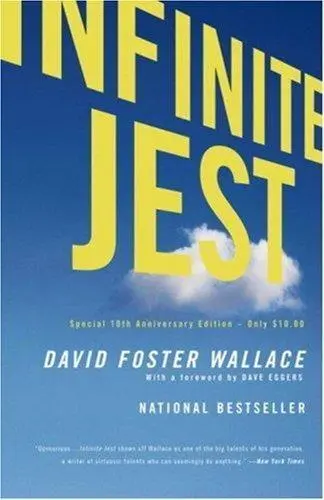
- Название:Infinite jest
- Автор:
- Издательство:Back Bay Books
- Жанр:
- Год:2006
- ISBN:нет данных
- Рейтинг книги:3 / 5. Голосов: 1
-
Избранное:Добавить в избранное
- Отзывы:
-
Ваша оценка:
Infinite jest: краткое содержание, описание и аннотация
Предлагаем к чтению аннотацию, описание, краткое содержание или предисловие (зависит от того, что написал сам автор книги «Infinite jest»). Если вы не нашли необходимую информацию о книге — напишите в комментариях, мы постараемся отыскать её.
Infinite Jest
On this outrageous frame hangs an exploration of essential questions about what entertainment is, and why it has come to so dominate our lives; about how our desire for entertainment interacts with our need to connect with other humans; and about what the pleasures we choose say about who we are. Equal parts philosophical quest and screwball comedy, Infinite Jest bends every rule of fiction without sacrificing for a moment its own entertainment value. The huge cast and multilevel narrative serve a story that accelerates to a breathtaking, heartbreaking, unfogettable conclusion. It is an exuberant, uniquely American exploration of the passions that make us human and one of those rare books that renew the very idea of what a novel can do.
Infinite jest — читать онлайн бесплатно полную книгу (весь текст) целиком
Ниже представлен текст книги, разбитый по страницам. Система сохранения места последней прочитанной страницы, позволяет с удобством читать онлайн бесплатно книгу «Infinite jest», без необходимости каждый раз заново искать на чём Вы остановились. Поставьте закладку, и сможете в любой момент перейти на страницу, на которой закончили чтение.
Интервал:
Закладка:
Pemulis appears to have left out of his calculations the fact that he’ll get that Saturday P.M. off classes only if he makes the travelling list for the Tucson-WhataBurger the following week, and that unlike Hal and Axford he’s not a lock: Pemulis’s U.S.T.A. rank, excepting his halcyon thirteenth year in the Year of the Perdue Wonderchicken, has never gotten higher than 128, and the WhataBurger draws kids from all over O.N.A.N. and even Europe; the draw will have to be weak indeed for him to get even one of the 64 Qualifying-Round invitations. Axford’s on the fringes of the top 50, but he got to go last year at seventeen, so he’s almost got to get to go. And Hal is looking at getting a Third or maybe Fourth Seed in 18’s Singles; he’s definitely going, barring some sort of cataclysmic ankle-relapse against either Port Wash, or Quebec. Axford postulates that Pemulis isn’t miscalculating so much as simply showing a slitty-eyed confidence, which as far as his match-play outlook is concerned would be unusual and rather a fine thing — prorector Aubrey deLint says (publicly) that seeing M. Pemulis in practice v. seeing M. Pemulis in a real match that means anything is like getting to know some girl through e-mail as like e-mail-keyboard-type penpals and really falling for her and then finally meeting her in person and finding out she’s got like just one enormous tit in the exact middle of her chest or something like that.[77]
Mario will get to come along if Avril can convince C.T. to bring him along to get WhataBurger footage for this year’s E.T.A. promotional Xmas-giveaway-to-private-and-incorporated-patrons cartridge.
Schacht and the glossy Syrian are laughing together about something up at the net-post, where they’ve walked to gather gear and various spare rotator-cuff- and knee-appliances after the Syrian kind of cornily jumped the net and pumped Schacht’s hand, breath and sweat-steam rising up off and moving off through the fence’s mesh toward the manicured western hills as Mario’s laugh rings out at some broad mock-supplicant’s gesture Schacht’s just now made.
7 NOVEMBER YEAR OF THE DEPEND ADULT UNDERGARMENT
You can be at certain parties and not really be there. You can hear how certain parties have their own implied ends embedded in the choreography of the party itself. One of the saddest times Joelle van Dyne ever feels anywhere is that invisible pivot where a party ends — even a bad party — that moment of unspoken accord when everyone starts collecting his lighter and date, jacket or greatcoat, his one last beer hanging from the plastic rind’s five rings, says certain perfunctory things to the hostess in a way that acknowledges their perfunctoriness without seeming insincere, and leaves, usually shutting the door. When everybody’s voices recede down the hall. When the hostess turns back in from the closed door and sees the litter and the expanding white V of utter silence in the party’s wake.
Joelle, at the end of her rope and preparing to hang from it, listening, is supported by a polished hardwood floor above both river and Bay’s edge, perched uncomfortably in striated light in one of Molly Notkin’s chairs molded in the likeness of great filmmakers from the celluloid canon, seated between empty Cukor and frightening Murnau in Méliès’s fiberglass lap, his trousers’ crease uncomfortable and his cummerbund M.I.T.-crested. The lurid chairs’ directors are larger than life: Joelle’s feet dangle well off the floor, her squished hamstrings beginning to burn under a damp thick cotton Brazilian skirt which is vivid, curled pale purples and fresh red against a Latin black that seems to glow above pale knees and white rayon kneesocks and feet in clogs that are hanging half off, legs swinging like a child’s, always feeling like a child in Molly’s chairs, conspicuously perched in the eye of a bad party’s somewhat forced-feeling storm of wit and good cheer, sitting by herself under what used to be her window, the daughter of a low-pH chemist and homemaker from western Kentucky, a lot of fun to be with, normally, if you can get over the disconcerting veil.
Among pernicious myths is the one where people always get very upbeat and generous and other-directed right before they eliminate their own map for keeps. The truth is that the hours before a suicide are usually an interval of enormous conceit and self-involvement.
There are decorative bars, slender and of black iron that pigeon droppings have made piebald, over the west windows to this third-floor cooperative apartment on the East Cambridge fringes of the Back Bay, where near-Professor Notkin is holding a party to celebrate passing her Orals in Film & Film-Cartridge Theory, the doctoral program where Joelle — before her retreat into broadcast sound — had met her.
Molly Notkin often confides on the phone to Joelle van Dyne about the one tormented love of Notkin’s life thus far, an erotically circumscribed G. W. Pabst scholar at New York University tortured by the neurotic conviction that there are only a finite number of erections possible in the world at any one time and that his tumescence means e.g. the detumescence of some perhaps more deserving or tortured Third World sorghum farmer or something, so that whenever he tumefies he’ll suffer the same order of guilt that your less eccentrically tortured Ph.D.-type person will suffer at the idea of, say, wearing baby-seal fur. Molly still takes the high-speed rail down to visit him every couple weeks, to be there for him in case by some selfish mischance he happens to harden, prompting in him black waves of self-disgust and an extreme neediness for understanding and nonjudgmental love. She and poor Molly Notkin are just the same, Joelle reflects, seated alone, watching doctoral candidates taste wine — sisters, sororal twins. With her fear of direct light, Notkin. And the disguises and whiskers are simply veiled veils. How many sub-rosa twins are there, out there, really? What if heredity, instead of linear, is branching? What if it’s not arousal that’s so finitely circumscribed? What if in fact there were ever only like two really distinct individual people walking around back there in history’s mist? That all difference descends from this difference? The whole and the partial. The damaged and the intact. The deformed and the paralyzingly beautiful. The insane and the attendant. The hidden and the blindingly open. The performer and the audience. No Zen-type One, always rather Two, one upside-down in a convex lens.
Joelle is thinking about what she has in her purse. She sits alone in her linen veil and pretty skirt, obliquely looked at, listening to bits of conversation she reels in out of the overall voices’ noise but seeing no one really else, the absolute end of her life and beauty running in a kind of stuttered old hand-held 16mm before her eyes, projected against the white screen on her side, for once, from Uncle Bud and twirling to Orin and Jim and YYY, all the way up to today’s wet walk here from the Red Line’s Downtown stop, walking the whole way from East Charles St., employing a self-conscious and kind of formal stride, but undeniably pretty, the overall walk toward her last hour was, on this last day before the great O.N.A.N.ite Interdependence revel. East Charles to the Back Bay today is a route full of rained-on sienna-glazed streets and upscale businesses with awnings and wooden signs hung with cute Colonial script, and people looking at her like you look at the blind, naked gazes, not knowing she could see everything at all times. She likes the wet walk for this, everything milky and halated through her veil’s damp linen, the brick sidewalks of Charles St. unchipped and impersonally crowded, her legs on autopilot, she a perceptual engine, holding the collar of her overcoat closed at her poncho’s neckline in a way that lets her hold the veil secure against her face with a finger on her chin, thinking always about what she has in her purse, stopping in at a discount tobacconist and buying a quality cigar in a glass tube and then a block later placing the cigar inside carefully in among the overflowing waste atop a corner receptacle of pine-green mesh, but keeps the tube, puts the glass tube in her purse, can hear the rain’s thup on tight umbrellas and hear it hiss in the street, and can see droplets broken and regathering on her polyresin coat, cars sheening by with the special lonely sound of cars in rain, wipers making black rainbows on taxis’ shining windshields. In every alley are green I.W.D. dumpsters and the smaller red I.W.D. dumpsters to take the overflow from the green dumpsters. And the sound of her wood-sole clogs against the receding staccato of brittle women’s high heels on brick westward as Charles St. now approaches Boston Common and becomes less quaint and upscale: sodden litter — flat the way only wet litter can be flat — appears on the sidewalk and in the curb’s seam, and now murky-colored people with sacks and grocery carts appraising that litter, squatting to lift and sift through litter; and the rustle and jut of limbs from dumpsters being sifted by people who all day do nothing but sift through I.W.D. dumpsters; and other people’s blue shoeless limbs extending in coronal rays from refrigerator boxes in each block’s three alleys, and the little cataract of rainwater off the edge of each dumpster’s red annex’s downsloping side and hitting refrigerator boxes’ tops with a rhythmless thappathappappathap; somebody going Pssssst from an alley’s lip, and ghastly-white or blotched faces declaiming to thin air from recessed doorways curtained by rain, and for an other-directed second Joelle wishes she’d hung on to the cigar, to give away, and moving westward into the territory of the Endless Stem near the end of Charles she starts to dispense change she is asked for from doorways and inverted up-tilted boxes; and she gets asked about the deal with the veil with a lack of delicacy she rather prefers. A sooty wheelchaired man with a dead white face below a NOTRE RAI PAYS cap silently extends a hand for coins — a puffed red cut across that businesslike palm is half-healed and almost visibly closing. It looks like a dent in dough. Joelle gives him a folded U.S. twenty and likes that he says nothing.
Читать дальшеИнтервал:
Закладка:
Похожие книги на «Infinite jest»
Представляем Вашему вниманию похожие книги на «Infinite jest» списком для выбора. Мы отобрали схожую по названию и смыслу литературу в надежде предоставить читателям больше вариантов отыскать новые, интересные, ещё непрочитанные произведения.









Обсуждение, отзывы о книге «Infinite jest» и просто собственные мнения читателей. Оставьте ваши комментарии, напишите, что Вы думаете о произведении, его смысле или главных героях. Укажите что конкретно понравилось, а что нет, и почему Вы так считаете.