David Wallace - Infinite jest
Здесь есть возможность читать онлайн «David Wallace - Infinite jest» весь текст электронной книги совершенно бесплатно (целиком полную версию без сокращений). В некоторых случаях можно слушать аудио, скачать через торрент в формате fb2 и присутствует краткое содержание. Год выпуска: 2006, Издательство: Back Bay Books, Жанр: Современная проза, на русском языке. Описание произведения, (предисловие) а так же отзывы посетителей доступны на портале библиотеки ЛибКат.
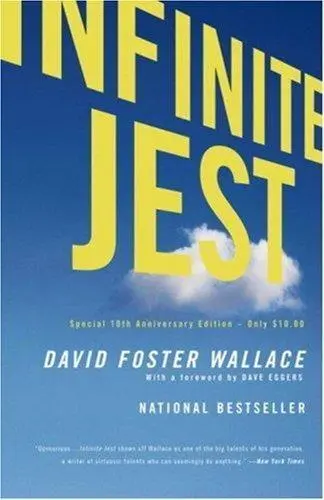
- Название:Infinite jest
- Автор:
- Издательство:Back Bay Books
- Жанр:
- Год:2006
- ISBN:нет данных
- Рейтинг книги:3 / 5. Голосов: 1
-
Избранное:Добавить в избранное
- Отзывы:
-
Ваша оценка:
Infinite jest: краткое содержание, описание и аннотация
Предлагаем к чтению аннотацию, описание, краткое содержание или предисловие (зависит от того, что написал сам автор книги «Infinite jest»). Если вы не нашли необходимую информацию о книге — напишите в комментариях, мы постараемся отыскать её.
Infinite Jest
On this outrageous frame hangs an exploration of essential questions about what entertainment is, and why it has come to so dominate our lives; about how our desire for entertainment interacts with our need to connect with other humans; and about what the pleasures we choose say about who we are. Equal parts philosophical quest and screwball comedy, Infinite Jest bends every rule of fiction without sacrificing for a moment its own entertainment value. The huge cast and multilevel narrative serve a story that accelerates to a breathtaking, heartbreaking, unfogettable conclusion. It is an exuberant, uniquely American exploration of the passions that make us human and one of those rare books that renew the very idea of what a novel can do.
Infinite jest — читать онлайн бесплатно полную книгу (весь текст) целиком
Ниже представлен текст книги, разбитый по страницам. Система сохранения места последней прочитанной страницы, позволяет с удобством читать онлайн бесплатно книгу «Infinite jest», без необходимости каждый раз заново искать на чём Вы остановились. Поставьте закладку, и сможете в любой момент перейти на страницу, на которой закончили чтение.
Интервал:
Закладка:
The samizdat Entertainment’s director’s other son chipped a return that caught the tape and sat there a moment and fell back.
“Veux que nous nous parlons en français? Serait plus facile, ça?’ This invitation because Poutrincourt’s eyes had gone hooded the minute the de-Lint person joined them.
Poutrincourt’s shrug was blase: Francophones are never impressed that anyone else can speak French. ‘Very well then look:’ she said (Poutrincourt did, in Québecois), ‘pubescent stars are nothing new to this sport. Lenglen, Rosewall. In A.D. 1887 a fifteen-year-old girl won Wimbledon, she was the first. Evert in the semifinals of the US Open at sixteen, ‘71 or ‘2. Austin, Jaeger, Graff, Sawamatsu, Venus Williams. Borg. Wilander, Chang, Treffert, Med-vedev, Esconja. Becker of the A.D. ‘8os. Now this new Argentinean Kleckner.’
Steeply lit a Flanderfume that made deLint’s face spread with distaste. ‘You compare it is like gymnastics, figure skating, competitive to-swim.’
Poutrincourt made no comment on Steeply’s syntax. ‘Just so, then. Good.’
Steeply was adjusting the long peasant skirt and crossing legs so he was inclined away from deLint, gazing at a kind of translucent mole on Poutrincourt’s long cheek. Poutrincourt’s thick rimless specs were like a scary nun’s. She looked more male than anything, long and hard and breastless. Steeply tried to exhale away from everyone. ‘The world-plateau tennis not being required to have neither the size and muscle of the hockey nor the basketball nor the American football, for example.’
Poutrincourt nodded. ‘But yes, nor the millimetric precision of your baseball’s hitting, nor how the Italians say the senza errori, the never-miss consistency, that keeps the golfers from true mastery until they have thirty or more years.’ The prorector switched for just a moment to English, possibly for deLint’s benefit: ‘Your French is Parisian but possible. Me, mine is Québecois.’
Steeply now got to give that same sour Gallic shrug. ‘You’re saying to me serious tennis doesn’t need of an athlete anything already adolescents do not possess, if they are exceptional for it.’
‘The medicinists of sports science know well what top tennis requires,’ Poutrincourt said, back in French. ‘Too well, which are the agility, the reflexes, [274]the short-range speed, the balance, some coordination between the hand and the eye, and very much endurance. Some strength, with particular importance for the male. But all these are achievable by the period of puberty, for some. But yes, but wait,’ she said, putting a hand on the notebook as Steeply started to pretend to inscribe. ‘The thing you have put as the question to me. This is why the quandary. The young players, they have the advantage in psyche, also.’
‘The edge of mentality,’ Steeply said, trying to ignore the boy speaking into his hand several seats over. DeLint seemed to be ignoring everything around him, engrossed in the match and his statistics. The Canadian prorec-tor’s hands moved in small circles out front to indicate engagement in the conversation. Americans’ conversational hands sit like lumps of dough most of the time, Rémy Marathe had pointed out once.
‘But yes, so, the formidable mental edge that their psyches are still not yet adult in all ways — therefore, so, they do not feel the anxiety and pressure in the way it is felt by adult players. This is every story of the teenager appearing from no location to upset the famous adult in professional play — the ephebic, they do not feel the pressure, they can play with abandon, they are without fear.’ A cold smile. Sunlight blazed on her lenses. ‘At the beginning. At the beginning they are without pressure or fear, and they burst from seemingly no location onto the professional stage, instant étoiles, phenomenal, fearless, immunized to pressure, numb to anxiety — at first. They seem as if they are like the adult players only better — better in emotion, more abandoned, not human to the stress or fatigue or the airplaning without end, to the publicity.’
‘The English expression of the child in the store of candy.’
‘Seemingly unfeeling of the loneliness and alienation and everyone wants a thing from the étoile.’
‘The money, also.’
‘But it is soon you start to see the burning out which the place like ours is hoping to prevent. You remember Jaeger, burned out at sixteen, Austin at twenty. Arias and Krickstein, Esconja and Treffert, too injured to play on by their late teenage years. The much-promising Capriati, the well-known tragedy. Pat Cash of Australia, fourth on earth at eighteen, vanished by the twenties of age.’
‘Not to be mentioning the large money. The endorsings and appearings.’
‘Always so, for the young étoile. And now worse in today, that the sponsors have no broadcasting to advertise with. Now the ephebe who is famous étoile, who is in magazines and the sports reports aux disques, he is pursued to become the Billboard Who Walks. Use this, wear this, for money. Millions thrown at you before you can drive the cars you buy. The head swells to the size of a balloon, why not?’
‘But can pressure be far behind the back?’ Steeply said.
‘Many times the same. Winning two and three upset matches, feeling suddenly so loved, so many talking to you as if there is love. But always the same, then. For then you awaken to the fact that you are loved for winning only. The two and three wins created you, for people. It is not that the wins made them recognize something that existed unrecognized before these upset wins. The from-noplace winning created you. You must keep winning to keep the existence of love and endorsements and the shiny magazines wanting your profile.’
‘Enter the pressure,’ Steeply said.
‘Pressure such as one could not imagine, now that to maintain you must win. Now that winning is the expected. And all alone, in the hotels and the airplanes, with any other player you could speak to of the pressure to exist wanting to beat you, wanting to be exist above and not below. Or the others, wanting from you, and only so long as you play with abandon, winning.’
‘Hence the suicides. The burn-out. The drugs, the self-indulging, the spoilage.’
‘What is the instruction if we shape the ephebe into the athlete who can win fearlessly to be loved, yet we do not prepare her for the time after fear comes, no?’
‘Therefore the terrible pressure here. They are being tempered. Oven-toughened.’
Hal served wide and this time followed it in, the serve, taking a stutter-step at the service line. Slice’s body seemed to elongate as he reached and got the stick up over the return, driving a forehand. Hal volleyed it too short and took a couple steps off the net as Stice came in, winding up for an easy pass. Hal guessed a direction and started to his left, and The Darkness chipped a lob right over him and hit the heel of his hand against his strings as Hal gave it up halfway back, Stice not rubbing it in but exhorting himself. Hal’s sweat was way heavier than the Kansan’s, but Slice’s face was almost maroon with flush. Each player twirled his stick in his hand as Hal walked back to retrieve the ball. Stice took his position in the deuce court, pulling up his socks.
‘Still smart for Hal to follow the serve in once a game or so,’ deLint said into Steeply’s ear.
And irritating throughout was the heavy-browed red-nostriled kid James Troeltsch at the very end of the top bleacher, speaking into his fist, coming at the fist from first one angle and then another, pretending to be two people:
‘Incandenza the controller. Incandenza the tactician.
Читать дальшеИнтервал:
Закладка:
Похожие книги на «Infinite jest»
Представляем Вашему вниманию похожие книги на «Infinite jest» списком для выбора. Мы отобрали схожую по названию и смыслу литературу в надежде предоставить читателям больше вариантов отыскать новые, интересные, ещё непрочитанные произведения.






Обсуждение, отзывы о книге «Infinite jest» и просто собственные мнения читателей. Оставьте ваши комментарии, напишите, что Вы думаете о произведении, его смысле или главных героях. Укажите что конкретно понравилось, а что нет, и почему Вы так считаете.